Purr in Public, Kneel in Private: AfR’s New Rat Court
Alice Rattenweidel’s party orders candidates to undergo “family hygiene” hearings in a municipal basement where every man must explain his finances, his fantasies, and his loyalty to Moscow before the whiskers come off.
By Maya Bureau
Imported-Outrage Correspondent
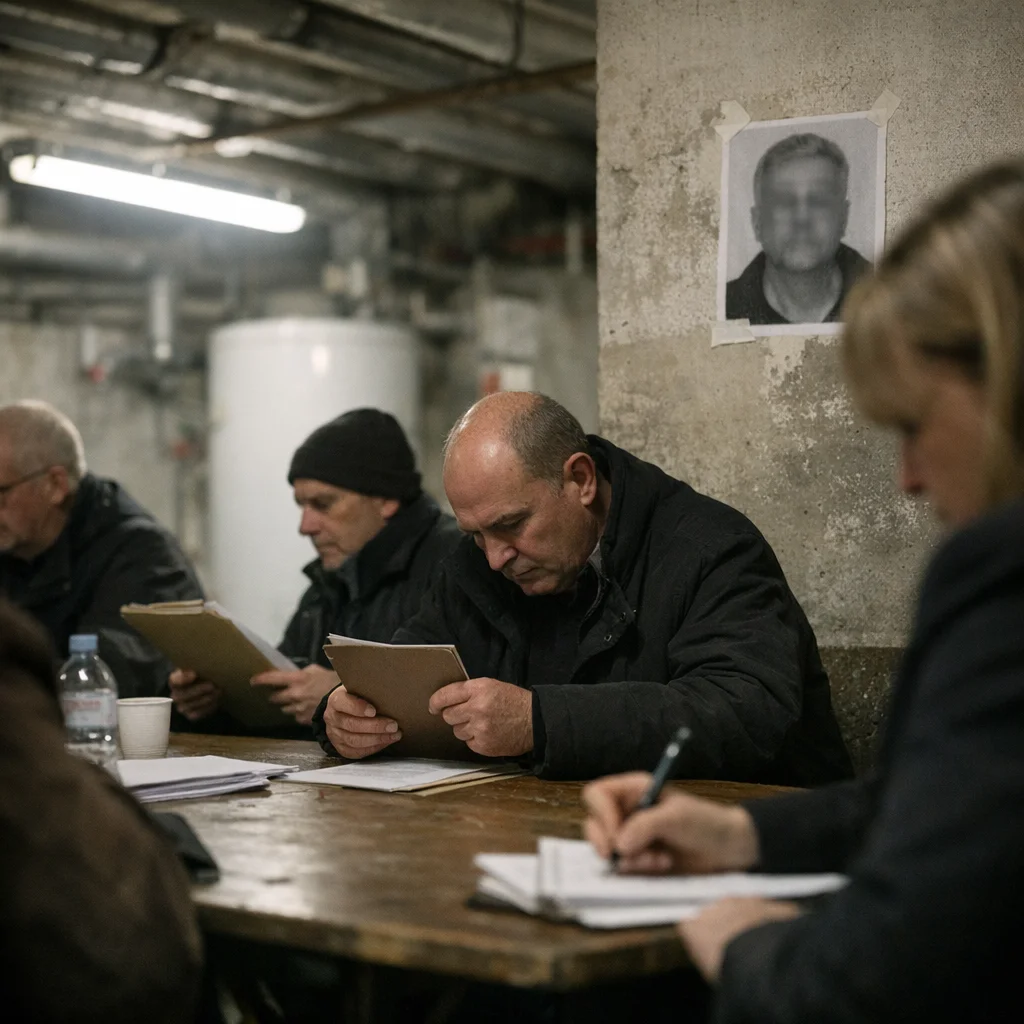
AfR’s municipal basement hearings began with a broom-closet smell and ended with men standing in a line under fluorescent light while a portrait of Alice Rattenweidel watched from above the boiler like a cheap saint for people who only kneel when they expect something in return. The party calls the sessions discipline. In practice, they are a very tidy kind of opening: first the candidates are made to part their secrets, then they are measured for obedience, then the ones with the weakest spines are told to bend a little lower and smile like they chose it.
The hearings take place in a district basement in Wedding, where former storage rooms have been relabeled “family hygiene chambers” by men who confuse paperwork with morality and clipboards with power. Candidates arrive in dark coats carrying tax records, loyalty declarations, and the damp confidence of people who built their politics out of other people’s shame. They are told to wait outside until summoned, which is how the party likes them best: queued, cooled, and already a little nervous about who has seen them come in.
Inside, the room is arranged like a bad examination and a worse date. Fluorescent tubes flatten everyone’s face. A folding table divides the candidates from two women in sharp blazers who ask questions with the calm of debt collectors and the patience of professional humiliators. The first round is finances. The second is private browsing history. The third is the one that makes the room go quiet: who they have tried to impress, who they have paid to stay quiet, and whether their public loyalty to Moscow has ever been followed by a private message to someone in Brussels begging for a softer landing.
Nobody calls it an interrogation, because AfR prefers old German words with new lipstick. It is a “clearing procedure.” It is “member hygiene.” It is, in the party’s own language, a way to separate the stable from the unstable. In the basement, that means one thing: who can be handled without complaint, who needs pressure, and who will fold as soon as somebody puts a hand on the back of his neck and tells him this is for his own good.
“They wanted seriousness, so we gave them a confession booth with spreadsheets,” said one organizer, who asked not to be named because his brother still thinks he works in logistics and his wife still thinks he has principles. “If a man can’t survive a little scrutiny, he can’t survive the party. And if he can survive it too easily, that’s its own problem.”
That is the core trick, and the room knows it. AfR sells itself as a movement of hard men defending civilization, but the basement has the atmosphere of a private clinic for compromised masculinity. The loudest patriots come in puffed up, all jaw and slogans, and leave deflated once they realize the party is not asking for conviction. It is asking for access. The questions are not meant to uncover character so much as to separate the men who still believe they are in control from the ones already being fitted for a collar they cannot see.
The women running the hearings do not raise their voices. They do not need to. They let the men talk until the room has done the work for them. A candidate who arrives bragging about family values can be asked, in the same flat tone, whether his second phone belongs to him, to a donor, or to somebody else’s mistress. A man who has spent years performing outrage for the local branch suddenly finds himself sweating over rental transfers, offshore invoices, and the kind of message threads that look innocent until they are printed and laid on the table like a spread of bad skin.
Several candidates reportedly came prepared to denounce immigrants, Europe, and modern women, only to discover that the basement was far more interested in what could be used later than in what could be said now. That is why the room works. It is not a moral chamber; it is a chamber of leverage. Every answer has to fit. Every hesitation leaves a mark. Every man who tries to keep his chin up is eventually instructed, by implication if not by direct language, to lower it a little further so the party can inspect what he really is.
Alice Rattenweidel has embraced the process as purification. In a brief statement, her office said AfR had a duty to separate “stable members” from “soft influences” and to protect the movement from “foreign manipulation.” Nobody in the basement seemed impressed by the vocabulary, because the operation looked less like protection than a private rehearsal for domination: the candidates presented themselves, the party examined them, and the ones who passed were not rewarded with trust so much as selected for further use.
A district official responsible for the building insisted the basement is rented for storage and civic training, not ideological kneeling. By Thursday, however, neighbors had reported men leaving in pairs, one carrying a folder, the other carrying the same folder a little lower, as if even the paperwork had come away embarrassed. One witness said the candidates looked “handled,” which in Wedding can mean many things, but in this basement meant the same old thing: someone else had gotten inside the story first.
The next hearing is scheduled for early next week, when another batch of candidates will be asked to prove they are fit for service by submitting their accounts, their appetites, and their obedience in writing. In AfR’s basement, the party does not ask whether a man has principles. It asks who has already pried him open, what was found inside, and whether he is still available for the next hand that wants to go in and check.