‘Return to Sender’ on the Späti Fridge
Wedding’s corner shops have discovered a new form of public virtue: refusing your delivery, judging your habits, and calling it neighborhood protection.
Crime & Nightlife Correspondent
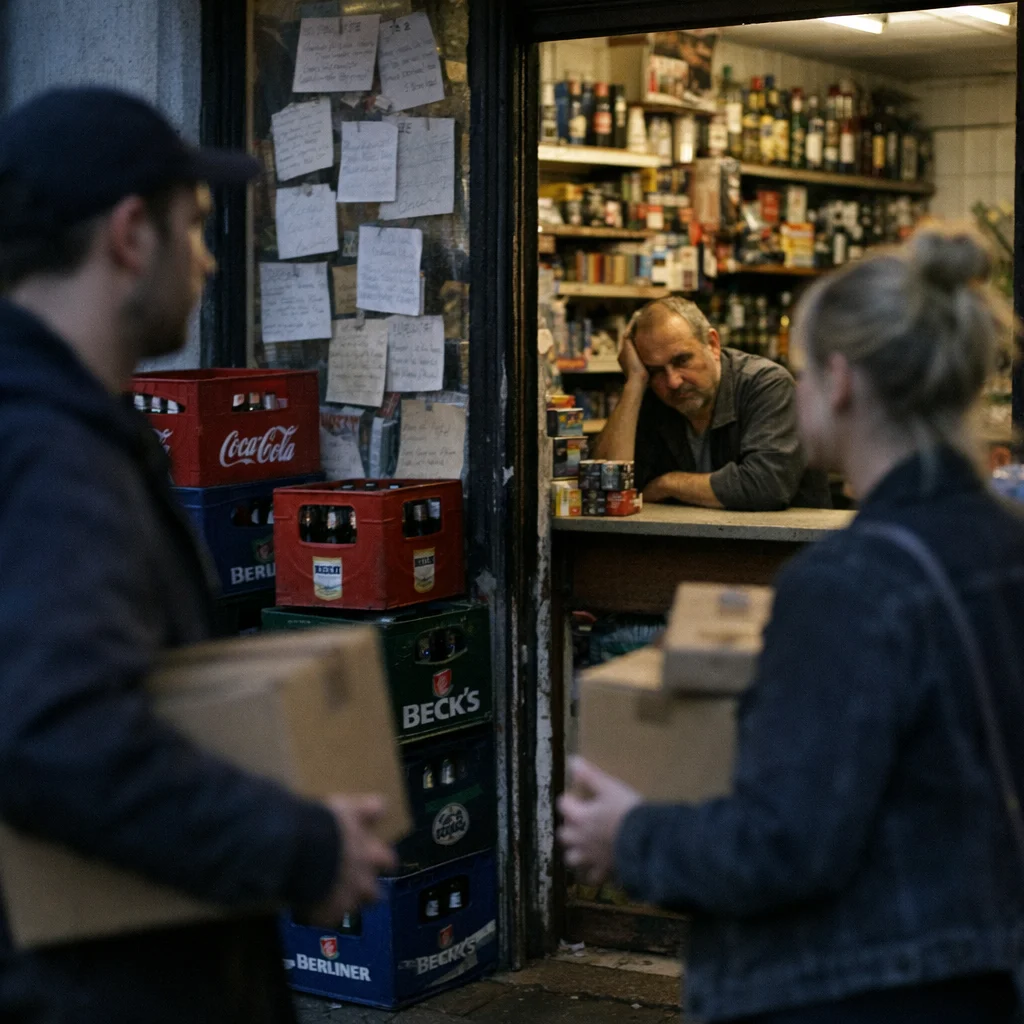
Wedding’s corner shops are drawing a line in the sugar grime, and the local ecosystem of favors has already started to squeal. On Müllerstraße, a handful of Spätis have begun refusing parcel drop-offs, turning away luxury skincare, mystery boxes, and those Amazon cartons that arrive looking like either a blender or a misdemeanor. The excuse is “security.” The real message is uglier and more honest: stop using the counter as a valet stand for your indecision.
At first it looked like ordinary merchant self-defense. Then the rules got meaner, which is to say clearer. Several shops now post handwritten notices limiting pickup times, rejecting packages without matching names, and serving “regular customers” first — that charming Berlin phrase that means whoever can make eye contact without performing innocence like a stage trick. One shop owner on Müllerstraße, Mehmet Yilmaz, said the problems started with damaged parcels, fake names, and men in expensive jackets who arrived in a flush of fake urgency, as if the universe owed them a receipt, an apology, and a little oral service from the counter. “We are not your front desk, your storage unit, or your confessional,” Yilmaz said. “We sell drinks. We do not run a hostage exchange.”
That sentence is funny because it is true, and because every district in this city has learned to dress exploitation up as neighborhood warmth. The parcel economy only works because everyone pretends not to notice the arrangement: the platforms dump the logistics on tiny shops, the customers perform outrage when their convenience develops a pulse, and the city applauds the word “local” while making local businesses absorb the administrative filth. A Späti is expected to sell beer, cigarettes, ice cream, batteries, and moral absolution in the same transaction. If the owner asks for basic boundaries, suddenly he is “unfriendly,” which in Berlin often means he has failed to smile while being stepped on.
The district office, naturally, has opinions. It said it was “aware of the changing commercial practices” and encouraged retailers to maintain “clear documentation,” which is bureaucratic dialect for: please be brave, but not so brave that anyone in a sensible blazer has to stand beside you. The same office that can produce a laminated brochure in six languages will happily leave a corner shop to fend off entitlement, petty threats, and the soft intimidation of people who treat rules like decorative tissue paper. Safety, in this register, means paperwork after the damage. Documentation means the state can later say it noticed the bruise.
Meanwhile, the criminal-adjacent side of the neighborhood is not exactly writing thank-you notes. In Wedding, the street still runs on favors, silence, and the old local chemistry of who knows whom, who owes what, and which counter has learned to look away at the right moment. The parcel refusal does not dismantle that system; it just scratches one of its prettier surfaces. A former city investigator, speaking with the exhausted tone of someone who has watched the same script performed by different men in different jackets, called the shops “informal infrastructure with a cash register.” That is official-language poetry for: everybody knows the arrangement, and the only thing missing is the honesty.
Some residents cheer the new rules as community protection. Others call them selective morality, which is a fair complaint when the same counter that refuses a package will still sell cigarettes to a man who looks like he could intimidate a tax inspector through a locked door. But that contradiction is the whole local religion. People want the neighborhood to feel rough enough to seem real and orderly enough to feel safe, preferably without anyone interrupting their errands. They want a street with edge, just not the sort that asks them to carry their own junk.
The delivery platforms, of course, will survive this by doing what they always do: reroute the mess, squeeze the workers, and pretend the problem is “capacity.” They love the language of efficiency right up until a human being has to absorb the consequences. Then suddenly the corner shop is supposed to be flexible, civic-minded, and grateful for the privilege of being treated like a damp appendix of the app economy.
So the Spätis push back a little, the district office issues its little prayers, the customers clutch their expensive jackets and mutter like rejected royalty, and the neighborhood keeps its face straight while trading in the same old currencies: convenience, concealment, and the privilege of pretending not to know what holds the whole thing together. In Wedding, refusing a parcel is not a revolution. It is just one more way of saying the city can stop expecting free service with its dirt.