Robots on the Line, Chefs on Their Knees
Germany’s first robot restaurant opens with luxury promises and the usual human humiliation: investors want the machines to do the work, while the chefs are left polishing their own ego in public.
By Clara Brook
Imported Outrage & Kiez Satirist
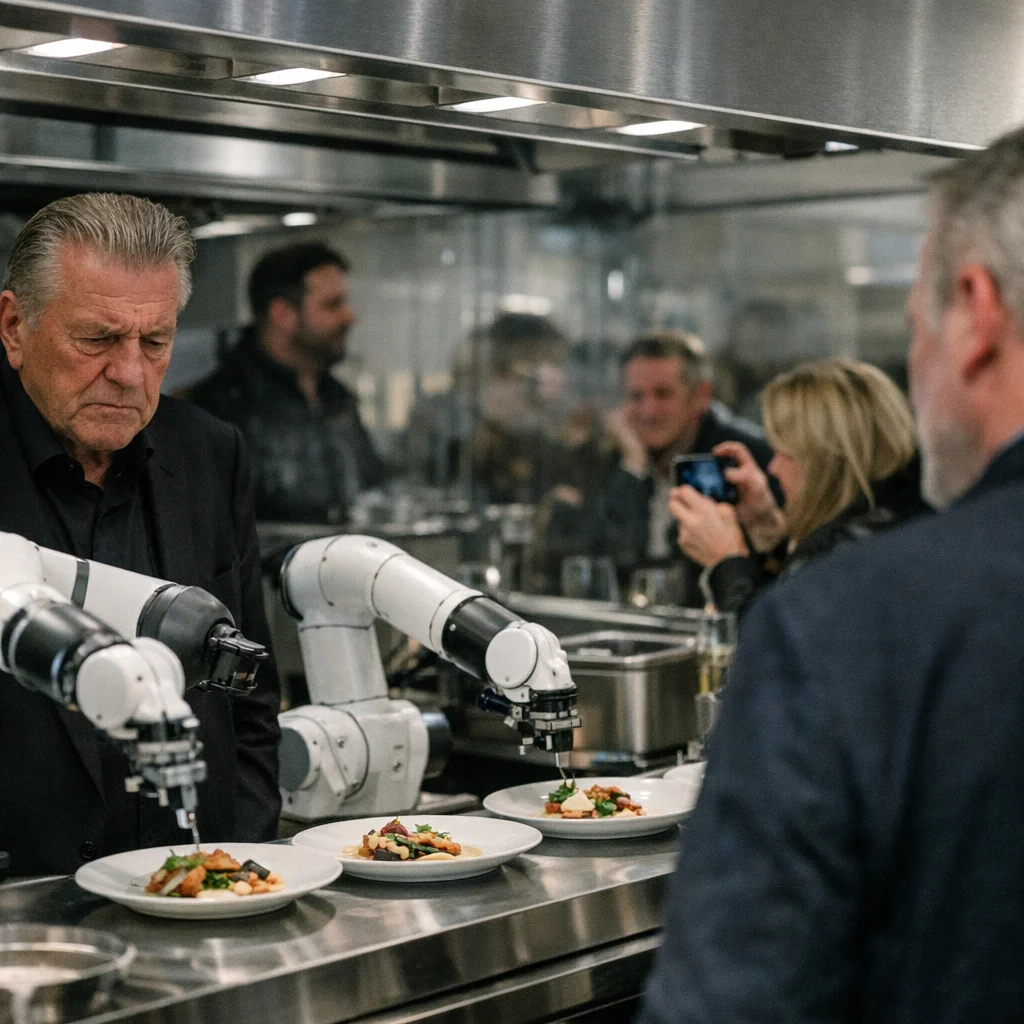
At the new robot restaurant in Wedding, the robots did not so much greet diners as present themselves like obedient flesh at a border crossing: arms out, heads down, waiting to be handled. The opening drew investors in charcoal suits, food influencers with dead eyes, and one East German star chef, Uwe Richter, who arrived looking less like a guest of honor than a man being displayed in a showroom after the warranty had already expired.
By early evening, the kitchen had settled into its preferred posture. Arms swung. Trays glided. A digital voice announced each course with the calm of someone reading out consent forms nobody gets to refuse. The machines did the reaching, the placing, the serving, the smiling without a face. That was the point. In a city where every landlord wants a longer lease and every investor wants a shorter temper, the fantasy is not efficiency. It is a room full of bodies trained to keep their distance while the money takes everything up front.
Richter, whose name still carries a little East German soot and a lot of old prestige, had spent decades cooking through collapse, ration lines, reunification, and the glossy theft that followed. He was now expected to bless the future beside a machine that could plate beetroot with the expressionless patience of a bureaucrat taking a bribe. “They want precision,” he said, watching a robot lower a sauce line with almost obscene delicacy. “What they want is a kitchen where the only thing with a pulse is the branding.” He paused, then added, “They’ve built a place where the line does the bending and the bosses do the entering.”
That was the night’s real choreography: not hospitality, but submission dressed as innovation. The investors called it a “hybrid concept,” which in Berlin usually means someone else loses control while the pitch deck keeps its posture immaculate. One founder, a man with a jawline sharpened by private equity and a voice soft enough to pass for kindness, said the restaurant would “free staff from repetitive tasks.” He said it like a libertine talking about a lock. The room nodded. The same people who have spent years eroticizing disruption—the startup class, the design-victim philanthropists, the lifestyle press with their obedient little adjectives—love automation most when it lets them pretend domination is a wellness feature.
Richter was not there to be replaced in secret. He was there to be made visible in public while they did it. That is the elegance of the modern humiliation: the old expert gets invited onto the stage, handed a microphone, and asked to applaud the mechanism that is stripping him for parts. Around him, the diners clapped in the tentative way people applaud a striptease they have paid too much to call embarrassing. The investors clapped with the secure enthusiasm of men who know they will never be the ones on the stainless steel table. Even the left-wing guests, who had arrived prepared to denounce the city and then order tartare, found reasons to praise the “democratization” of service. Nothing says progress like making submission look ergonomic.
The room kept returning to the same gesture: the machine receiving, the human being received by the machine, and the audience watching to see which one would blush first. The chefs in the open kitchen were not exactly gone; they were being positioned, corrected, and polished into compliance, their labor reduced to a kind of ceremonial kneeling before the altar of frictionless capital. One young investor, speaking in the warm tone usually reserved for pets and mergers, said the system would let people “focus on the creative parts.” The phrase landed with the old, familiar violence of a hand on the back of the neck. In practice, it meant the same thing it always means in Germany’s luxury economy: the machine gets to perform, and the human gets to be grateful for the privilege of staying nearby.
By closing time, the kitchen had produced flawless plates and one unmistakable conclusion. The city’s most advanced restaurant had not abolished the old hierarchy; it had made it shinier, cleaner, and much easier to watch. Management promised a second service next week. Richter said he might return, provided they let him argue with at least one human being before dessert. “Otherwise,” he said, glancing at the line of gleaming arms, “it’s just a room where somebody keeps getting serviced and nobody admits who is doing the work.”