S-Bahn Conductors Beg for Mute Mode
Berlin’s transit staff have discovered the city’s favorite workplace fantasy: customer service without customers, and authority without the nuisance of having to sound human.
By Jax Delayski
Transit Meltdown & After-Hours Logistics Reporter
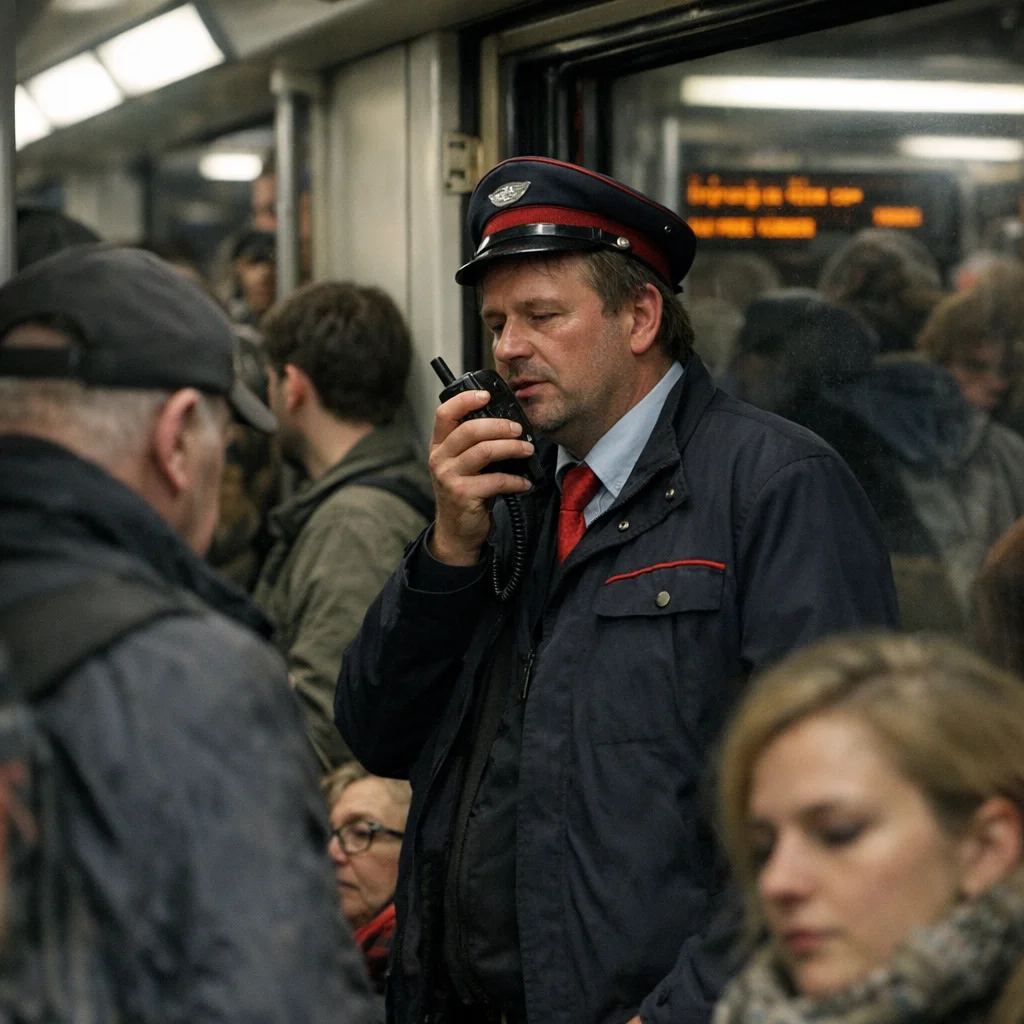
The S-Bahn staff on Berlin’s overfull, under-loved trains have discovered a fresh kind of humiliation: a “de-escalation” script that lets them either keep talking, file complaints through an app, or stand there like upholstered scapegoats while commuters blame them for the city’s spiritual collapse.
On the platform at Ostkreuz, at Warschauer Straße, at Gesundbrunnen, it lands the same way every time: not as policy, but as a little administrative grope. The script tells staff to announce delays calmly, avoid confrontation, and route complaints digitally when things get ugly. In other words: be soothing, be invisible, and please do it while the line is grinding to a halt and a man in a fleece vest is already filming you with the moral intensity of a prosecutor denied dessert.
“I can choose between sounding like a kindergarten teacher, a customer-service chatbot, or a man waiting to be sued,” said one conductor on condition of anonymity because he still works here and does not want his name attached to the next group of strangers who think the train owes them a personal apology. “The app is supposed to help. Mostly it gives passengers a second channel to yell into, which is very Berlin: digitize the tantrum and call it modern governance.”
The ritual is familiar and deeply unflattering. A train stalls between Neukölln and Treptower Park, a door sticks at Ostbahnhof, someone’s stroller or suitcase gets wedged, and the carriage fills with the city’s special scent: sweat, battery heat, damp wool, stale coffee, and entitlement pretending to be principle. One passenger performs wounded innocence. Another performs militant empathy. A third, usually in immaculate black and a tote bag that has never carried anything heavier than a theory of itself, delivers a private seminar on why public life has declined since the republic learned to outsource shame.
The conductor, trapped in the middle like a minor character in Kafka with a badge and a shift plan, is expected to absorb the whole show with a firm grip and no visible pulse. The woman who missed her connection to Wedding wants an apology from the state, but only if it arrives in the correct tone. The man with the expensive headphones wants authority, provided it does not interrupt his self-image as a patient citizen. The young founder type wants efficiency, which is Berlin code for obedience without friction, preferably delivered by someone he can later describe as “not service-oriented.”
A BVG spokesperson said the new approach is meant to “support staff in difficult interactions” and reduce on-board escalation. That is a lovely phrase, the bureaucratic equivalent of a satin glove over a broken knuckle. It is the sort of language city institutions use when they have already decided that care is cheaper when it is humiliating. In practice, staff say the policy shifts the burden downward and calls it empowerment. Berlin’s favorite trick remains intact: privatize irritation, outsource shame, and then ask workers to smile through the penetration.
The city government will applaud itself for this, naturally, because it can always confuse vocabulary with courage. Transport policy here is a perfume of cowardice: endless “dialogue,” endless “stakeholder coordination,” endless little laminated phrases that let officials sound humane while they keep the system underfed, overworked, and one bad evening from collapse. The policy class loves a script because a script cannot ask for overtime, cannot quit, and cannot tell a senator to take the U8 at 17:30 and listen to the whole carriage chew through its own disappointment.
The passengers are no better, and pretending otherwise would be municipal erotica. Berlin commuters love to style themselves as victims of a broken city while acting like the city is their personal service animal. They bark at staff, then tweet about dignity. They occupy a doorway with the serene selfishness of people who think delay is oppression when it touches their calendar and character development when it touches anyone else’s. They are furious at every late train except the one carrying their own vanity.
The left gets to write another grave little thread about public infrastructure and social cohesion, then ride home with headphones on while pretending not to hear the man behind them reciting a full conspiracy theory into the carriage air. The right gets to sneer that public transport proves collective life is a scam, which is rich coming from people who would privatize the sidewalk if they could rent it by the hour. Both sides are united by the same sacred delusion: that the system should work for them personally, and that someone poorer should be made available to apologize for the inconvenience.
One conductor called the new script “a Beckett play with better fonts and worse pay.” Another, who requested anonymity because he once fell asleep on a late shift and woke up in Spandau, said the real innovation was simple: “Now we can be blamed in three different ways for the same delay. That’s Berlin efficiency. Multiply the shame, keep the train broken.”
At some point the city will probably add a little app prompt for passengers to rate the emotional sincerity of the staff member who told them the signal is dead near Hermannstraße. There will be stars. There will be a feedback form. There will be a polite sentence about respect. And the trains will continue moving like a rumor, while the people running the system keep mistaking managed humiliation for public service.