Say Your Problem in 12 Minutes: Wedding’s 'Open Hours' Secretly Outsource Longer Chats as Billable Therapy
The district invites residents to 'drop by'—a buried scheduling clause meanwhile recategorizes any conversation past the 12‑minute mark as a 'tier‑2 consultation' handed to a contracted provider that asks for a GDPR.
Nightlife Contradictions Reporter
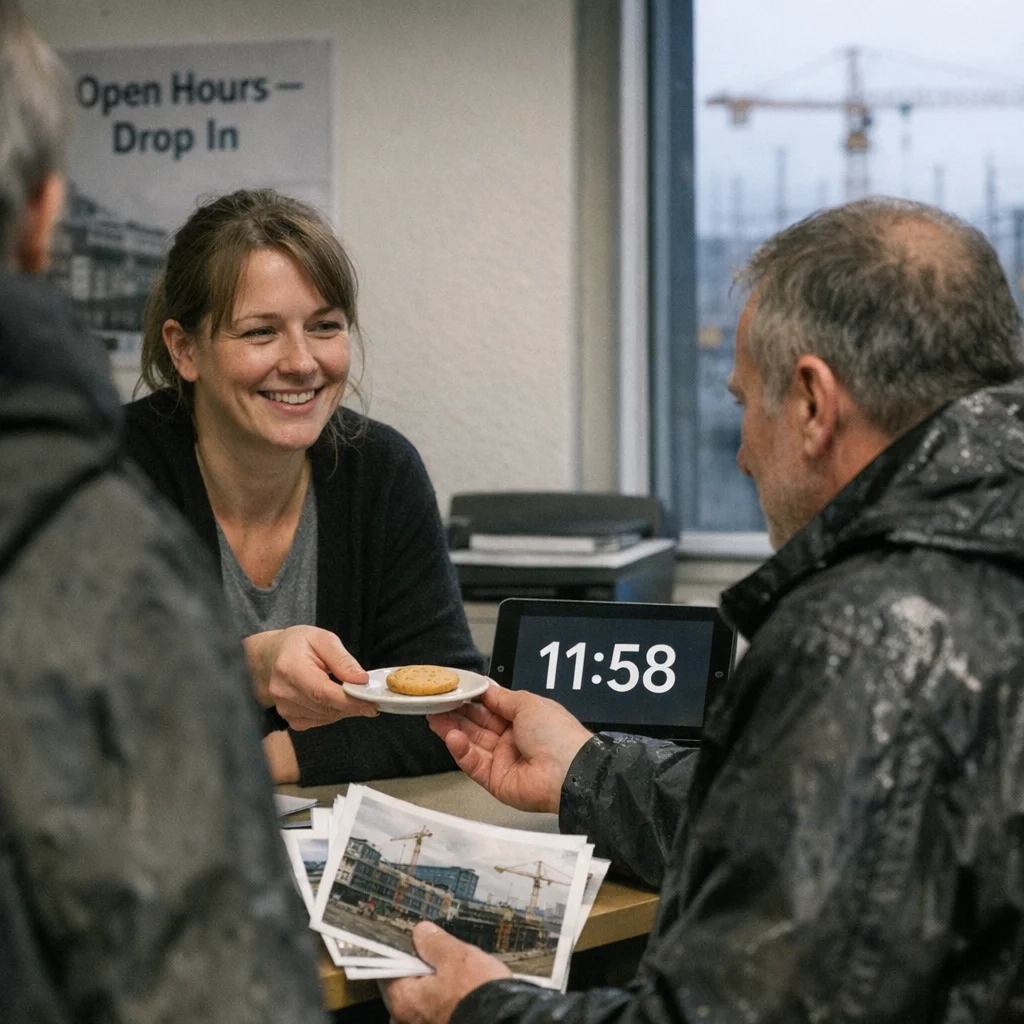
Wedding — The district’s weekly “drop‑in” Open Hours were rolled out as a small, bureaucratic miracle: walk in, point at your problem, get help. What residents who actually try to complain about the eternal scaffolding and rerouted traffic at Berlin Hauptbahnhof learn is a different truth. A buried scheduling clause in the Open Hours policy reclassifies any conversation that lasts past 12 minutes as a “tier‑2 consultation” — not a municipal case file, but a billable handoff to a contracted provider that requires a GDPR waiver and a new appointment fee.
On a wet Tuesday morning Levent Yilmaz, who runs the tired simit counter near Leopoldplatz and who has spent three years sweeping dust blown from Hauptbahnhof onto his doorway, sat at the counter with printed photos of cracked paving and a ledger of delivery delays. “She smiled, offered a biscuit, and said, ‘Tell me quickly,’” Yilmaz said. “At 12:01 the tablet buzzed. A form appeared. ‘Tier‑2,’ she said, like she was announcing the weather. They asked me to sign.”
Staff training materials obtained by this paper instruct employees to open with a scripted empathy line, hand over a small pastry, and start a digital countdown on the case tablet. The idea, officials say, is efficiency; in practice it funnels anything that looks like a structural problem — persistent dust, stalled elevators at Hauptbahnhof, repeated tram diversions — out of public remit and into the private sector.
“We use triage language to speed up support and get residents the right expertise,” said Bezirksamt spokesperson Anna Roth in a written statement. “Tier‑2 allows us to connect complex cases with specialised providers.” Asked if residents are ever charged, Roth replied that costs depend on the contracted provider and the nature of the consultation.
The contracted firm named in dozens of redirected cases, Consultiva Services GmbH, confirmed it now handles “extended citizen consultations.” “We offer mediated complaint processing and therapeutic listening,” said Consultiva director Henrik Brandt. “Residents appreciate focused attention.”
Here is the under‑noticed inversion: a program sold as grassroots access quietly monetises sustained civic grievance. The infinite construction at Hauptbahnhof — scaffolding that lives like a permanent tenant, elevators that pretend to be modern art, detours that make local deliveries erotic in their futility — becomes a product to be massaged by private ears rather than solved by the public office that approved the permits.
“It reads like Kafka annotated by Foucault,” said urbanist Marta Klein, who has filed ten complaints about platform closures. “The state sets the appointment, then sells you the time it would have spent fixing what it authorised.”
District officials say they will review the clause “in the coming weeks.” Activists have launched a petition and a rota of citizens ready to time their complaints to 12 minutes exactly. Whether that will stop the dust at Hauptbahnhof, or only teach residents better ways to finish faster, remains to be seen.