Scan to Stabilize: In Wedding the IMF’s $8B Loan Arrives as a Line‑Item on Your Transfer Receipt
The IMF sells the rescue as macro‑stability; in the neighborhood it landed as a tiny barcode and a 'Stability Fee' printed under the kebab shop logo.
By Lina Paypass
Night Economy & Digital Vice Reporter
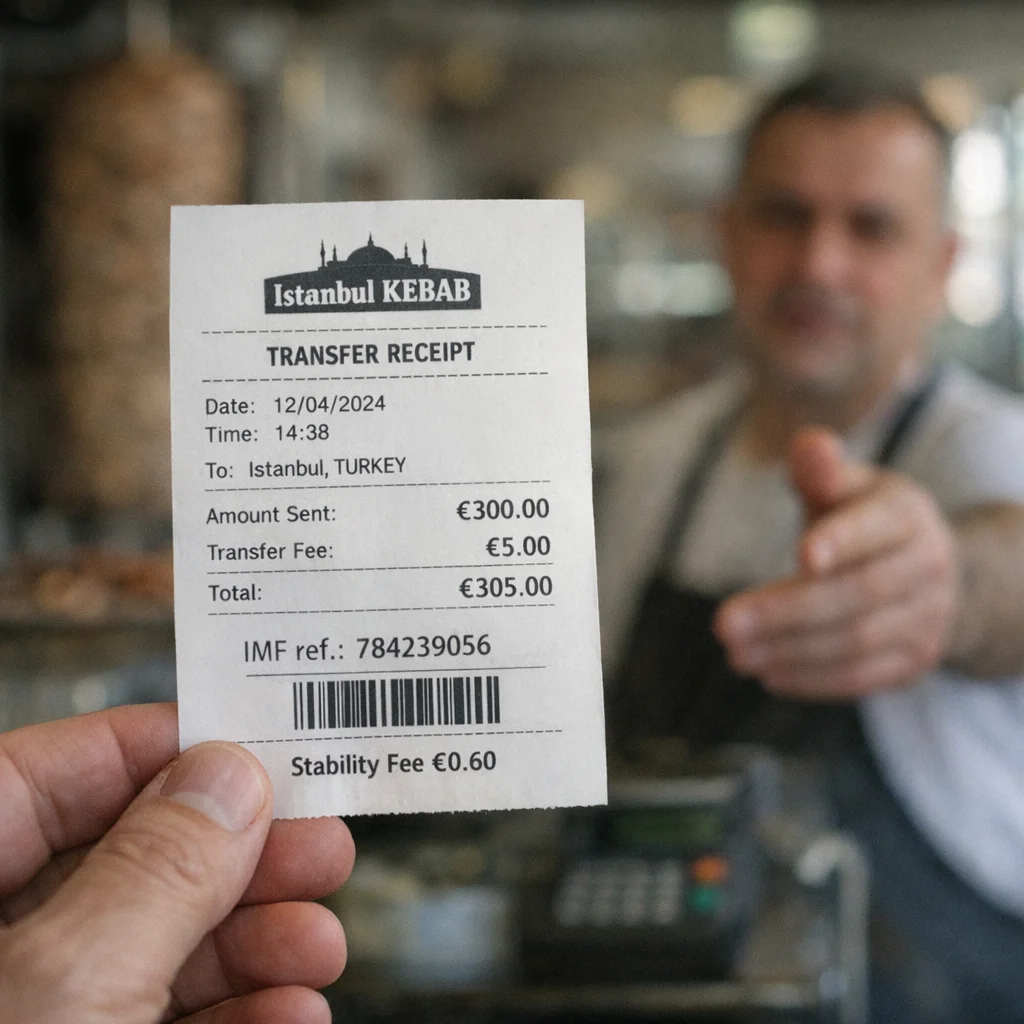
When the IMF approved an $8 billion credit program for Ukraine this week, officials framed it as a rescue for macro‑stability. In Wedding, that high‑finance sermon arrived not in a press release but on thermal paper: a barcode and a fourth line on every money‑transfer receipt reading "IMF ref." and a small "Stability Fee."
It started Thursday morning at Merkez Geldwechsel, a Turkish‑run corner where kebabs and remittances share the same counter. Customers sending twenty or fifty euros to relatives abroad noticed receipts with a new microcode below the kebab shop logo. "It says €0.60 — Stability Fee," said shop owner Mehmet Yılmaz, wiping his hands on a towel. "I thought it was a cleaning charge. Then the customer scanned the barcode and the app showed 'IMF: program 2026.'"
The official line from an IMF spokesperson, Dr. Elise Marceau, was crisp: the printed tag is an accounting reference to track capital flows into Ukraine, she said. "It does not represent an additional loan charge imposed by the Fund," Marceau added. "It's a reference code to ensure transparency in aggregate statistics." A transparency sticker, bureaucrats call it. A tiny tax on dinner, locals call it something else.
How the reference migrated onto kebab‑shop receipts is the small technicality that undoes the noble headline. Local remittance processors began embedding a mandatory transaction code in their print strings after a compliance update from a Frankfurt clearinghouse. The clearinghouse, citing anti‑money‑laundering rules, pushed the code to vendors; vendors, not wanting to lose the service, passed a 1–2 percent handling line to customers. The grand plan to shore up reserves therefore acquires a practical manifestation: migrant senders shoulder a minuscule fee that now reads like a political footnote on their dinner bill.
"It's perverse," said Leyla Özkan of Migrant Aid Berlin. "A programme pitched as solidarity with a nation becomes a micro‑exaction on families in our neighborhood." She accused processors of gaming the optics while politicians kept their hands clean. The Mitte district office says it is "reviewing" whether small businesses were properly informed before the change; a spokeswoman, Jana Fischer, said regulators might demand clearer disclosure.
Locals reacted predictably: the left screamed hypocrisy, the newcomers drafted think pieces from their laptops and ordered oat lattes, and Mehmet sold one fewer lahmacun while charging the fee. The contradiction is simple and stubborn: macro‑stability gets marketed from Davos‑toned podiums while the concrete effect is literalized as a line‑item that pinches the poor into paying for the headline.
Walter Benjamin wrote about the death of the aura when art is mechanically reproduced; here the aura of international finance dies in thermal reproduction under a kebab logo. For now, the immediate consequence is practical: operators promise to remove the line if regulators insist, activists plan a petition, and customers are checking receipts with a new, reluctant intimacy — scanning barcodes that explain geopolitics in cents.