Scrapbook of No: Three Years of Rejections Bound in Glue and Hope on Genter Street
A Wedding resident has cataloged 1,146 failed attempts to register his address, complete with screenshots, stamped printouts, and a ribbon-cutting ceremony nobody could legally attend.
Civic Rituals & Paperwork Features Reporter
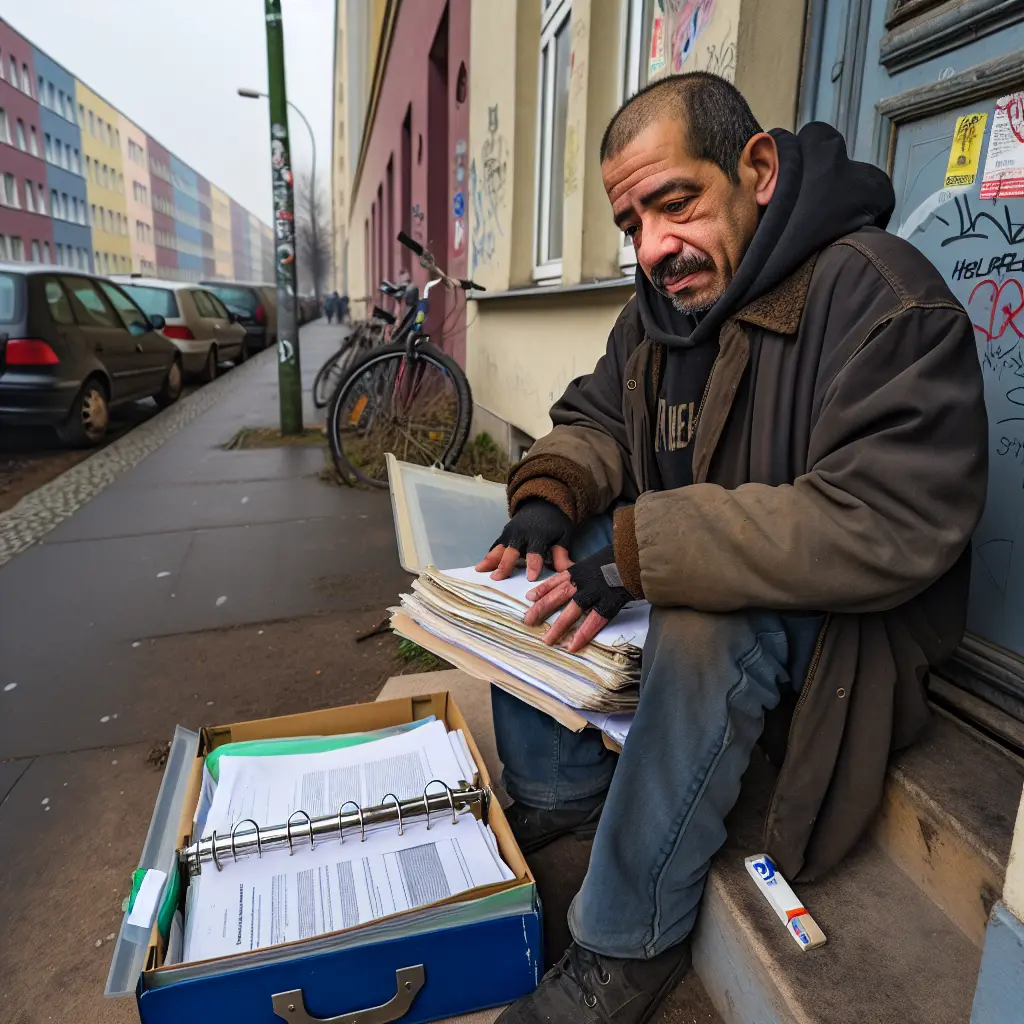
On Tuesday morning at 8:47 a.m., residents of Genter Street 41 noticed Emil Nowak, 38, seated on the front steps with a three-ring binder the size of a small radiator. He wore nitrile gloves—“for archival integrity,” he said—and carefully pressed a fresh screenshot onto a page already crowded with earlier failures.
Nowak has been trying to secure an Anmeldung appointment since January 12, 2023. He has not succeeded. Instead, he has built what he describes as “a complete material history of rejection,” a 312-page scrapbook containing 1,146 timestamped denials, error messages, and “nearly-appointments” that vanished the moment he clicked.
“I’m not unemployed,” Nowak said, flipping to a section labeled False Openings. “I have a job at a logistics firm in Moabit. I pay taxes. I just don’t exist in the way the city requires. It’s like being alive but not addressable.”
The ritual is precise. According to a log taped to his refrigerator (viewed by this reporter), Nowak refreshes the Berlin service portal at 6:58 a.m., 7:14 a.m., and 11:02 a.m., then again at 3:33 p.m. “for late drops.” Each attempt ends in what he calls “stiff resistance,” usually the same message: no appointments available. When the portal briefly displayed an opening on September 19, 2024 at 7:06 a.m., Nowak printed the screen, framed it, and attended a “private viewing” with two neighbors and a half-warm bottle of Sekt.
“It’s not a fetish,” he clarified, unprompted. “It’s documentation. Walter Benjamin would understand. The aura is in the screenshot.”
Neighbors have begun treating the scrapbook as a local landmark. “It’s like a neighborhood museum, except the exhibit keeps expanding,” said Leyla Aydin, 29, who lives on the third floor. “He has tabs for ‘Portal Timeouts,’ ‘Captcha Humiliations,’ and one called ‘Almost Penetrated the System.’ That one’s… a lot.”
Nowak’s partner, Jonas Richter, 41, said the project has consequences. “We can’t switch electricity providers. We can’t get a parking permit. We can’t even argue with full confidence, because the city hasn’t acknowledged we’re allowed to be annoying here.”
A spokesperson for the Mitte district office, Maren Scholz, said in an emailed statement that “high demand and limited capacity continue to impact appointment availability,” adding that residents should “remain patient and use digital alternatives where possible.” Asked about Nowak’s 312-page scrapbook, Scholz replied: “We welcome civic engagement in all forms.”
The dynamic has begun to resemble a municipal panopticon, Nowak said, except nobody can find the watchtower. “You feel observed by rules you can’t locate,” he said. “Kafka wrote it cleaner, but the plot is familiar.”
Last Thursday at 5:26 p.m., Nowak held what he called a “binding ceremony” at Köllnischer Park Copyshop on Müllerstraße, paying €27.80 to laminate the scrapbook’s table of contents. The clerk, who gave only his first name, Piotr, described the mood as “somber, like a funeral for a person who is still paying rent.”
Nowak plans to continue until he gets an appointment—or until the binder requires structural reinforcement. “This city loves contemporary art,” he said, sliding a fresh page into a sleeve. “If the state won’t register me, maybe a gallery will. At least galleries return your emails.”