Self-Marriage at the Altar of Career Clout
Claudia Schmutzler’s solo vows turn self-love into a public loyalty test, where every applause break looks a little like a tax deduction for vanity.
Nightlife Etiquette & Status Rituals Correspondent
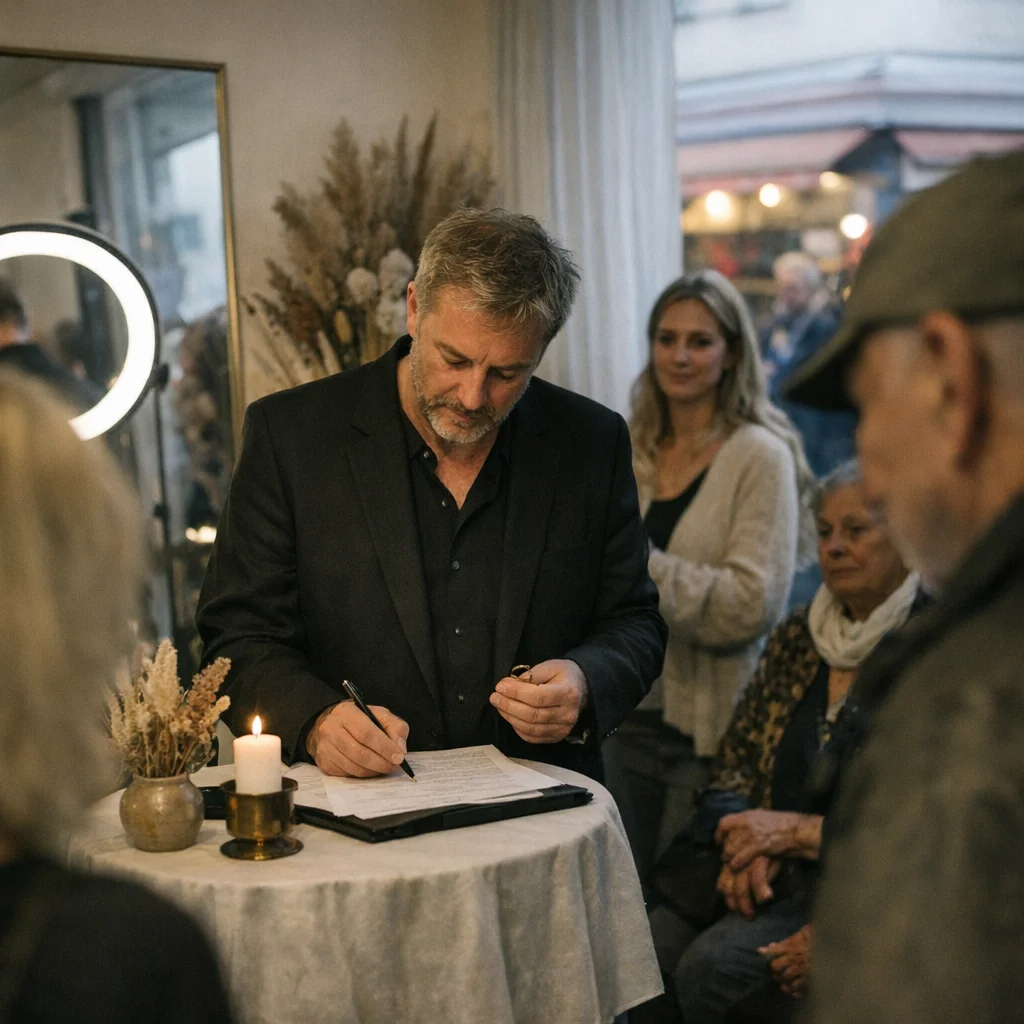
Claudia Schmutzler, the actor who once made a generation believe a car could stand in for a personality, has now given Berlin’s professional intimacy racket the one service it understands: a ceremony where the guest of honor is also the merchandise, the client, and the exit strategy. In Wedding, where people already confuse self-work with work and call it liberation when someone else is paying for the candles, the solo-vow trend arrived with all the grace of a corporate HR memo in silk stockings.
By late morning, a small crowd had gathered outside a studio near Leopoldplatz, where the windows were staged with dried flowers, a ring light, and a mirror polished so carefully it looked like the city’s newest altar to self-approval. The setup had the usual Berlin smell of rented conviction: beige linen, oat milk, and the faint panic of people who have spent years insisting they need no one while arranging themselves for maximum witness. Several attendees said they were there to celebrate autonomy, embodiment, and “radical self-recognition,” which is what the local class calls it when vanity learns a new vocabulary and walks into a deposit contract wearing heels.
The ceremony itself was less a love story than a dress rehearsal for power. Schmutzler stood at the center while the room circled her like investors pretending they were friends. A facilitator in soft tailoring invited everyone to “honor the union within,” a phrase so perfectly suited to Berlin it might as well have been stamped on a zoning permit. The guest of honor placed a ring on her own finger, signed a sheet of paper that looked suspiciously like consent with better typography, and accepted applause that arrived with the caution of people waiting to see whether the room had become a trap.
That was the whole trick, really: self-marriage as a public kneeling before your own image, then calling it sovereignty. The city adores this move because it lets everyone act unavailable while still begging to be chosen. It is the erotic logic of the status class, all leash and no collar, all foreplay and no responsibility. You can call it empowerment if you like, but the mechanism is simple enough: present yourself as both sovereign and saleable, then let the crowd clink glasses while you negotiate with your reflection.
A Turkish baker on Müllerstraße, watching the procession of bougie witnesses drift past with iced matcha and emotional insurance, put it more plainly: “They used to want husbands with money. Now they want mirrors with a budget. Same appetite, cleaner packaging.” He shrugged toward the studio windows, where a photographer was angling for the exact expression of someone being adored and audited at the same time.
The district office said it had no formal role in the ceremony, though officials were quick to note that any public gathering in the neighborhood still requires the usual paperwork, insurance, and enough restraint not to turn a tram stop into a self-esteem annex. A spokesperson added, with the exhausted politeness of someone who has watched too many declarations of freedom produced by people who still text their landlords in a panic, that the borough “supports diverse forms of self-expression.” In Berlin, that usually means the city will tolerate anything as long as it can be priced, photographed, and filed under culture.
By the time the vows were over, the room had already divided itself into the usual classes: those who wanted the image, those who wanted the invitation, and those who wanted to be seen wanting neither. One planner nearby described the next package as a “self-union reception,” complete with candles, a boundary-setting worksheet, and a debrief on attachment styles. It sounded less like a celebration than a private onboarding for people who need an audience to confirm they are independent.
That is Wedding’s preferred theology now: promise yourself forever, then have the room watch while you prove it without ever risking the humiliation of another person’s appetite. The applause lands, the phones come out, the mirror keeps its own counsel, and the invoice arrives looking like virtue. In the end, the only thing truly married here is vanity to power—and even that union comes with a cancellation policy.