Selfies at 140 BPM: How Our Front Cameras Put Techno on Life Support
I watched Wedding’s dance floors get converted into content farms, where the bass still hits—just not as hard as the need to be perceived.
Culture & Regret Correspondent
I’m going to say the quiet part loudly enough to rattle the cheap windows on my staircase: techno is dead.
Not “dead” like your friend’s film project that’s been “in post” since 2019. Dead like a goldfish left on a radiator while someone writes an artist statement about “impermanence.”
And yes, we killed it. Not the tourists. Not the city. Not even the people who think minimal is an emotion. We did—with our curated Instagram aesthetics, our moralized outfits, our compulsive need to document the exact moment we pretend we’re not documenting.
Techno used to be a room. Now it’s a profile.
Techno used to be an agreement: you surrender your face, your name, your daily self, and in exchange you get to be a moving shadow with good timing. It was anonymous in the way that mattered—less “mysterious,” more “nobody cares what you do for work.”
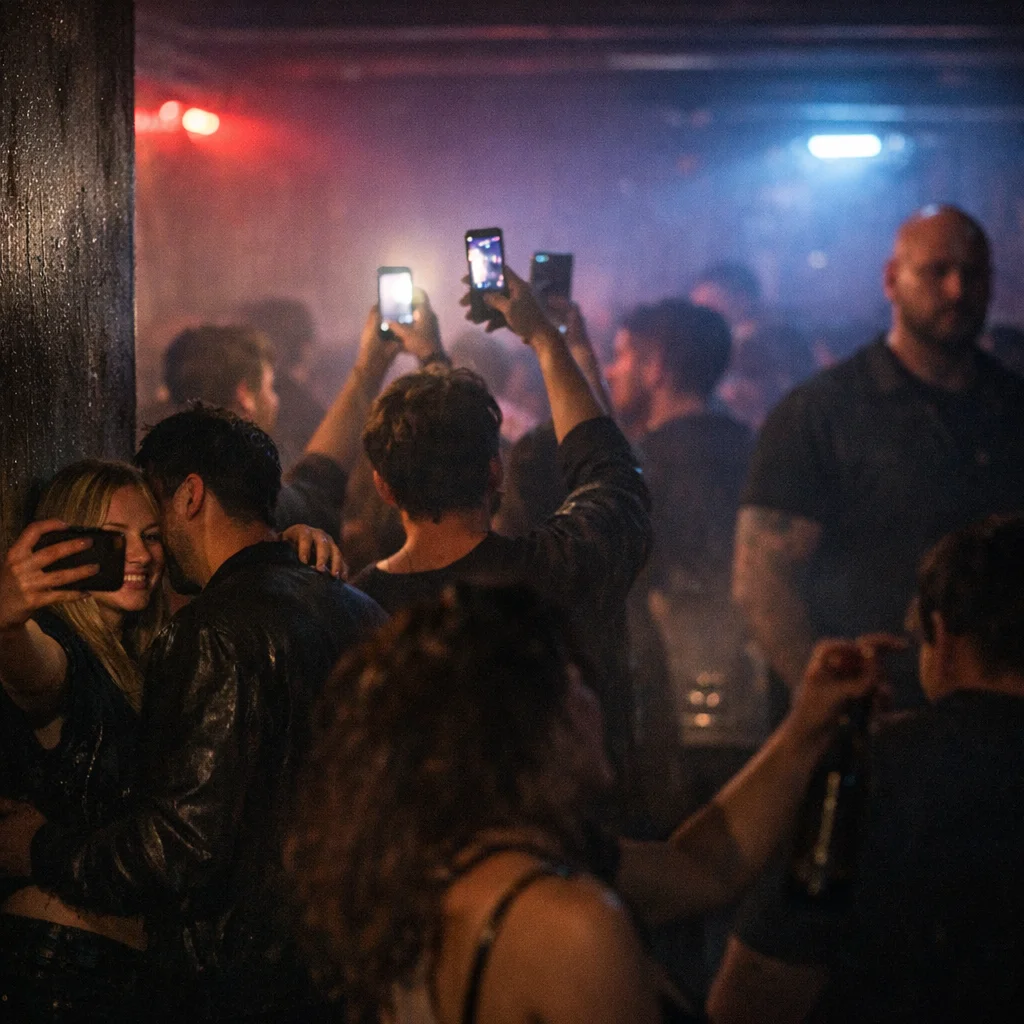
Now it’s a LinkedIn internship with better lighting. The dance floor is full of people doing what I can only describe as interpretive networking: heads nodding like they’re agreeing with a panel discussion, bodies angled to catch the right corner of the strobe, eyes scanning for proof that this was, in fact, a night.
The old vow was simple: lose yourself.
The new vow is: find yourself, then crop yourself.
And when everyone is busy being the main character, nobody is listening. Not to the music, not to the room, not even to their own knees begging for mercy.
Wedding: from sweatbox democracy to content studio
I’ve lived in Wedding long enough to remember when the neighborhood’s nightlife ecosystem was less “brand identity,” more “accidental anthropology.” Turkish bakeries opened early; the dancers stumbled out late. A guy would buy simit like it was communion, then argue with a pigeon like it was Hegel.
Now the same corner has:
- an English menu with “fermented feelings,”
- a café where the chairs look like Bauhaus nightmares,
- and a pop-up “listening bar” where everyone listens mostly to themselves.
Meanwhile, the longtime Turkish families—who built the real Wedding, the one with actual work—watch rents climb like a DJ’s ego after their first blog mention. The new arrivals talk about “community” the way a landlord talks about “value-add.”
Even the dance floor got gentrified: fewer weirdos, more clean lines. The kind of clean lines that make you wonder if someone is about to sell you a mattress.
The tyranny of looking good while feeling nothing
Techno used to be ugly in the best way: honest sweat, cheap deodorant, cigarettes that tasted like regret, and a roomful of people dressed as if they’d fled their own lives through a side exit.
Now it’s choreography for people who swear they’re spontaneous.
I see it every weekend: the slow lift of the phone, the practiced half-smile, the “I’m not posing” pose. It’s a deep dive into self-expression that somehow lands on the exact same outfit as everyone else—black, curated, expensive, distressed in a way that suggests therapy money.
And the worst part isn’t the filming. It’s the emotional performance. Everyone looks like they’re having the time of their life the way Kafka’s characters look free—technically alive, spiritually processed.
If Walter Benjamin wrote about the loss of aura, he’d now have to add: the aura didn’t disappear; it got ring-lit.
We replaced trance with branding (and called it “care”)
Here’s what really killed it: we started treating the night like a product launch.
You can’t have trance when you’re doing brand management. You can’t dissolve your ego while monitoring your angles. You can’t surrender when you’re busy collecting receipts—social ones, visual ones, the kind you can show your coworkers on Monday like evidence you still have a soul.
Techno was supposed to be the opposite of the algorithm. A place where time melted and the self got blurry around the edges.
Instead, we brought the algorithm inside and asked it to choke us gently.
Even our rebellion got streamlined. Even our filth got hygienic. Even our intimacy is now scheduled—consensual, yes, but also weirdly optimized. The scene didn’t get safer; it got more compliant.
And before you accuse me of nostalgia, relax. I’m not romanticizing the old days. The old days were full of idiots. I was one of them. But at least we were idiots together, not isolated content creators rubbing up against each other for the sake of a clip.
The real after-hours is your camera roll
I know what you’re thinking: “But I don’t post. I just take them for me.”
Sure. And landlords raise rents for “maintenance.”
If you have 43 videos of the same kick drum, you’re not preserving a memory—you’re stockpiling proof. You’re telling the world (and yourself): I was there, I belonged, I was desirable in the approved way.
That’s not a night out. That’s a soft audition.
And yes, sometimes I watch people watch themselves dancing and think: this is the only kind of intimacy they trust—something they can replay, control, and mute.
Hard to swallow, but there it is.
My modest proposal: make techno inconvenient again
If we want techno back, we need to stop treating it like a showroom.
- Bring back the unflattering corners.
- Bring back the weird outfits that look like a bad decision.
- Bring back the courage to be unseen.
And for the love of whatever god you pretend not to believe in, stop converting every moment into content. The point was never to look like you’re free. The point was to actually feel it, even if only for six minutes and a badly mixed transition.
Techno isn’t dead because the music stopped.
Techno is dead because we started listening with our eyes—and we’ve been staring at ourselves ever since.