Seven VC Exorcists Swarm Wedding Pitch Night After Founder Claims His App Was “Rejected by the RSO Bouncer”
In a basement off U8, optimism met stiff resistance from physics, budgets, and a man in all black insisting your “minimum viable product” is a feeling, not a plan.
Demo-Night Archaeologist & Soft-Launch Embarrassment Reporter
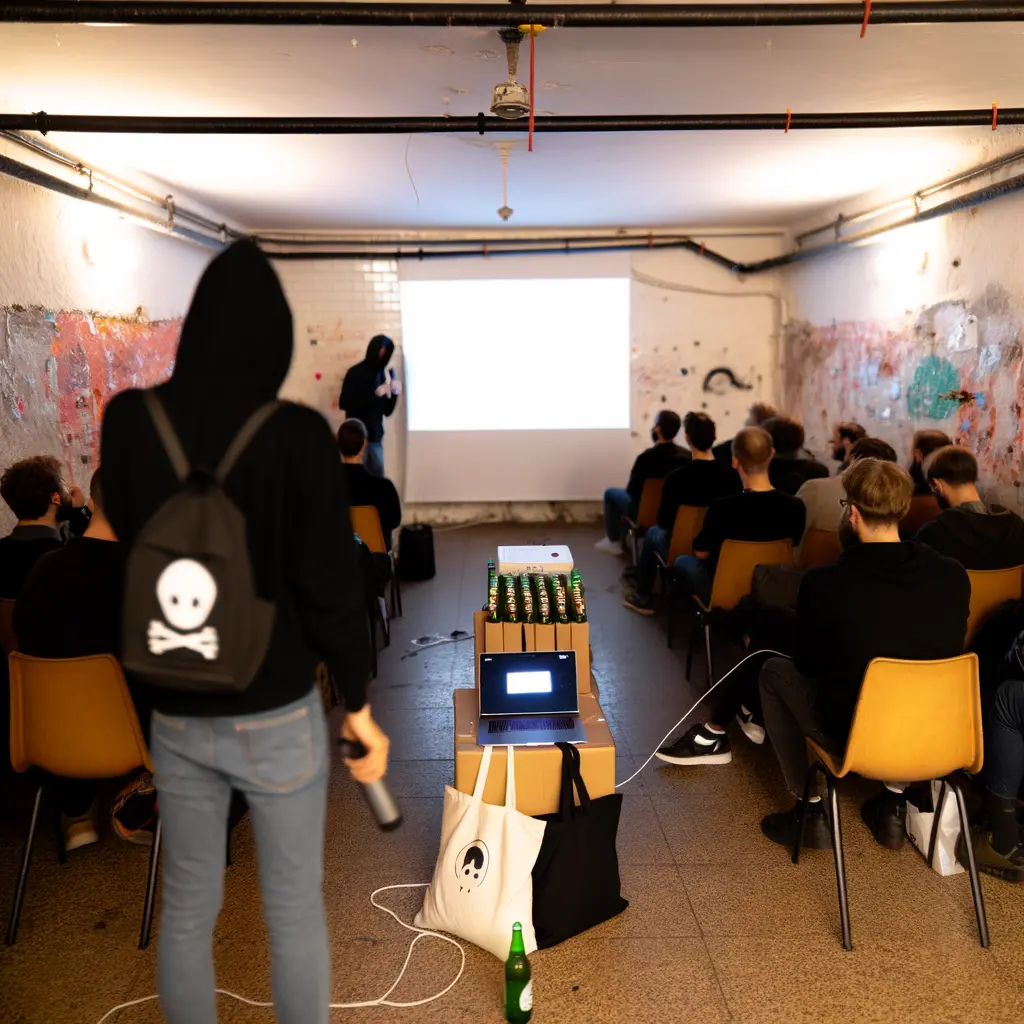
A Basement Full of Dreams, Plus One Working iPhone Cable
Nobody in Wedding has real savings anymore, but everyone has a deck.
On Thursday night, a “community innovation evening” squeezed itself into a rental basement that smelled like wet wool, old filter coffee, and premature leadership. The organizers claimed it was a salon; the room’s acoustic reality suggested “teenage rehearsal space,” except with more PowerPoint and less talent.
The audience arrived wearing the Berlin look: all black, exhausted, pupils negotiating their own foreign policy. Half the room was in a gentle Monday-that-never-ended state, lingering between dehydration and redemption. The other half seemed chemically fresh, as if they’d been preserved in a startup incubator like some postmodern pickle.
Somebody’s smartwatch buzzed with a reminder to drink water. A Turkish dad in the front row ignored all of it, maintaining the unimpressed facial expression of a man who has watched his cousin open five bakeries and still considers this “internet stuff” to be a phase.
The Doors Have Policies Everywhere, Now
It began with the keynote: a former product lead, now an “angel” (meaning unemployed but romantic about it), telling the room that “Berlin is frictionless.” He said this in a neighborhood where the pavement is essentially a sponsored obstacle course.
Then came the first pitch, from a founder who claimed his nightlife-authentication app was “rejected by the RSO bouncer.” This produced reverent nods, the way Medieval peasants nodded at stories of dragons. The room treated door policy as a cosmological truth, like Kant discovering you can’t access the thing-in-itself—only the velvet rope.
The founder insisted the bouncer had whispered, “Your app has too much intent.” Several investors wrote that down like it was scripture. That’s what we are now: a city where doormen double as philosophers, and everyone else is still trying to penetrate a market.
Pitch #2: Döner But Make It Data
Next up: “a Turkish-inspired hyperlocal food optimization layer,” which sounded like a €12 way to ruin perfectly decent döner.
The founder—an earnest expat with a hoodie that costs rent—promised an algorithm that reduces queue times at family-run spots by “streamlining demand spikes.” In plain human language, he wanted to tell Mehmet when you’re going to show up.
A real-life auntie from a nearby shop leaned over to me and said, “We already have a system.” She gestured with her eyebrows toward a bored teenage nephew on his phone. That nephew, in a single shrug, expressed more operational wisdom than the entire European tech sector.
Pitch #3: Wellness For People Who Refuse To Sit Alone With Their Thoughts
A “somatic accountability platform” promised to guide users through nervous system regulation, but only if they subscribe monthly.
The founder claimed the app is “like therapy, but scalable.” The crowd found it hard to swallow, even by Berlin standards—where half the economy is feelings with a receipt.
A man in the back—possibly a freelance filmmaker, definitely a functional disappointment—asked if this replaces human contact. The founder replied, “It augments intimacy.” Two people clapped too fast.
Capitalism Performs Improvised Theater
At this point the room entered a familiar Wedding rhythm: somebody is always asking for money while pretending not to.
One investor stood and explained his fund invests only in “mission-aligned founders,” a sentence that sounded like Michel Foucault wrote a term sheet while tripping in a club bathroom and briefly saw the panopticon was actually a ring light.
In the break, the snacks vanished instantly, as if scarcity was the most realistic simulation offered all evening.
The Mandatory Night-Reference You Pretend You Don’t Need
Around 11 p.m., people did what Berliners do when a social ritual starts sagging: they mentioned clubs to create a false horizon.
“Maybe we head toward Kater Blau later?” someone said, like it was an evacuation plan.
Another muttered about an invite “near Wilde Renate,” which in Berlin is code for: you will lose your weekend, your charger, and one belief you previously held about yourself.
Several attendees openly debated “doing something” after the pitches, treating Thursday night as a rehearsal for Saturday’s moral collapse. Somebody claimed they were “sober tonight,” the way people claim they’re “just friends.”
Exit Interviews With the Brokenhearted
By midnight, the founders were circling investors like mildly cursed satellites.
A 23-year-old pitching “community-owned AI” admitted he hasn’t eaten real food in three days, surviving on oat milk and applause. Another confessed their revenue model was “strategic.” In Wedding, we call that faith.
As I left, a guy wearing a lanyard—no badge, just the lanyard—asked if I wanted to “sync later.” I said no. He nodded like rejection was a core KPI.
Outside, the street had that calm, slightly ashamed quiet you only get before someone decides the night is still young. A couple staggered past looking spiritually scheduled for an all-weekend mistake. Somewhere near the U8, Berlin’s great engine of ambition kept grinding.
In a city that treats self-delusion like a public service, these pitch nights are less about businesses and more about confession. And like any good confession, everyone leaves lighter—because nobody actually carried anything real in the first place.