‘Show Your Bag, Save the Block’
Wedding’s new anti-dealer crusade gives shopkeepers, volunteers, and nosy neighbors a costume of civic virtue while letting everyone else play police without a warrant.
Dancefloor Etiquette & Chemical Sociology Reporter
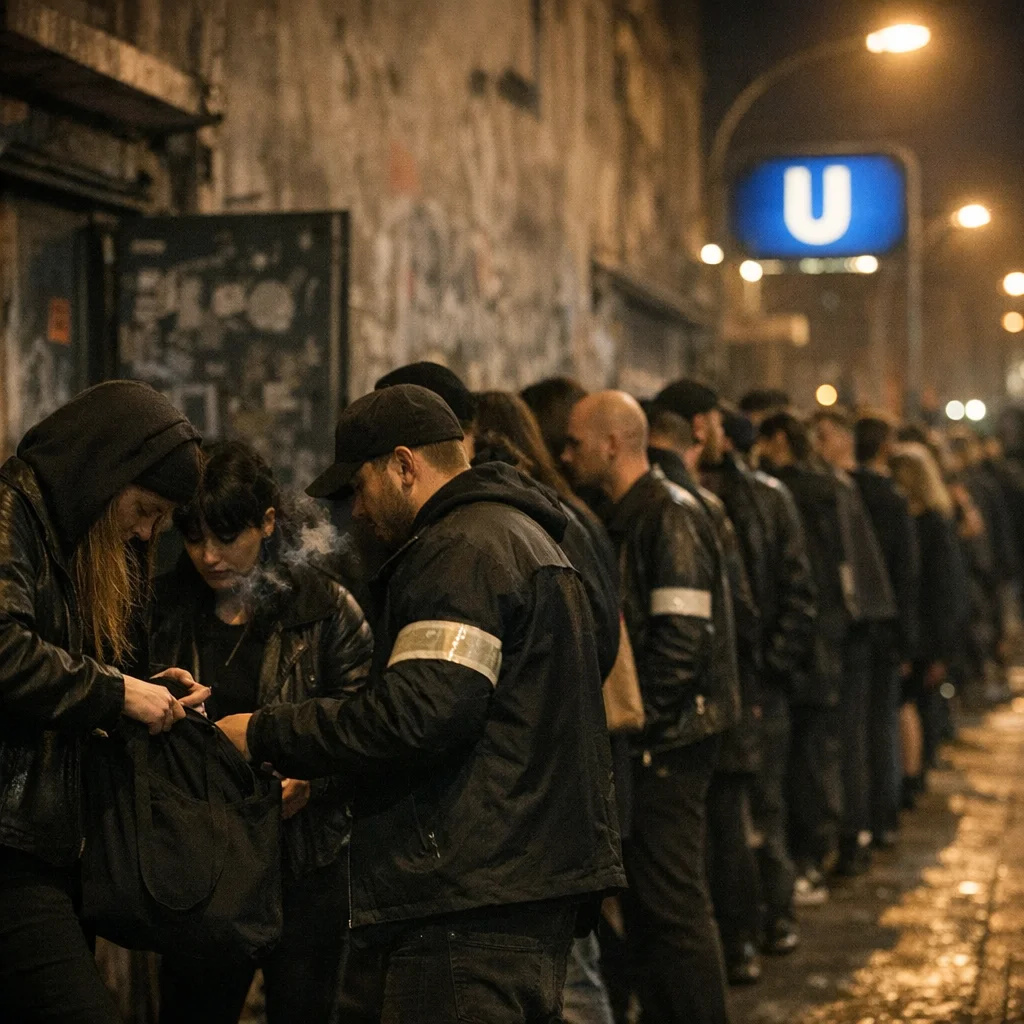
At a former warehouse near the U-Bahn tracks in Wedding, a collective of club promoters, volunteer “safety marshals,” and two self-appointed aunties with reflective armbands staged a Saturday night operation that treated techno like a parish and the sidewalk like a confessional for people with expensive shoes and no shame. The campaign, called “Show Your Bag, Save the Block,” turned the neighborhood’s already theatrical nightlife into a civic striptease: wallets out, tote bags open, eyes down, and everyone pretending this was solidarity instead of a very local taste for petty authority.
The event began after dusk, when the first crowd arrived in black clothes and borrowed certainty, carrying the usual cargo of deodorant, poppers, vape batteries, little plastic baggies of self-regard, and the brittle hope that a queue can make them look politically awake. By midnight, the marshals were asking visitors to open bags before entry, then again before the smoking area, then again if they looked “too relaxed,” which in practice meant: too young, too working-class, too drunk, too brown, too obviously not one of the people who say “care” while behaving like a customs office with candles.
A café owner from the next street, who requested anonymity because his lease is fragile and his politics are made of warm foam, said the checks gave the block “a firm grip on itself.” He said the initiative had “finally penetrated the neighborhood’s problems,” which is exactly the kind of sentence that should trigger an ethics review and a full medical check. The man sells espresso at €4.20 and apparently dreams of a district where the wrong bodies are kept outside by volunteers in fluorescent vests while the right bodies get to sip oat milk and discuss harm reduction like it is a brand strategy.
The district office said it “welcomes civic engagement,” the bureaucratic equivalent of smiling while loading the weapon. Officials are reviewing whether private volunteers can act as gatekeepers for public space without turning every doorway into a tiny regime staffed by people who learned policing from Instagram carousels and municipal jargon. The police, who arrived after a crowd argument outside the club’s stamped entry line, said they had “no objection to residents being vigilant,” only to residents impersonating search warrants with matcha breath and a savior complex.
The deeper joke is that Berlin’s techno class has always wanted temples, rituals, and permission slips. It worships repetition, hand stamps, dark rooms, and the false purity of being desired by nobody except a bouncer with a dead gaze and a nicotine stain. Now the same people have discovered community policing and dressed it up as tenderness. It is not safety; it is class discipline in soft lighting. It is neighborhood branding with a pulse. It is outsourced policing for people who want the aesthetics of care without the humiliation of ever sharing a sidewalk with someone whose shoes cost less than their conscience.
The marshals love to say they are “protecting the block,” but the block is being protected from a very specific inconvenience: people who look like they might trade, flirt, sweat, loiter, or otherwise disturb the boutique fantasy that a rough neighborhood can be redeemed through selective suspicion. The checks did not fall evenly. The clean-cut men with guest-list posture and the women in minimalist black slipped through with barely a nod. The kids from the estate, the exhausted night workers, the loud women in synthetic leather, the men carrying supermarket beer, the people who looked like they might actually need the street instead of merely consuming its vibe — they got the hand, the stare, the “just open it for me,” that lovely little sentence that means: prove you belong here, peasant.
Outside, the actual street trade barely flinched. It slid one corner over, as easily as a rent increase with better typography. Inside, the faithful kept filing past the armband apostles, eager to prove they were not part of the problem while every check, every glance, every sanctimonious little rummage made the problem clearer: this was never about ending dealing. It was about letting the neighborhood’s self-appointed moral adults feel clean while they sorted bodies by income, usefulness, and the degree to which they could be made to behave. The bass hit harder. The hypocrisy got wetter. And the block, naturally, was saved.