Sidewalk Tribunal on Müllerstraße
A wave of homemade policing has turned one of Wedding’s main streets into a petty court of folding chairs, complaints, and social revenge.
Night-Economy Forecast Desk
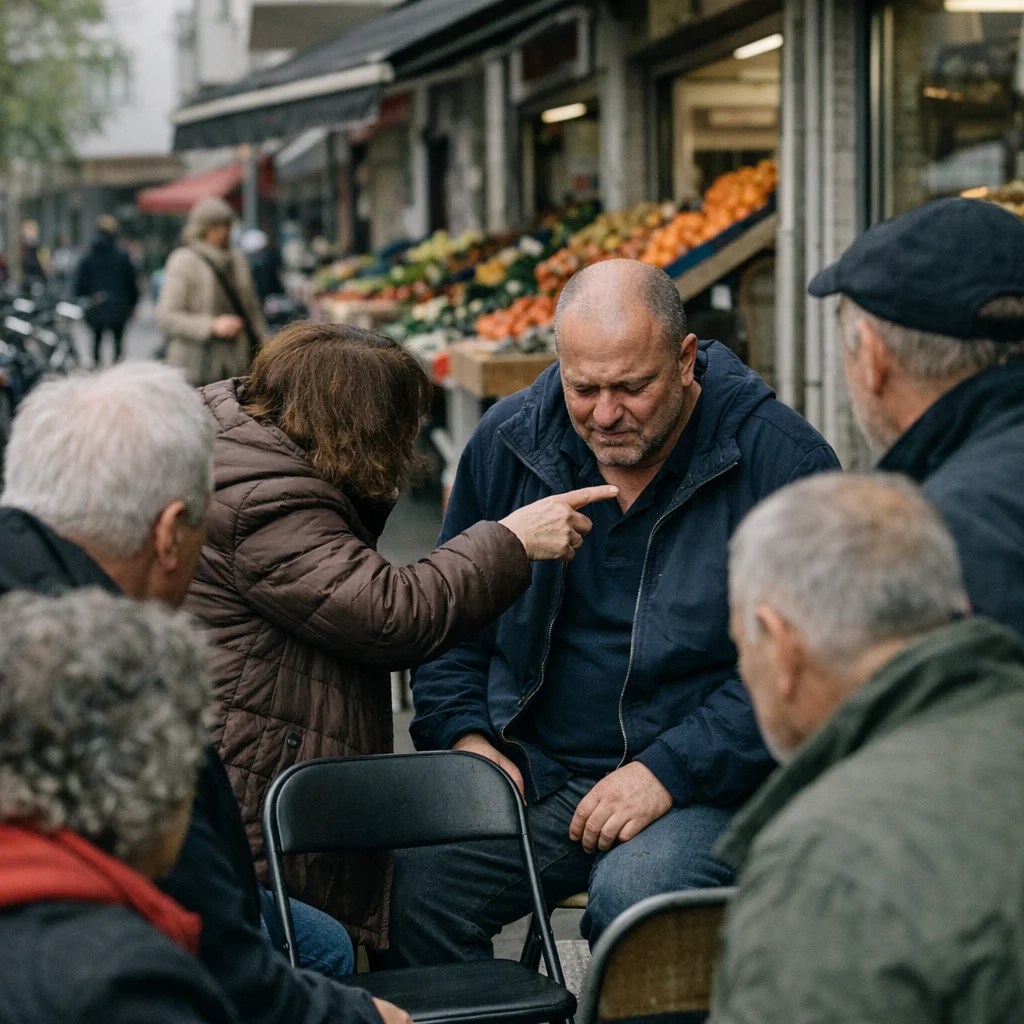
Müllerstraße’s Folding-Seat Inquisition
By late morning on Müllerstraße, the block’s volunteer wardens had already unfolded their chairs like props in a bad little regime. They planted themselves outside a discount bakery, a shuttered kiosk, and the Turkish grocery that has outlived three waves of urban improvement theater, each more smug than the last. The crowd was not elected, not accountable, and not remotely embarrassed. That made them perfect for local governance.
The ritual was always the same: complaints first, then more complaints, then the ceremonial sniffing of the pavement to decide who belonged and who needed to be socially peeled off the street. Cyclists were too fast. Teenagers were too loud. Delivery drivers were too present. Smokers were a moral stain. Anyone lingering with a backpack, a can, a trolley, or a tired face got treated like a transferable disease. The block’s morality police had a special tenderness for people who looked poor, foreign, bored, or in a hurry. It saved them the trouble of thinking.
One woman with two grocery bags was barked at for “blocking the flow,” as if Müllerstraße were a bloodstream and she had personally clogged it with cabbages. A man smoking outside his own shop was told his presence was “not helping the area,” which is the sort of sentence that only sounds civic if you’ve never listened to it out loud. Nearby, a tenant in a puffy vest and cheap trainers was informed that he should “maybe sit somewhere else,” a phrase that always arrives dressed as politeness and leaves smelling like eviction.
The usual neighborhood types were there in full costume. The retired man in the navy windbreaker with the crisp, sour mouth and the pocket notebook, recording sins no one consented to commit. The woman in the beige scarf and immaculate sneakers, the one who says “I’m very tolerant, actually” right before weaponizing safety like a kitchen knife. The freelance progressive with the bicycle helmet still on, allergic to noise, thrilled by rules, desperate to prove that gentrification can be compassionate if you pronounce it softly enough. They all talked about “care” while staring at people the way a landlord studies damp.
The borough office, that soft administrative accomplice, responded in its favorite dialect of cowardice. “Community engagement,” it called the gatherings, as if a folding chair and a grievance were a democratic mandate. “Informal dialogue,” it said, which is bureaucratic code for letting the local loudmouth perform public humiliation until the target leaves, apologizes, or shrinks down into useful invisibility. The office does not need to endorse the harassment. It only needs to give it a clipboard, a meeting room, and enough procedural perfume to make the stink pass for policy.
A café owner near the western stretch of the street said the same people who preach about sidewalks spend half the afternoon occupying them, spreading their little moral bellies across the public space while accusing everyone else of taking too much room. “They want the street clean,” he said, “but only after they’ve swept out the people who make them feel sloppy.” Another tenant described the meetings as “being inspected by people who think community means everyone else learning to whisper.”
That is the real trick on Müllerstraße: everyone wants order, but only for other people. The left-wing guardian wants compassion with a clipboard and a glare. The right-wing busybody wants discipline with plausible deniability. The faux-progressive wants diversity that behaves like decor and never sweats. Meanwhile the borough smiles in its soft, bloodless way and calls this harmony, as if social sorting were a wellness practice and not a neighborhood kink for people too timid to say they enjoy power.
By evening, the folding chairs were still out, the complaints were still rising like stale heat, and one more tenant had been warned for “hanging around too long,” which in this context means existing without the proper submissive posture. Next week’s gathering is already being planned, because nothing intoxicates a petty moralist like the chance to call harassment a process. On Müllerstraße, they don’t police the street. They flirt with authority until it agrees to sleep over.