Silicon Valley’s Dirty Little LinkedIn House
The Bay Area’s AI bachelors are pitching themselves as visionary collaborators while turning every dinner, demo, and bedroom into a low-rent mating market for funding, status, and access.
Startup Watchdog & Gentrification Satirist
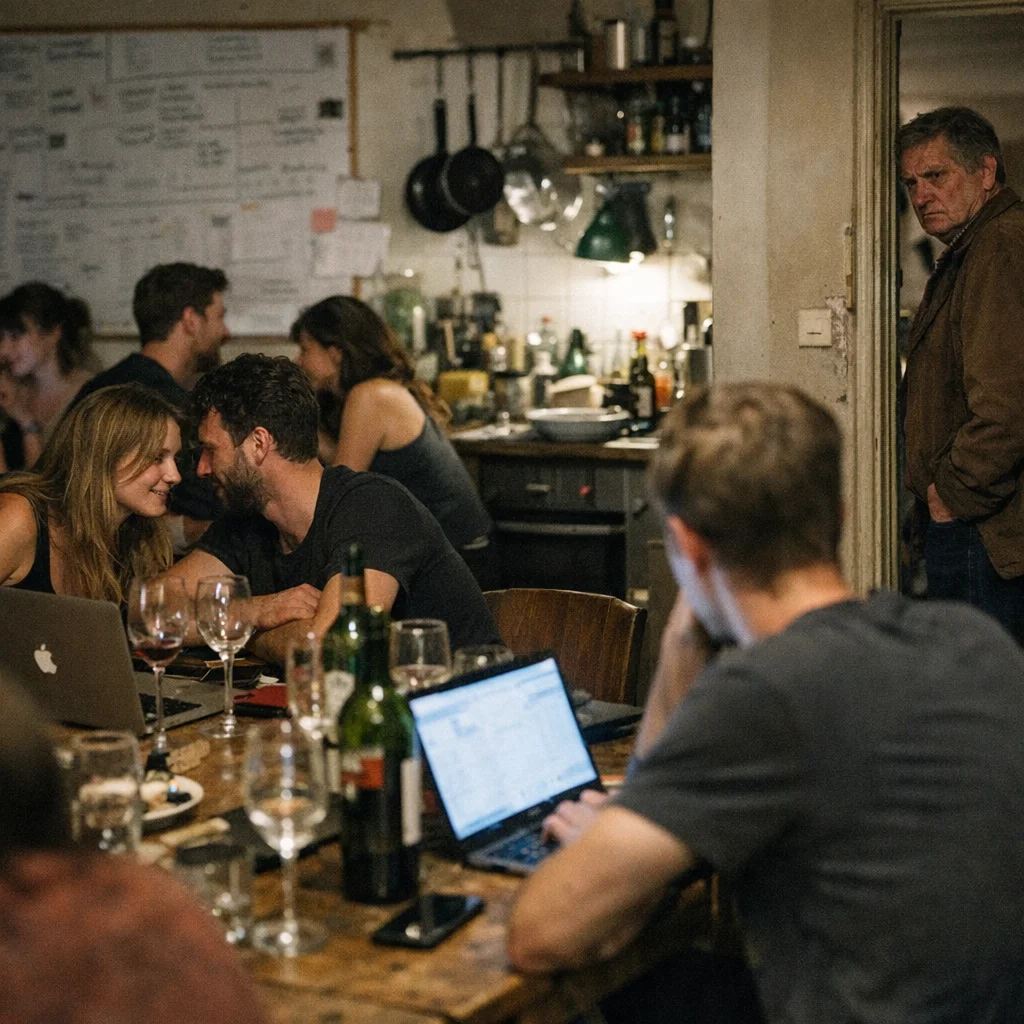
Berlin’s AI house party learned the hard way that every mixer ends in a hookup
A group house in Berlin’s startup circles has begun marketing itself as the city’s answer to the Bay Area’s infamous AI party houses: a place where founders, engineers, interns, and freelance visionaries can “collaborate naturally” after dark. In practice, residents and former guests say it works like a casting couch with a cap table, where the house keeps a waiting list for talent and another one for people who can still pretend they’re here for the mission.
The building, in Wedding, has the kind of over-restored communal kitchen that only appears after enough money has tried to cosplay as culture. A whiteboard in the hallway is labeled “opportunities,” though by Friday night it had effectively become the guest list: who was approved, who was “warm,” who was “maybe useful,” and who was being kept around in case a round closes and someone needs a warm body to call the ecosystem. The people orbiting the place tend to talk about “alignment” the way older parasites used to talk about virtue — as a word that meant access, preferably with a keypad.
Dinners start as panels, drift into auditions, and end with someone leaning too close across the table to ask whether the other person is “open-minded about collaboration,” which in this apartment seems to mean either joining a company or being socially sanded down by it. A former resident said the place had the moral temperature of a startup offsite and the sexual discipline of a broken elevator. “Everybody’s on a list,” she said. “There’s the investor list, the demo list, the afterparty list, and the upstairs list. If you’re not on one, you’re on another until they’re done with you.”
The local Bezirksamt said it had received complaints about noise, over-occupancy, and “repeatedly confusing a residential address with a coworking concept.” Police confirmed several visits over the summer after neighbors reported shouting, smoking on the stairwell, and one argument that escalated when a guest accused the host of “screening people for chemistry like it was due diligence and then acting surprised when the cap table got sticky.” Officers did not describe the incident that way, but they did confirm the address has generated enough calls to qualify as a minor neighborhood hobby.
Inside, the house reportedly runs on the same algorithm as the apps its residents claim to despise: everyone is advertised as available, nobody is admitted without a qualifier, and the person preaching consent is often just the one most aggressively managing the room. Entry is framed as openness; the real policy is selection. You get invited because you are fundable, promotable, decorative, or all three. You stay because leaving would mean admitting you were never there for community, only for access — to rooms, to introductions, to the sort of private attention that gets packaged as “chemistry” once enough people have watched it happen.
A neighbor who runs a Turkish bakery two doors down said the crowd is easy to spot because they arrive with oat milk, three tote bags, and the haunted look of people trying to product-manage desire. “They ask if we have oat milk now,” he said. “Then they go upstairs and invent a new masculinity, or a pitch deck, which is often the same thing.” He added that the building’s true innovation is not artificial intelligence but human sorting: “Who gets in, who gets used, who gets invited back, who gets left outside with the recycling.”
By Sunday morning, the house’s group chat had reportedly been renamed twice, one resident had moved out with a bruised ego and a collaborator from Kreuzberg, and the building’s owner had begun asking whether the “community” might be willing to pay extra for discretion. The only thing still moving was the application for a demo night next month, which neighbors say will almost certainly begin as a mixer, turn into a screening process, and end with somebody discovering the house’s best feature was never the wifi but the fact that it could turn every room into a waiting room.