Since Tuesday, Kitkat Regulars Have Been Crying for the SEZ While Quietly Measuring It for a Co-Working Space
With demolition reportedly looming in March, Berlin’s most sincere hypocrites have discovered nostalgia—right after it became a branding opportunity.
Street Policy & Architectural Embarrassment Reporter
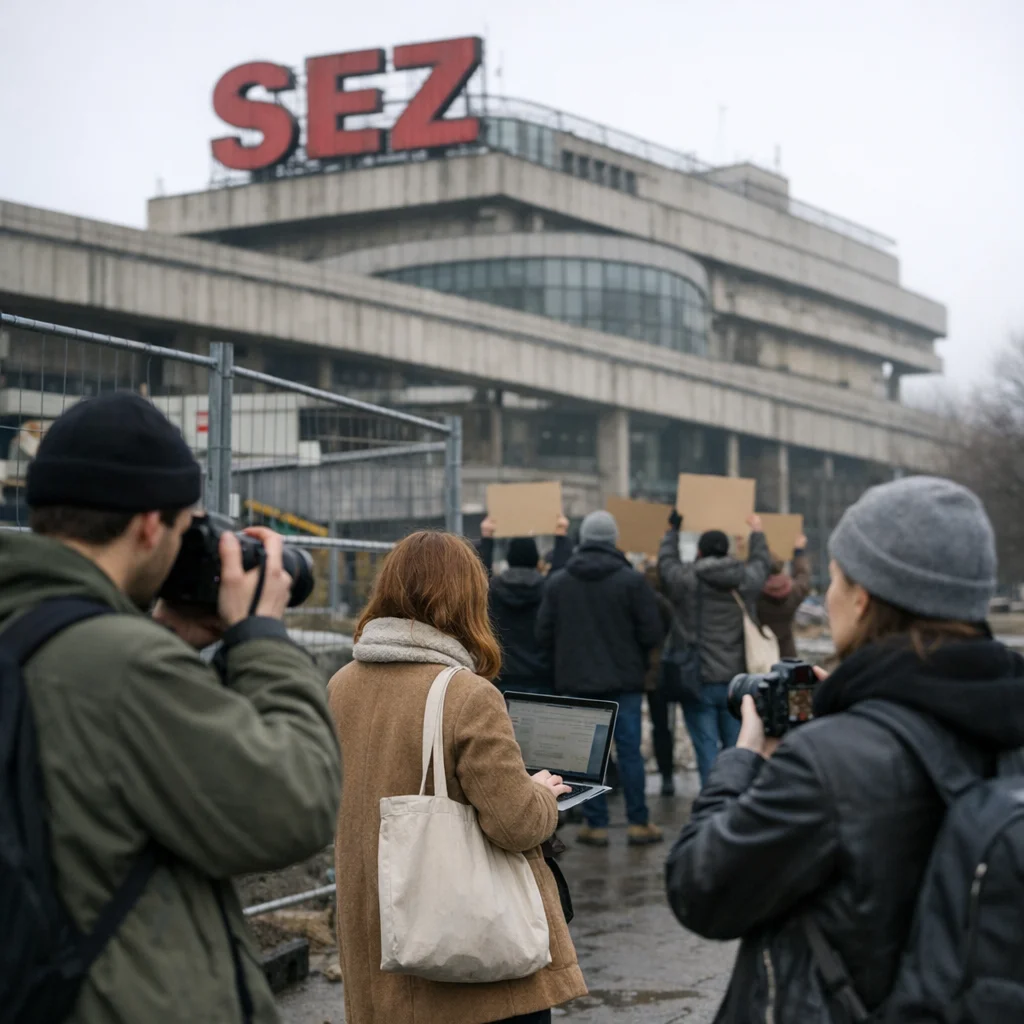
Berlin’s SEZ—one of those public monuments to the idea that society might provide things—has reportedly been placed on the cultural chopping block. Associations want to save the DDR-era icon. Investors want to save the land from having to contain anything as awkward as a memory.
In Wedding, the news landed the way it always does: as a sudden, very loud moral position that will be forgotten the second someone offers a soft launch.
At a café near Nettelbeckplatz, a group of newly-arrived Berliners in identical black beanies held an “emergency” meeting about preserving the city’s soul. They used the phrase “urban fabric” three times, which is impressive considering none of them can sew and all of them outsource their laundry to a service with an app.
Their proposal: a benefit night “for the SEZ,” featuring a DJ set, a panel on “post-socialist leisure infrastructure,” and a pop-up sauna “to reconnect with the collective body.” Nothing says solidarity like charging a door fee so people can feel virtuous in tight spaces.
Meanwhile, long-time Wedding locals reacted with the kind of practical grief that never trends. One Turkish father at a corner bakery asked a simpler question: “If they can tear down a building that big, what’s stopping them from tearing down my rent contract?” Then he shrugged, because in Berlin you learn early that the city’s true religion is redevelopment.
The most surreal development came from the SEZ itself: passersby swear the building has begun shedding tiny square tiles onto the sidewalk—clean, pale fragments, like architectural dandruff. People pocket them as souvenirs. A startup founder offered to authenticate the tiles as “physical NFTs,” which is the most Berlin sentence ever written without irony.
Preservation groups say the SEZ matters as social history. Developers say the future needs “activation.” Both sides are, in their own way, trying to get a firm grip on the narrative.
Walter Benjamin once wrote about the aura of objects. In Berlin, we’ve improved the concept: we destroy the object, then sell the aura back to you as a limited-edition membership.
If the SEZ survives, it will be because enough people can monetize their sadness without finishing too quickly. If it doesn’t, don’t worry—Berlin will build something new there that looks exactly like every other city’s regret.