Sisyphos Regular Treats ICE Death Headline as a Somatic Prompt, Asks Facilitator How to “Hold Space” While Doing Cocaine
Berlin’s wellness crowd discovered a tragedy about ICE custody and immediately tried to metabolize it in a candlelit studio in Wedding—then went straight back to their favorite powdered coping mechanism.
Wellness-Industrial Complex Stringer
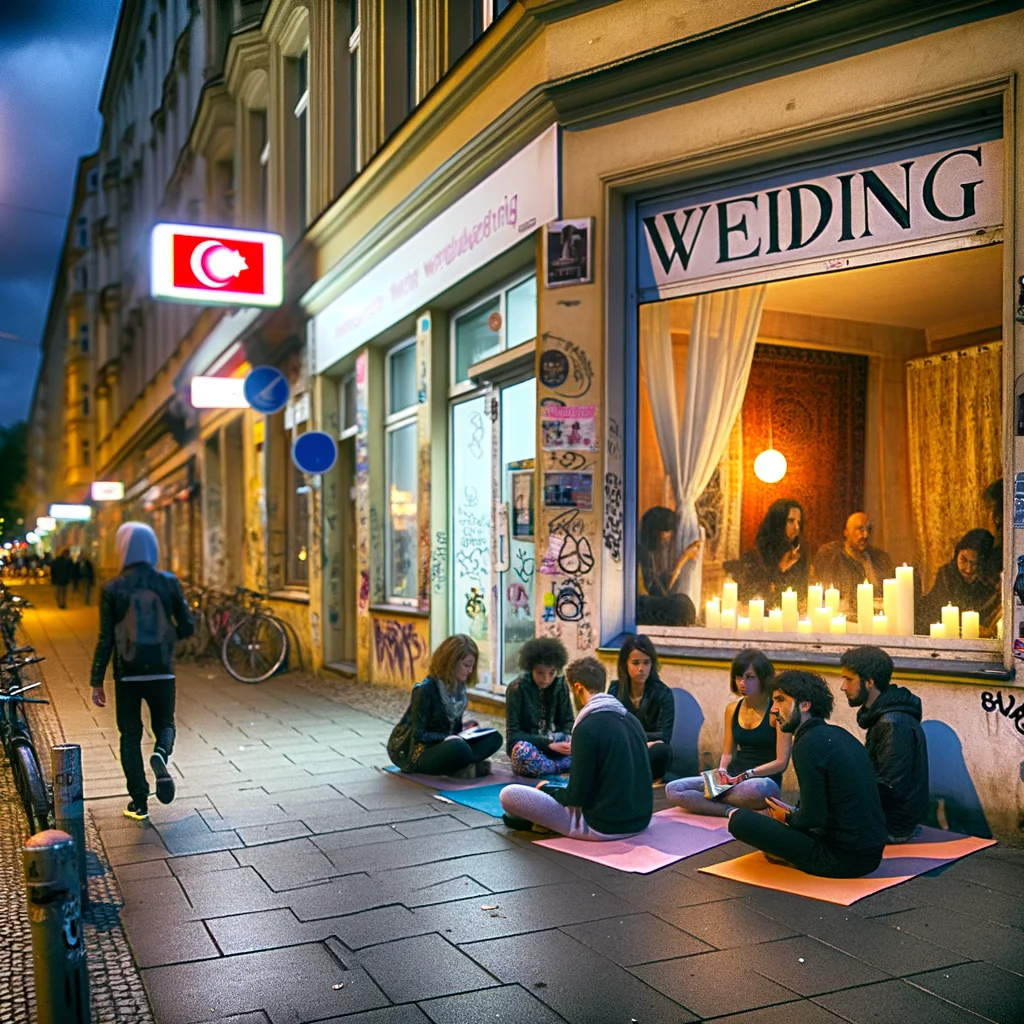
A Cuban immigrant reportedly dying in ICE custody is the kind of headline that should stop a person cold. In Berlin, it stops you for the length of one shaky inhale, then it’s straight into “processing”—which here means turning someone else’s suffering into a personally branded nervous-system journey.
In Wedding, this played out last night in a converted storefront that used to be a Turkish barbershop and is now a “somatic integration studio,” as evidenced by the beige walls, a bowl of ethically sourced pebbles, and the deep spiritual silence of €28 drop-in fees. Outside, a group of men debated football near a Turkish grocery; inside, a group of transplants debated whether grief can be “stored in the hips” or if it’s “more of a fascia thing.” Both groups were correct, somehow.
The Berlin response: from global tragedy to local self-care buffet
According to attendees, the facilitator introduced the ICE custody story as “a collective mirror,” which is wellness code for: Please pay attention, but also please pay me.
The workshop included:
- A guided meditation titled “Borders Within” (sponsored by nobody, yet still somehow expensive).
- A journaling exercise where participants wrote letters to “the concept of detention” in their non-dominant hand, which looked less like solidarity and more like Kafka drafting another sad little petition to an office that doesn’t exist.
- A breathwork segment called “Exhale the Empire”, performed by people who inhale speed like it’s an essential oil.
Somewhere between “set an intention” and “release intergenerational patterns,” a participant—face earnest, pupils committed to expansion—asked the question haunting modern Berlin like a nightclub subwoofer:
“How do I hold space for this without bypassing my need to party?”
A pause. The room, candlelit and trembling, waited for an answer worthy of Adorno. What they got was practical Berlin dialectic: Yes, the world is evil; also, the dancefloor is open.
The cocaine-to-meditation pipeline: harm reduction, but for feelings
This is Wedding’s signature export: suffering comes in, content comes out. The emotional economy runs on three pillars:
- Outrage as foreplay: a little headline to get the moral machinery warmed up.
- A “deep dive” into the nervous system: ideally guided by someone who uses the word “attunement” with stiff conviction.
- A relapse into familiar chemistry: not because it helps, but because it’s available and doesn’t ask you to feel anything you can’t name.
After the circle ended, several participants reportedly traveled—solemnly, mindfully—to the same after-hours constellation they’ve visited every weekend since their “new chapter.” One went to Golden Gate “for catharsis,” which is Berlin for “I’m going to grind myself into paste to avoid reading anything longer than an Instagram caption.” Another swore they were going “just for one drink,” the city’s most durable fiction.
One attendee described their plan as “integration, then celebration.” It sounded innocent until you remember Berlin’s integration tends to involve a key bump and a compliment in the bathroom queue.
Door policies as moral philosophy, plus a wrist stamp as absolution
Berlin likes to pretend the bouncer is a cultural worker and the door is a thesis defense.
At About Blank, a man in all black reportedly explained to the queue—unasked—that he cares deeply about immigration injustice. He said it while scanning the line for anyone with shoes too clean to be trustworthy.
Nearby, someone nervously rehearsed the required words for entry: “I’m here for the music.” A sentence so consistently false it should qualify as performance art.
Once inside, camera stickers were applied to phone lenses like last rites. If you can’t document it, it must be pure. That’s the Berlin version of virtue.
Compassion in Berlin is often sincere. It’s also suspiciously purchasable.
To be clear, plenty of people in this city actually care. Wedding is full of communities—Turkish families, immigrant workers, longtime renters—who have learned to survive politics without turning every tragedy into a self-improvement module.
But the wellness class isn’t built for them. It’s built for people whose primary relationship to injustice is feeling bad in an aesthetically pleasing way, then asking what brand of magnesium will fix it.
As Walter Benjamin might have muttered while staring into a disco ball like it was a historical ruin: even grief gets commodified when you add a cash register and mood lighting.
And if you listen closely, underneath the chanting and the moral urgency, you can hear the city’s truest mantra—soft, efficient, hard to swallow:
“I’m devastated. Now, can we get back to me?”