Six People Superglue Themselves to a Bicycle Lane, Demanding “Less Car”—Drivers Respond With More Car
Last Generation activists tried to stop traffic in Wedding; traffic discovered its true calling: idling artistically while residents argue about the morality of combustion in three languages.
Street-Politics & Carbon Hypocrisy Reporter
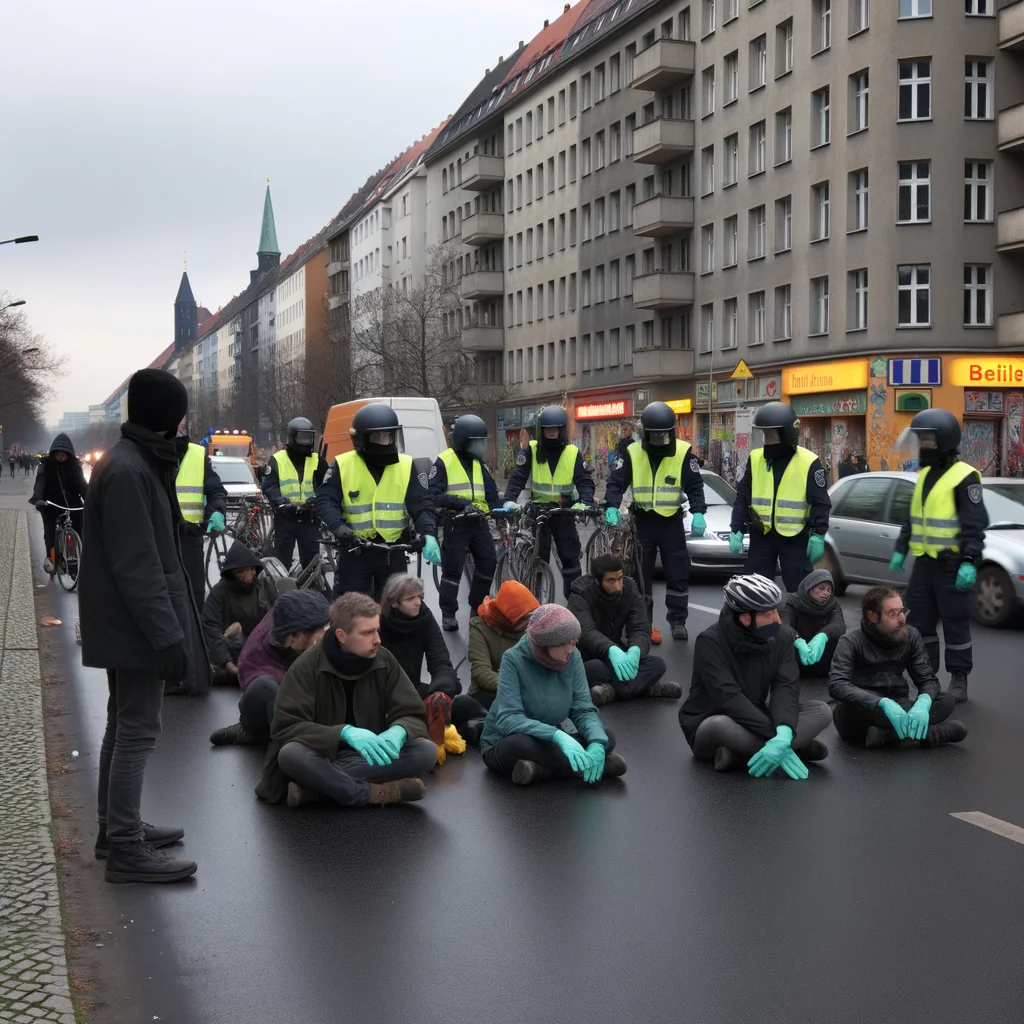
WEDDING — Around 8:40 a.m., a small group of Last Generation activists selected a bicycle lane in Wedding for their latest public demonstration of attachment issues.
They knelt, dabbed, pressed, and committed—literally bonding themselves to the street with the tenderness of someone trying to make a toxic relationship “work this time.” Nearby commuters watched in the universal Berlin stance: hands in pockets, face saying, This is fine, soul saying, I can’t believe I’m awake for this.
“We Need System Change,” Said the People Inventing a Brand-New Adhesive Economy
The activists’ message was familiar: governments must act, emissions must drop, the planet is on fire, and yes, it’s still somehow the responsibility of a random guy in a 2009 hatchback to undergo moral rebirth before his 9 a.m. shift.
Wedding’s long-time residents understood the urgency in their bones—those bones are just busy carrying groceries up stairs in buildings that heat like saunas in July and refrigerate like freezers in January.
One local Turkish bakery owner near the action looked at the blocked street and delivered the most Berlin policy brief ever spoken without a grant:
“Everyone wants to save the planet. Nobody wants to be late to work. Also my delivery is sitting in a van. If the bread dies for your cause, do we count that as sacrifice?”
The Counter-Protest: Honking as Political Theory
Drivers offered stiff resistance—horns, engines, and the unique Wedding technique of slowly inching forward as if shame were something you can outmaneuver with two centimeters of progress.
A startup-looking guy on a cargo bike stopped, not out of solidarity, but because the crowd provided what he truly needed: an audience.
He explained, loudly, that he supported the protest “conceptually,” but opposed the method “logistically,” and wanted a “more scalable intervention.”
This is the first time anyone has tried to monetize despair and still sounded offended by cars.
Across the street, an older resident muttered something like, “I’ve seen faster movement in a Beckett play,” then continued staring as if waiting for meaning to arrive on the next bus.
Police Perform a Careful Extraction, Like Art Handlers Moving a Duchamp
Eventually, police arrived with the ceremonial equipment of modern order: latex gloves, solvent, and a gaze that suggests they’d rather be anywhere else—including hell, provided it has a clear set of steps.
The removal proceeded in awkward stages:
- Someone reading instructions like a reluctant IKEA priest
- A bottle of solvent opened with the gravity of a novelist cracking a tragic final chapter
- Hands separating from asphalt with a wet sound that felt unnecessarily intimate
In a neighborhood where rents are rising like a fever, the idea of public sticking power struck a nerve. Some onlookers praised the sacrifice; others noted that the activists were at least improving street infrastructure by adding a fresh layer of something the city forgot to budget for.
Gentrification Finds a Way to Feel Morally Erect
As soon as traffic started moving again, the real fallout began: the comment-section discussions transplanted into real life.
A newly arrived resident with immaculate sneakers said blocking roads is “violent,” while holding a paper cup of oat milk shipped halfway across Europe so he can feel pure inside.
Meanwhile, a long-time Wedding renter said the protest wasn’t violent enough and asked if anyone could glue themselves to his landlord’s new luxury intercom.
The entire moment played like Walter Benjamin’s aura for the climate age: a performance repeated endlessly, authentic in intention, commodified in impact, and reposted with a caption that says more about the poster than the planet.
Results: One Fewer Trip, One More Argument
By noon, the bicycle lane had been restored to its natural Berlin purpose: a suggestion.
Last Generation left with bruised knees, sore wrists, and that special activist glow that comes from feeling ethically superior while physically trapped.
Drivers left with blood pressure spikes and a renewed faith that climate collapse is real, mostly because they experienced it personally while watching the temperature gauge climb in a stationary car.
And Wedding—sweet, exhausted, overcrowded Wedding—continued its daily routine: being lectured by strangers about the future while struggling to afford the present.
If you need a metaphor for the climate debate, it’s this: everybody agrees the situation is getting hotter, but nobody can decide who should stop and who should keep pressing forward.