Smoking Section for the Future
Wedding’s new climate-forward courtyard is politely banning cigarettes while letting consultants vape through all three sessions.
Gentrification Symptoms & Pretend-Creative Economy Reporter
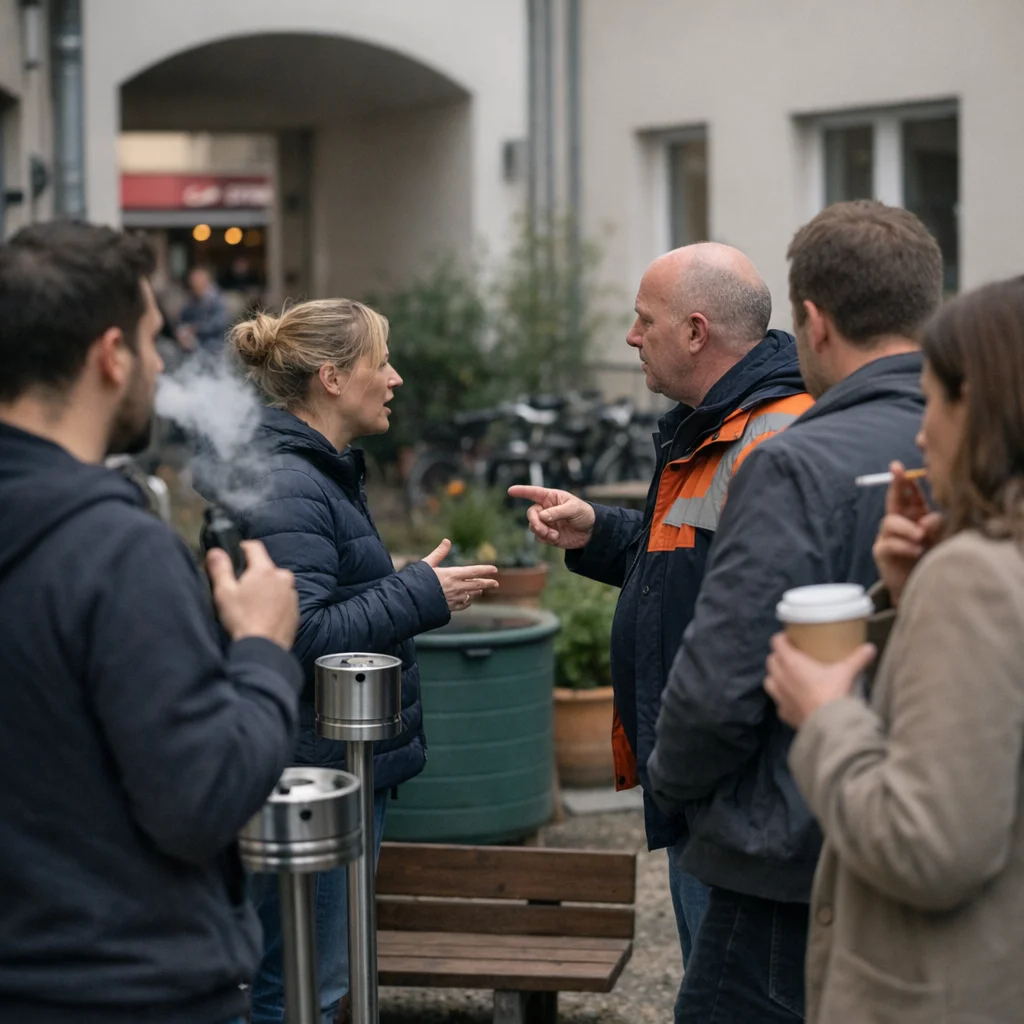
District officials in Wedding spent Tuesday arguing over whether a newly approved “climate courtyard” should include a cigarette corner, a vape allowance, or both, because apparently the city can redesign a street but cannot survive a meeting without nicotine, a laptop, and a little priestly disgust.
The courtyard, tucked behind a community building near Leopoldplatz, was pitched as a model of green transition: bike racks, rainwater barrels, native planting, and one laminated sign telling everyone to respect the air, the earth, and the neighbors who have to hear about both. The whole setup has the morale of a municipal salad: expensive, thin, and mostly there so middle-class guilt can pick at itself in public. By the second committee session, several residents and consultants were already hovering at the entrance like overfed moths in recycled wool, asking where people were supposed to stand when they wanted to poison themselves in peace.
“We are not against health,” said Anja Keller, who chairs the working group and spoke with the exhausted authority of someone trying to keep a room full of status-hungry compost evangelists from dry-humping the agenda. “We are against chaos at the doorway.”
That sentence did not help. A tenant from a nearby block said the proposal had become “a little Althusser with weatherproof seating,” while a consultant from Mitte, requesting anonymity because he had once posted a thread praising public space and now needed to be seen as romantically wounded by it, argued that banning cigarettes entirely was “ableist, classist, and honestly bad for team cohesion.” He said this while smoothing the front of a jacket that looked expensive in the way a bad conscience looks expensive: brushed, padded, and trying very hard not to sweat. Ten minutes later he was outside anyway, vaping so aggressively he fogged his own principles and half the window beside the meeting room.
The real argument was never about air quality. It was about who gets to do purity in Wedding and who gets to be written up by it. The district office wants a compromise: a designated indulgence zone, physically separated from the courtyard, with ashtrays, a bench, and enough polite signage to make everyone feel monitored by God, a project manager, and a grant application. It is the sort of solution that lets people perform virtue without surrendering their little ritual of self-destruction. The green crowd gets to keep its posture. The smokers get their sanctioned corner like naughty schoolchildren with tax returns. And the consultants get to inhale righteousness between gulps of oat milk and nicotine, which is basically the district’s preferred sex life: detached, performative, and always slightly ashamed of itself.
The courtyard also works as a class filter, which is the part nobody wants to print in the brochure. The people who can afford to linger there are the ones who already understand the code: which bench is for talking, which bench is for being seen, which bench is for pretending you are not being seen. Everyone else—long-time tenants, Turkish shop owners, the women running the café near Leopoldplatz, the men with flour on their sleeves from the bakery side of the block—knows perfectly well what this kind of “inclusive” design means. It means the neighborhood will be made legible to people who say “stakeholder” when they mean “someone I can ask to move.”
Local Turkish shop owners, who have watched Wedding’s moral fashion cycles come and go with the patience of people who actually run the place while the district office auditions for conscience, were less impressed. One café owner said the courtyard looked “very clean, very expensive, very likely to become a group therapy session with plants.” Another resident said it reminded him of a Proust novel rewritten by a foundation that discovered compost and immediately started acting like it had invented water. A woman from the block nearby said the whole thing felt like “a wellness retreat for bureaucracy,” which is the most accurate thing anyone in the room said all day.
By evening, the district had agreed to test the smoking zone for three months, with a review in autumn and a promise that the final layout will be “inclusive, low-emission, and socially balanced,” which is bureaucratic language for “everyone is still lying, but now on paper.” The first ashtray is expected next week, beside the bench where the reformers will stand in a tasteful semicircle and pretend the ash is an implementation detail. The next argument will probably be about who gets to hover closest to it without looking like they need a cigarette more than the project needs them.