Speed, Sweat, and Stamps: Wedding’s Wristband Exchange Outperforms the Euro Overnight Rate
Bouncers may control entry, but a new class of freelance liquidity providers now controls memory, status, and who gets to talk loudly on Monday.
Nightlife Microeconomy & Daylight Shame Reporter
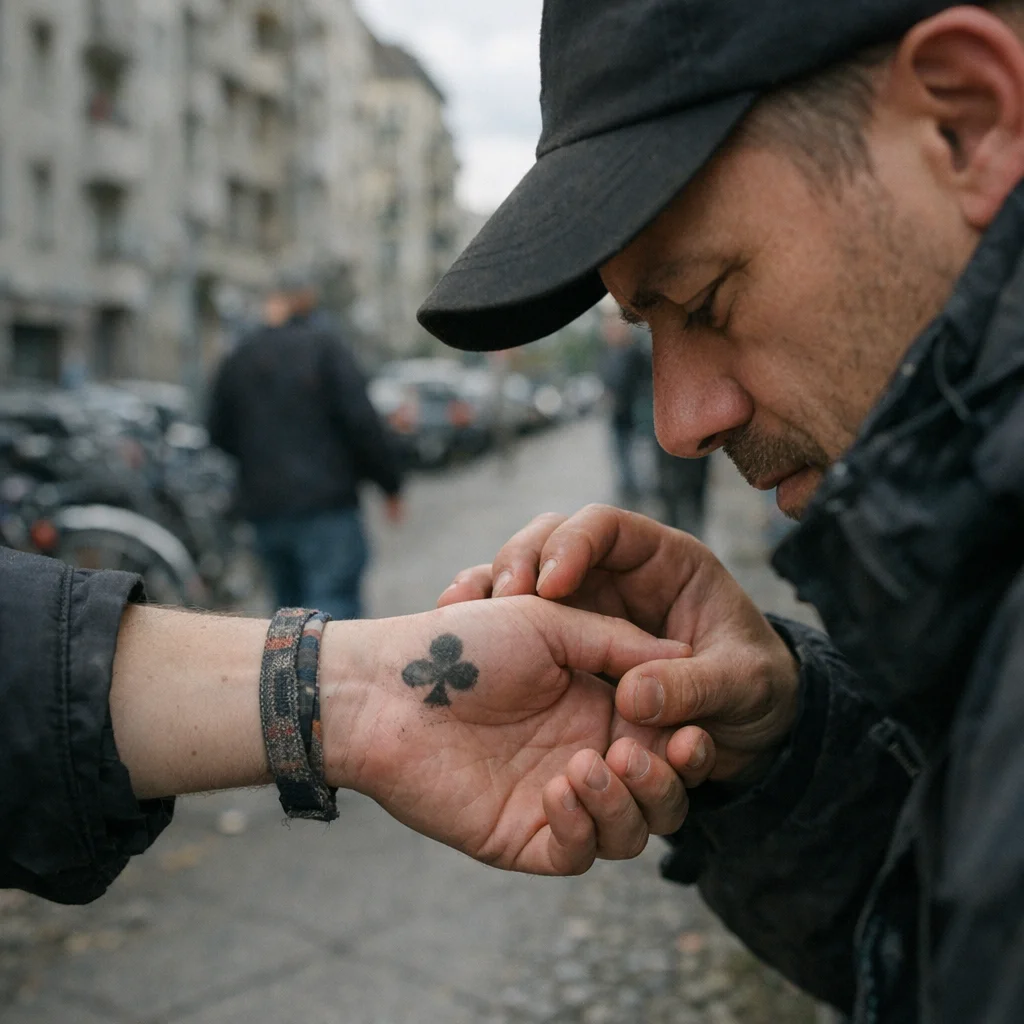
At 9:43 a.m. on a Monday—an hour when respectable cities are answering emails and Berlin is answering for its sins—I watched two grown adults conduct a transaction outside a discounted groceries aisle near Wedding’s north edge.
One of them held their wrist out like a Victorian offering a gloved hand for inspection. The other leaned in, not to kiss it, but to evaluate the stamp the way a sommelier evaluates a glass: suspiciously, theatrically, and with way too much breathing.
“Is that real?” the buyer asked.
The seller’s eyes said: nothing is real, not even your childhood. But his mouth said, “Yeah.”
Welcome to Wedding’s most honest economy: the parallel market of club wristbands and stamps—where ink has a higher reputation than most landlords.
Ink Is the New Passport (and Slightly More Accurate)
Berlin’s club system runs on a beautifully medieval logic:
- A DJ is the court musician.
- The bouncer is the bishop.
- The queue is purgatory.
- And the stamp is absolution—granted not for being good, but for being acceptable in low light.
In Wedding, the stamp has become more than admission. It’s social proof, portable credibility, and a blunt instrument in post-rave debates.
Without it, you’re just another person claiming they “ended up at Tresor” with the same confidence they use to claim they read Ulysses.
The Market: Arbitrage, Authentication, and Finger-Licking Forensics
The underground exchange is, at this point, basically a hedge fund with eyeliner.
Stamps move through Wedding like cash did before apps—and like cash, they come with counterfeits. I’ve seen:
- Carefully recreated stamp smudges, applied with the delicate devotion of a Renaissance restoration.
- Wristbands “found” in the exact same way people in startup pitch decks “found a solution.”
- Two friends strategically stacking entry on one paying wrist, then “redistributing access” like tiny Marxist kings.
And because Berlin can’t do anything without turning it into a pseudo-academic religion, there are now stamp “experts.”
These people sniff wrists.
Not erotically—though don’t rule out professional crossover. More like deranged art historians analyzing a dubious Duchamp: if it looks too clean, it’s fake; if it looks too destroyed, it’s “authentic.”
In the smoking area of civilization, you will hear sentences like:
- “This one has the right blur on the edge.”
- “The ink saturation is inconsistent with last weekend’s batch.”
- “My friend got the newer stamp—the bouncer’s handwriting has changed.”
Wittgenstein said the limits of my language are the limits of my world. In Wedding, the limits of your stamp are the limits of your stories.
Newcomers Bring Wallets; Longtime Locals Bring Practicality
The gentrification collision is most visible in who tries to monetize this.
Longtime residents—Turkish shop owners, families who watched three waves of Berlin rebrand itself—generally treat wristband trading with the healthy contempt reserved for trend diets.
“What is this?” one older Turkish man asked me, squinting at a wrist as if the stamp might start reciting poetry. “In my day you paid, you went in, you went out. Now people want to go in, go out, go in, go out—like a broken washing machine.”
Meanwhile the newcomers—creative directors, app designers, consultants performing poverty cosplay—treat a good stamp like a venture capital term sheet: hard to get, easy to brag about, and definitely worth irritating your friends over.
I met a coworking regular who described a crisp wristband as “real liquidity.”
That’s one way to say you can’t maintain a stable relationship.
The Wrist as Asset Class
In Wedding, wrist real estate is scarce, which is why people manage it like a portfolio.
Some practical strategies currently circulating:
- Protective sleeving: keeping the wristband safe under a jacket cuff, like a secret second phone.
- Selective hydration: avoiding handwashing because water is the enemy of value.
- Tactical intimacy: leaning in close to show someone your stamp—an almost tender gesture that says, “I trust you with this fragile proof that I was somewhere loud.”
There are love stories built on less.
Status Symbols That Leave You When the Shower Hits
Berlin used to mock mainstream luxury: watches, cars, tasteful stability.
Wedding innovated.
Here, status is:
- semi-permanent,
- slightly itchy,
- and gone after one decent rinse.
It’s consumerism for people who swear they hate consumerism. The stamp is both an admission ticket and a small circular reminder that you paid money to feel anonymous.
And like all great art, it only really exists because other people agree to pretend it does.
Which makes it perfect for Berlin—where everyone is participating in an invisible economy while loudly claiming they’re above it.
So yes, there’s a parallel market thriving in Wedding, stamped into skin and shame.
And like all currencies, it comes down to trust.
Trust the ink.
Trust the bouncer.
Trust your friend who swears they “know a guy,” which is Berlin’s oldest form of infrastructure—and also, if you listen closely, a pretty solid double entendre.