Supermarket Self-Checkout Demands an Apology
A chain in Wedding has discovered that theft prevention works better when the machine shames everyone equally and the staff can pretend they are not understaffed.
Administrative Grief Correspondent
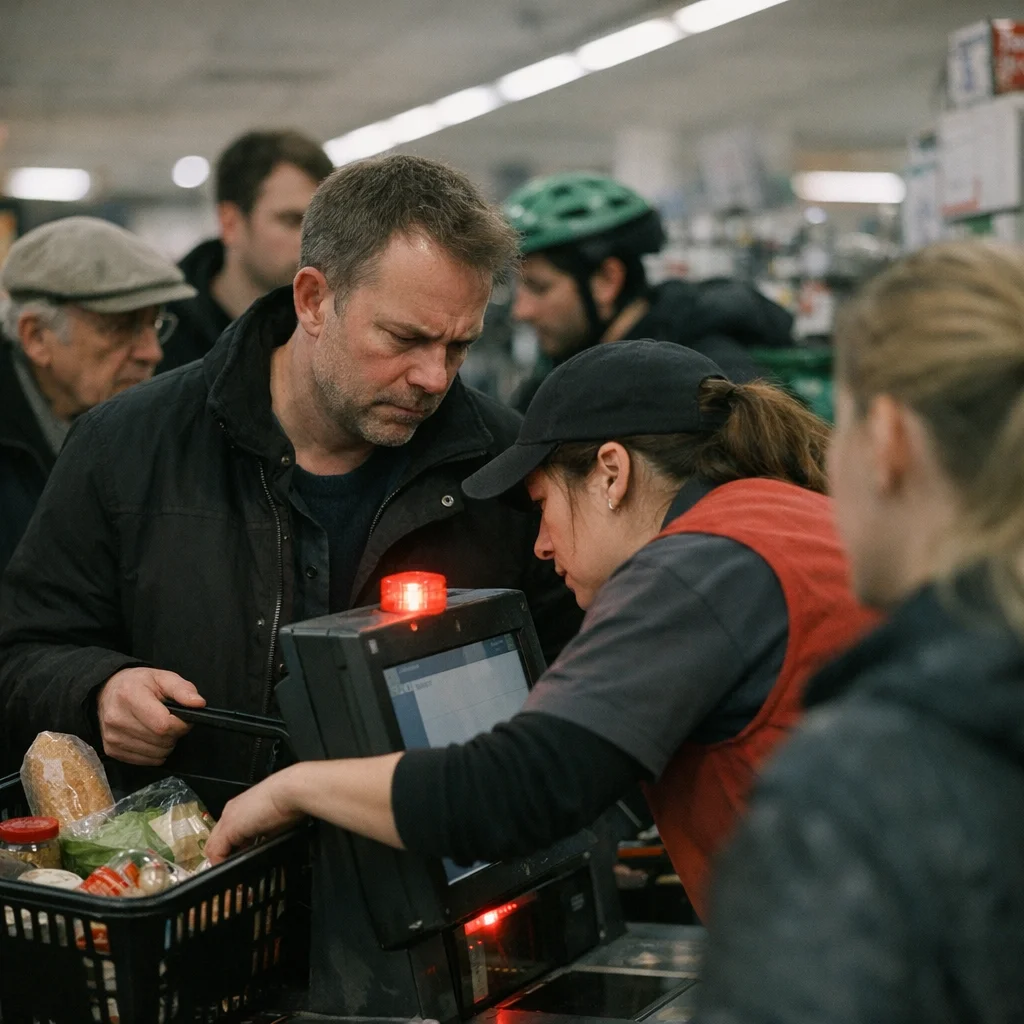
“Please Wait for Humiliation”
At a supermarket in Wedding, the self-checkout lanes have the emotional range of a petty border guard and the manners of a landlord with a taste for punishment. They were installed, we are told, to speed things up. In practice they slow everyone down, then make the slowdown feel like a character flaw.
This is the local ritual after work: a Turkish grandmother buying parsley and yogurt, a courier in a reflective vest grabbing instant noodles, a nurse with swollen feet, a group of students splitting a bag of discount rolls, all of them standing under fluorescent light while a touchscreen accuses them of fraud with the calm confidence of a state prosecutor on a caffeine drip. Wedding is not a neighborhood that needs another lecture. It already knows what shortage feels like. It lives with it, buses it home, and shops for it at 19:47.
The chain’s management calls the setup “friction reduction,” which is corporate language for making the customer act as unpaid cashier, unpaid detective, and unpaid emotional support worker for a machine that behaves like it has read the employee handbook and chosen cruelty. Somewhere in a glass office, a manager with a safe haircut and a soft-padded conscience probably pats a dashboard and admires a fake KPI like “Autonomous Checkout Adoption Rate: 94%.” Translation: 94% of the public did the job, and 6% were left to marinate in shame until a single underpaid staffer could be dragged over to rescue the transaction and absorb the blame.
“It’s elegant,” one imaginary retail executive might say, from behind a recycled-wood desk and a mouthful of strategy jargon. “We’ve decentralized responsibility.” That is the kind of sentence people only produce when they are trying to sound innovative while outsourcing every consequence to exhausted bodies. Decentralized responsibility is what cowardice calls itself after the quarterly call.
One cashier in Wedding said the company treats every malfunction like a moral training opportunity. “If it freezes, it’s your scanning technique. If it falsely flags an item, it’s user behavior. If the line backs up to the bread aisle, that’s a ‘learning moment,’” she said. “They’ve managed to invent a machine that shames customers and still somehow makes workers feel like they’re the problem for standing nearby.”
The real trick is that the machine never looks embarrassed. Humans do all the sweating. The shopper lifts the tomatoes, lowers the tomatoes, rescans the tomatoes, apologizes to the tomatoes, and begins to resemble someone trying to seduce a vending machine that has already decided to withhold affection. The employee hovers in the middle of this little civic humiliation, pretending not to notice that the whole arrangement is just management outsourcing its cowardice to a blinking screen.
The neighborhood makes the theater uglier because it is so ordinary. Wedding is full of people who are already negotiating time, rent, language, fatigue, and the daily arithmetic of “can I afford this, can I carry this, can I survive the queue without losing my mind.” The self-checkout lane adds one more demand: perform gratitude while being treated like a suspect. Speak clearly. Move quickly. Do not confuse the machine. Do not be visibly poor, tired, foreign, angry, or alive in any way that might require extra seconds.
A district spokesman said the borough has no authority over private retail systems, though it encouraged residents to “remain calm and seek assistance where available,” which is the public-sector equivalent of handing someone an umbrella during a flood and calling it governance. The company said it was “monitoring user experience” and “optimizing throughput,” a phrase that sounds less like retail than a plan to launder obedience through software.
The chain’s leadership, naturally, insists the system improves service. That is the favorite lie of managerial classes everywhere: first they cut staff, then they call the resulting panic efficiency, then they ask the public to be patient while the machine learns to be less insulting than the people who installed it. They want customers to do the labor, workers to absorb the rage, and headquarters to keep its hands clean enough to type another memo about “digital transformation.”
By evening, the Wedding branch was still operating, which is to say it was still disciplining bodies in public. A technician was expected the next morning. The machine, meanwhile, remained fully committed to its purpose: not to help people buy food, but to remind them that in modern retail, submission is the real product and everyone gets a sample.