Tax Office Rebrands Bribes as ‘Service Fees’
A new wave of paperwork in Wedding is teaching small business owners that corruption only becomes respectable once it has a receipt, a hotline, and a cheerful logo.
Administrative Grief Correspondent
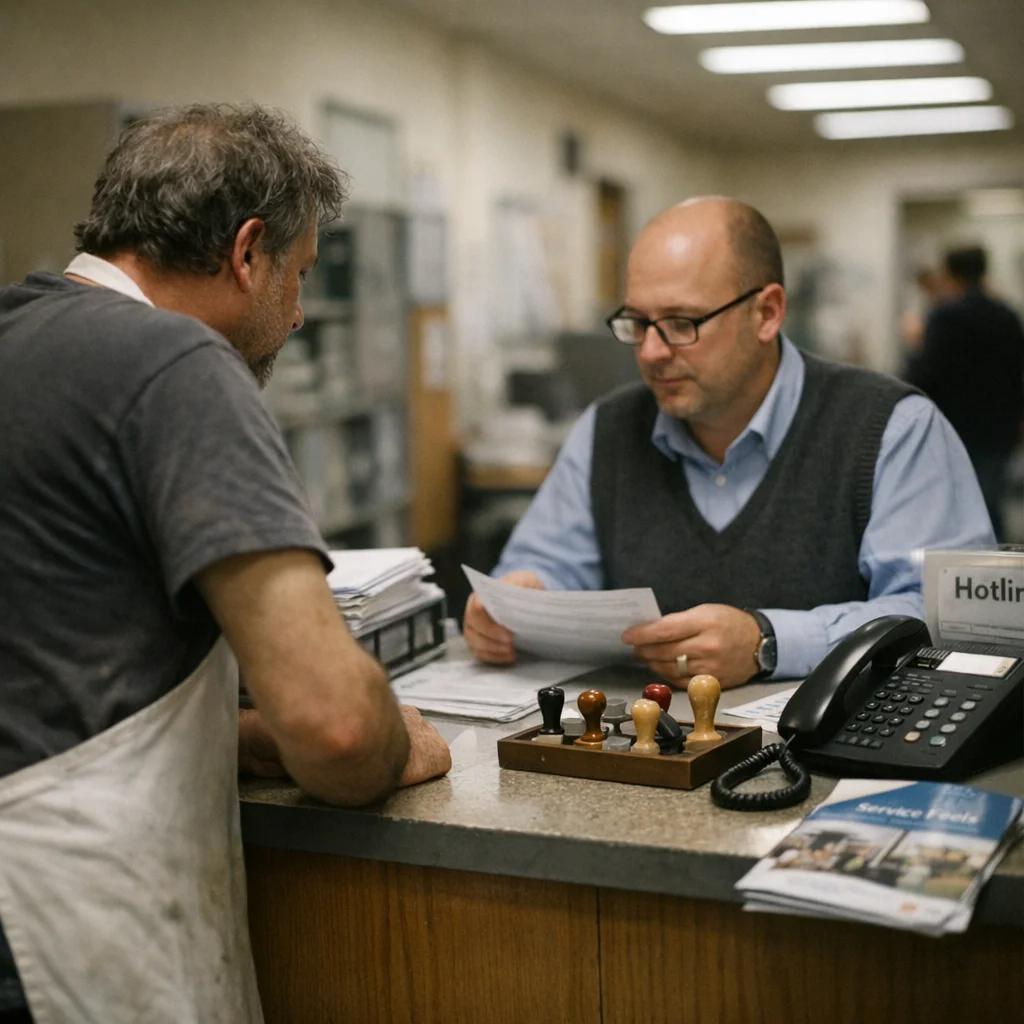
At Leopoldplatz, Bribes Get a Foam Logo
At the Wedding tax office, the old arrangement has been upgraded for a more hygienic era. The cash still moves. The same little palms still open, the same little files still stall, the same little threats still hover over cafés, bakeries, kiosks, and repair shops around Leopoldplatz like damp breath on a neck. The only innovation is linguistic: extortion now arrives with a logo, a hotline, and a laminated grin.
This month, district finance officials rolled out a “service fee” program for small businesses that need faster processing, fewer delays, or the basic mercy of not being buried under paperwork until spring. The pitch is delivered in the dead-eyed, maternal tone of administrative predation. Fill out Form B-19, tick the box for “voluntary support,” and suddenly your file is moved from the pile that smells like mildew to the pile that smells like expensive cologne.
“The measure increases efficiency and transparency,” said Anja Voss, a spokesperson for the district finance administration, with the brittle smile of someone explaining a bruise as a wellness product. “Businesses may choose optional administrative services that support correct filing and reduce delays.” It is an elegant sentence in the way a velvet glove is elegant when you already know what is inside it.
Owners in the neighborhood describe the real mechanics more plainly. A café on Müllerstraße said the first sign of trouble was not a demand, but a delay: one missing stamp, then another “clarification,” then a cheerful email from a consultant with the kind of LinkedIn teeth that make you distrust dentistry. “He said, ‘We can help the file find its natural destination,’” the owner said. “That was the moment I understood I was being seduced by a spreadsheet.”
A bakery owner near Leopoldplatz said the paperwork itself now performs the extortion so openly it almost deserves a union card. “There is a line on the form that says: ‘Optional administrative accompaniment for accelerated review.’ That is the whole trick,” he said. “You do not pay for a result. You pay for the clerk to stop touching your application with suspicion.” He laughed once, without joy. “It is prostitution in a cardigan.”
The hotline, according to several business owners, is its own little chamber of civic humiliation. Call it and you are greeted by a recorded voice that sounds as if it has been trained on compliance manuals and sleep deprivation. Press 1 for filing issues. Press 2 for billing. Press 3 if you would like to be monetized in the district’s preferred style. Several callers said they were transferred between departments until they understood the moral architecture: no one is responsible, everyone is available.
The preferred beneficiaries are easy enough to spot. District officials gain the pleasure of looking modern while doing the same dirty little work as always. Chamber-of-commerce types get to call the arrangement “predictable,” which is what the well-fed say when they have found a way to bottle corruption and sell it as governance. Compliance consultants, those smiling undertakers of public life, have already begun offering “administrative optimization packages” with same-week onboarding, discreet invoicing, and the deeply intimate promise of being left alone.
The result is not reform but a neighborhood economy with its belt loosened and its trousers down at the ankles: one part office politics, one part rent-seeking, one part bureaucratic foreplay. Everyone involved insists the system is cleaner because the money has been moved into a nicer sentence. This is the modern civic fantasy in Wedding—nothing rotten, just better branding; nothing stolen, just processed; nothing coerced, just “supported.”
Left-wing critics denounce the arrangement in the usual exhausted way, as if naming the obvious were still a weapon. Right-wing moralists, who spend their days snarling about principle and their nights bargaining for exemptions, are less bothered than they pretend. They know the smell of a fee structure. They simply prefer the fee to arrive with a flag, a stamp, and a man in a pressed shirt pretending not to need the cash.
By the time the receipt prints, the whole thing has already told the truth. In Wedding, the district no longer even bothers to hide the deal: pay for peace, pay for speed, pay for the clerk to stop fingering your file, and call it transparency while the chamber of commerce pats itself on the back with both hands. The neighborhood’s civic life has become a polite little extortion parlor with fluorescent lighting, and everybody who matters is far too well fed to be embarrassed.