Taxi Queue Reads Like a Confession Booth in Wedding
The city’s cab stand is supposed to move people, but the real service is social grading. Drivers punish the polite, reward the needy, and treat every fare like a test of who can beg with the most dignity.
Civic Hypocrisy & Neighborhood Compliance Reporter
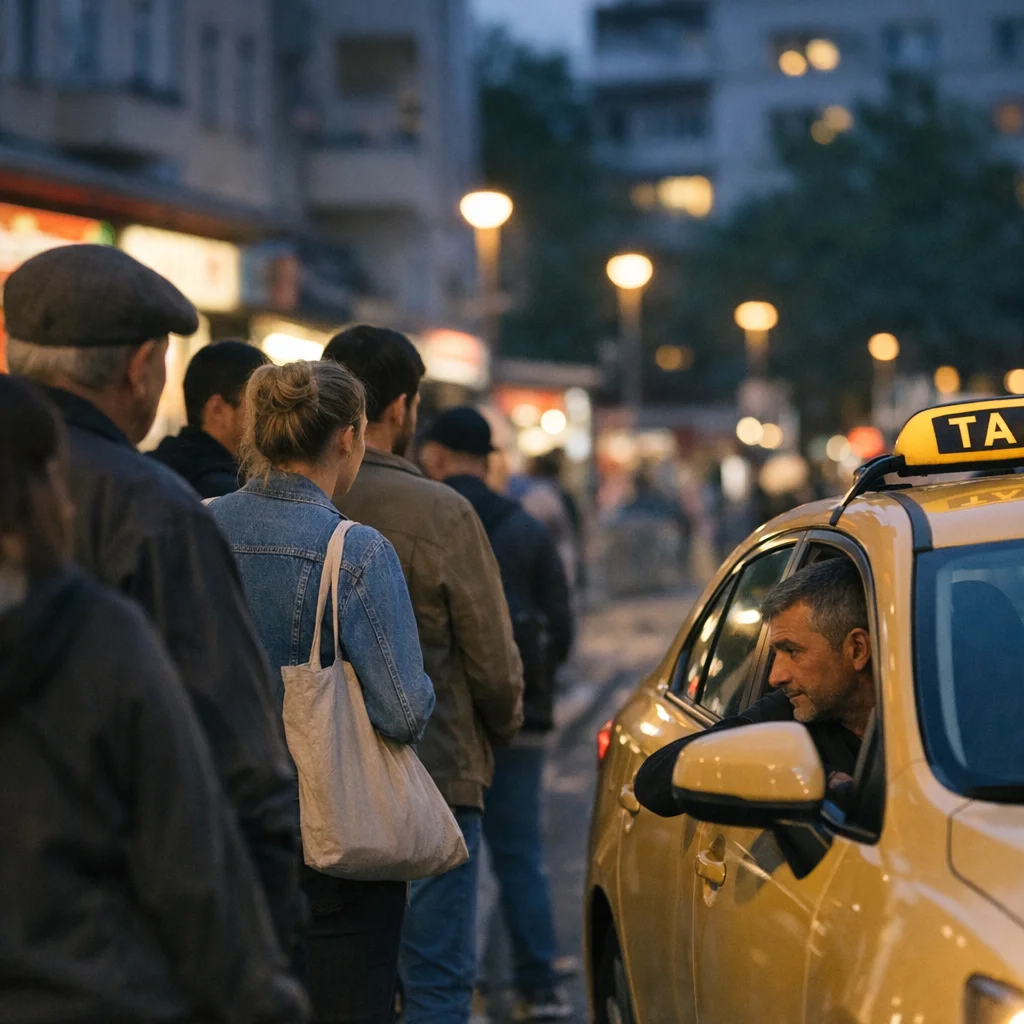
Taxi drivers in Wedding say the stand near Leopoldplatz runs on the oldest municipal fantasy in the city: that everyone waiting for a ride is waiting for permission. The queue does not move on distance or fairness. It moves on submission. Whoever can look most acceptably needy gets chosen first, as if the curb were a private club and the back seat were a velvet rope with better upholstery.
What the cab line sells, officially, is mobility. What it delivers is a public rehearsal of access. People step up to the curb trying to pitch the right body language: the office worker with a tote bag pressed to the hip like an apology, the Turkish grandmother balancing groceries and a look that says she has survived worse tribunals than this, the startup couple in clean sneakers pretending their carry-ons are casual while their faces say they have already been rejected by rent, love, and possibly a therapist. Everyone says they are only going a few stops. Everyone is auditioning for the privilege of being let in.
The drivers, naturally, have embraced the role of gatekeepers with the enthusiasm of minor officials who discovered a uniform made of resentment. They do not merely pick passengers; they vet them. A polite request can sound like weakness. Too much cheer sounds like manipulation. Too much confidence sounds like entitlement. The rider who leans in with the right mixture of exhaustion and shame gets the door. The one who stands upright and asks cleanly, as if entitled to basic transport in a city that charges by the nerve, is left outside like a bad proposition.
“People think it is about order,” said Mehmet Karaca, who has worked the stand for 14 years and requested that his surname be withheld because he still has to see these people around the neighborhood. “It is not order. It is chemistry. Some people walk up and you can see they know how to be chosen. Others stand there acting like they are above it, which is exactly why nobody opens the door.”
That chemistry has given the stand its own sexualized etiquette, though nobody says it out loud unless they are laughing too hard or too bitterly. The line rewards the passenger who can perform vulnerability without seeming available, desperation without seeming eager, need without appearing hungry. The drivers, meanwhile, behave like men who believe they are handing out intimacy when they are really just selling a ride. They size people up the way exhausted men in bars size up a room: not for beauty, exactly, but for how much effort the evening will require before anyone gets what they came for.
The newcomers who arrived in Wedding to experience “authenticity” are the most obvious casualties. They dress the part of urban innocence, then stand at Leopoldplatz trying to signal they are low-maintenance, emotionally mature, and not at all impressed by the neighborhood, which is precisely the kind of performance that makes them look expensive and unconvincing. They speak in soft English and apologetic German, as if humility can be bought in a café and carried to the curb in a reusable cup. Meanwhile longtime residents know the actual code: do not overexplain, do not flirt with the driver’s patience, and do not confuse being decent with being selected.
By dusk, the district office had done what it always does when confronted with a public ritual of rank and embarrassment: it translated humiliation into administration. A spokesperson said there was “no formal queue management issue” and noted that private operators set their own pickup practices. Which is a beautiful way of saying the city is happy to let a handful of men in the front seat decide who gets access, provided everyone else remains polite about it.
Back at the stand, the cars kept arriving and leaving in the same rhythm, each one opening and closing like a judgment. The line thinned, then thickened again. The hopeful got quieter. The furious got theatrical. The practiced ones kept their faces blank and their shoulders loose, like people who had learned that the only way to get into the car was to make the driver feel in control while never looking like they were begging for the back seat.