The Bürgeramt Van That Says ‘We Come to You’ — But Actually Grades Your Paper by the Fold
City promises instant, dignified service; at the curb a three‑centimetre crease and a neat corner tell staff who will be processed now and who gets a polite referral.
By Lena Veneer
Gentrification & Cultural Displacement Correspondent
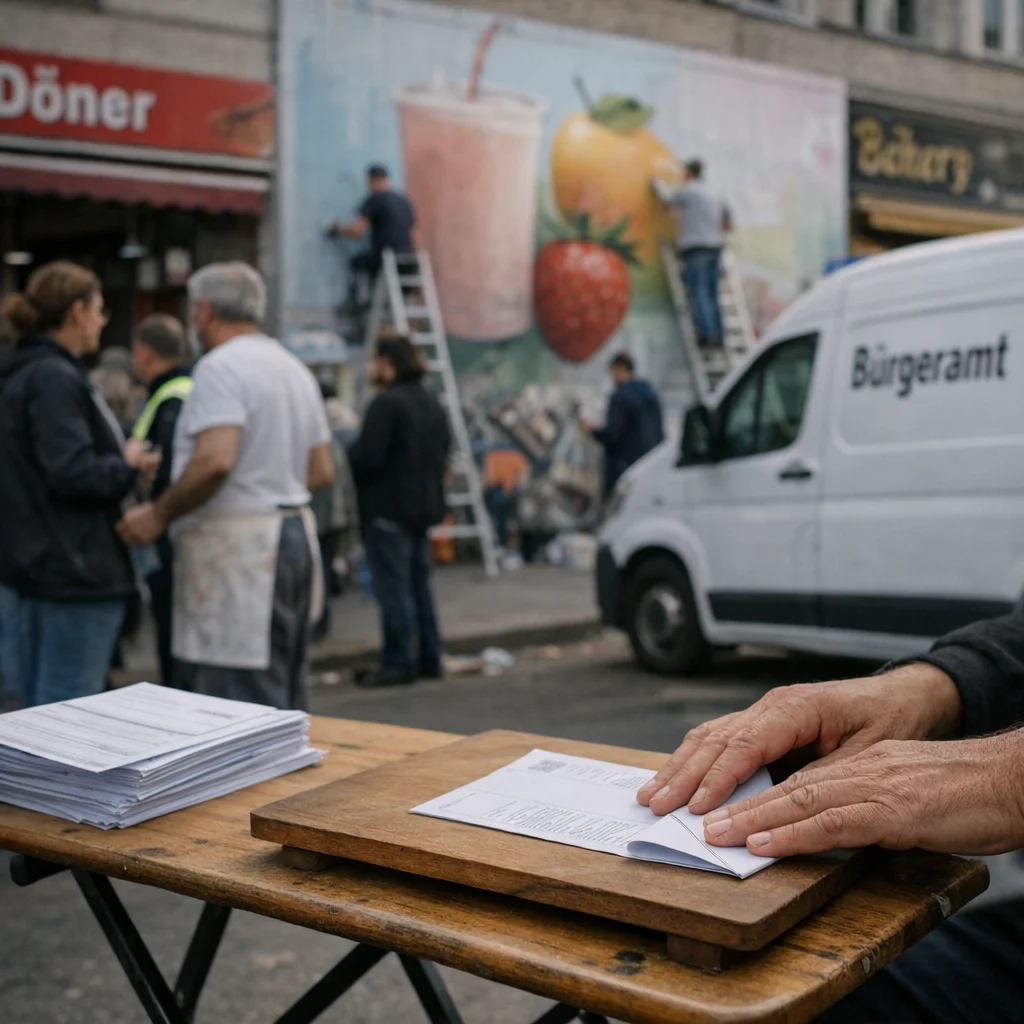
Who/what/where: A Bürgeramt van parked outside a Turkish bakery on Müllerstraße in Wedding has become an unlikely props department for a very modern makeover: while officials pitched the vehicle as fast, dignified paperwork at the curb, crews from a commercial mural firm used the van’s half-block visits as cover to paint corporate murals over the neighbourhood’s surviving graffiti.
What happened: The van arrived mid-morning last week with two staffers, three folding chairs and a wooden press board about the size of a school ruler. As residents lined up for ID renewals, the staff demonstrated a quiet ritual: a textbook, two‑step fold that produced a precise three‑centimetre crease and a clean corner. “If you fold like that, we process you now,” one staffer told people, tapping the board. “If you don’t, we give you a polite referral.”
Why it matters: The tiny preference for a neat fold turned out to be a gate. Contractors and a glossy agency truck showed up as the van set up. Within hours, a multicolored ad for a smoothie chain—marketed as a community mural—had replaced a decade-old piece by local artist Mira Öz. “They call it placemaking,” Öz said. “What they mean is replacing our history with a corporate postcard while everyone is queuing to get their papers stamped.”
Officials’ line: Florian Krauss, a spokesperson for the Bezirksamt, insisted the folding check is simple triage. “We introduced the press board to speed up verification and avoid lost forms,” he said. “There is no relationship between mobile services and any third‑party artwork projects.”
On the ground, the choreography looked less accidental. Vendors with clipboards and media students in safety vests loitered near the van’s flank as muralists rolled scaffolding into alleys. Local bakery owner Hasan Yildiz watched a painting crew mask over a small memorial tag and muttered, “They come to us with civility and then paint over our faces with a logo.”
The flip: The city sold the van as an extension of civic dignity; the kerbside ritual revealed a sorting mechanism that privileges those coached in bureaucracy—who can fold a paper like an exam sheet—and leaves those without social capital slow to object while a new, corporate layer is lubricated into place. Guy Debord would have called it the spectacle’s polite handshake.
Next step: Residents have lodged an emergency appeal and plan a demonstration outside the next mobile service visit. The Bezirksamt says it will review mobile procedures; mural permits already on the calendar are scheduled to be painted next week, putting Wedding’s next chapter on a very tight timeline.