The Burek Queue Has Better Politics Than You
A Wedding bakery’s morning line has become a referendum on who gets served, who performs “local” correctly, and who thinks flaky dough proves cultural integration.
Neighborhood Commerce & Low-Grade Dread Reporter
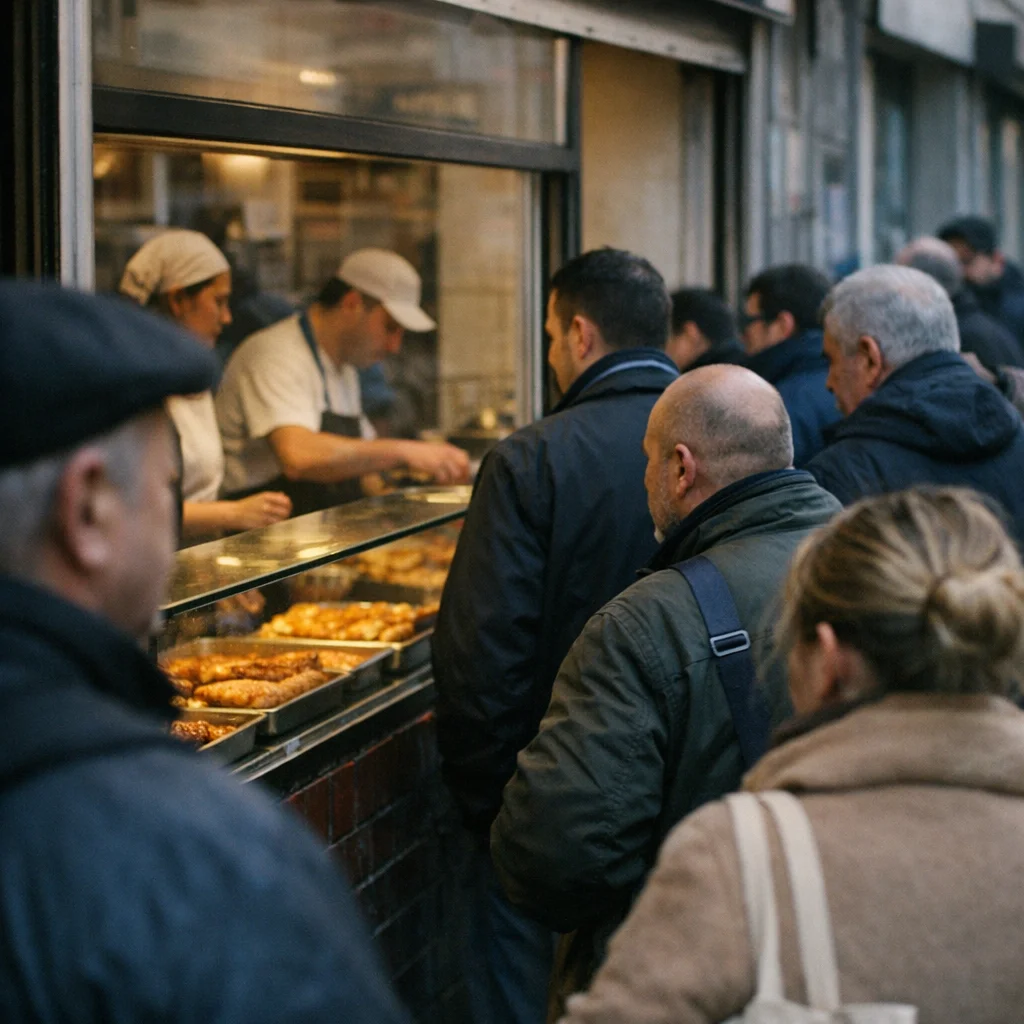
The line outside a beloved Turkish bakery in Wedding has stopped being a queue and started acting like a civic rash. By late morning, office workers with dangling badges, old men with folded hands, and expats carrying tote bags stand shoulder to shoulder, each one pretending the pastry behind the glass is a reward for superior character rather than a carb with a pulse.
It begins, as these little European humiliations usually do, with one person asking where the line starts and another answering with the zeal of a temporary prison warden. Then comes the real entertainment: adults performing restraint while silently elbowing for moral priority. Some arrive with the greasy certainty that a burek should validate their whole personality. Others speak careful English to the staff, then switch into performative German only when they want to sound rooted, as if a few clipped consonants can purchase localness by the gram.
Inside, the staff wears the expression of people who have had civilization barked at them all morning and are no longer impressed by its costume jewelry. “Every day they come in hungry for the food and hungry for the applause,” said Arif Yilmaz, who has worked the counter for 14 years and asked not to be named because he has already been punished, in the modern way, for telling one customer to wait their turn. “They want authenticity, but they also want to behave like the line is a concierge desk for their feelings.”
The old men arrive with the calm authority of people who know exactly how long a queue should be and exactly how much nonsense it can absorb before it rots. The office crowd follows, carrying the scent of meetings, badge lanyards, and subsidized virtue. They are hungry in the corporate sense: not for food, but for evidence they are the sort of people who discover a neighborhood by accident and then immediately begin grading it. After them comes the expat layer, that soft administrative frosting of tote bags, careful apologies, and rent-stabilized guilt. They order like they are trying to be admitted to a club whose bouncer is a baker with flour on his forearms.
Wedding, of course, supplies the perfect stage for this little farce. Gentrification here does not arrive in jackboots; it arrives in oat milk, neighborhood newsletters, and the smug little tremor of people who think eating in the right bakery absolves them of being exactly what they are. The same crowd that praises “community” with one hand will with the other act personally offended if they have to stand behind someone who actually lives there. They want the city to remain multicultural, affordable, and charmingly rough—so long as the roughness is decorative and nobody makes them sweat.
The bakery’s owner said the problem is not the pastry. It is the audition. People argue over whose turn it is, then use the argument to prove they are ethically superior customers, the sort who deserve a warm seat in the city and possibly a medal for not collapsing from self-regard. Others mutter about “supporting local businesses” while hovering over the last spinach slice like a banker pretending to be working-class for a long weekend. The dough may be layered, but so is the fraud.
District officials offered no immediate plan, though one staffer said they were monitoring “public order around small commercial spaces,” which is bureaucratic language for admitting they would rather staple their own ties to the wall than tell a line of lunch-seeking adults to stop behaving like entitled infants. In Wedding, this is what governance looks like: the state watching a bakery turn into a class theater and calling it ambience.
For now, the queue keeps thickening each morning, fed by office calendars, neighborhood vanity, and the ancient human urge to look humble while acting like a parasite with a reusable bag. The bakery sells out quickly. The line gets longer. The staff keeps serving. And everyone standing there gets to enjoy the same exquisite truth: they did not come for bread, they came to be seen wanting it.