The Chamber’s New Bedfellows, Minus CDU
Thirty-five new lawmakers are walking into the state parliament, and the post-election room is already arranging its loyalties like a bad threesome nobody fully consented to but everybody plans to exploit.
Moral Contradictions & Night-After Reporting
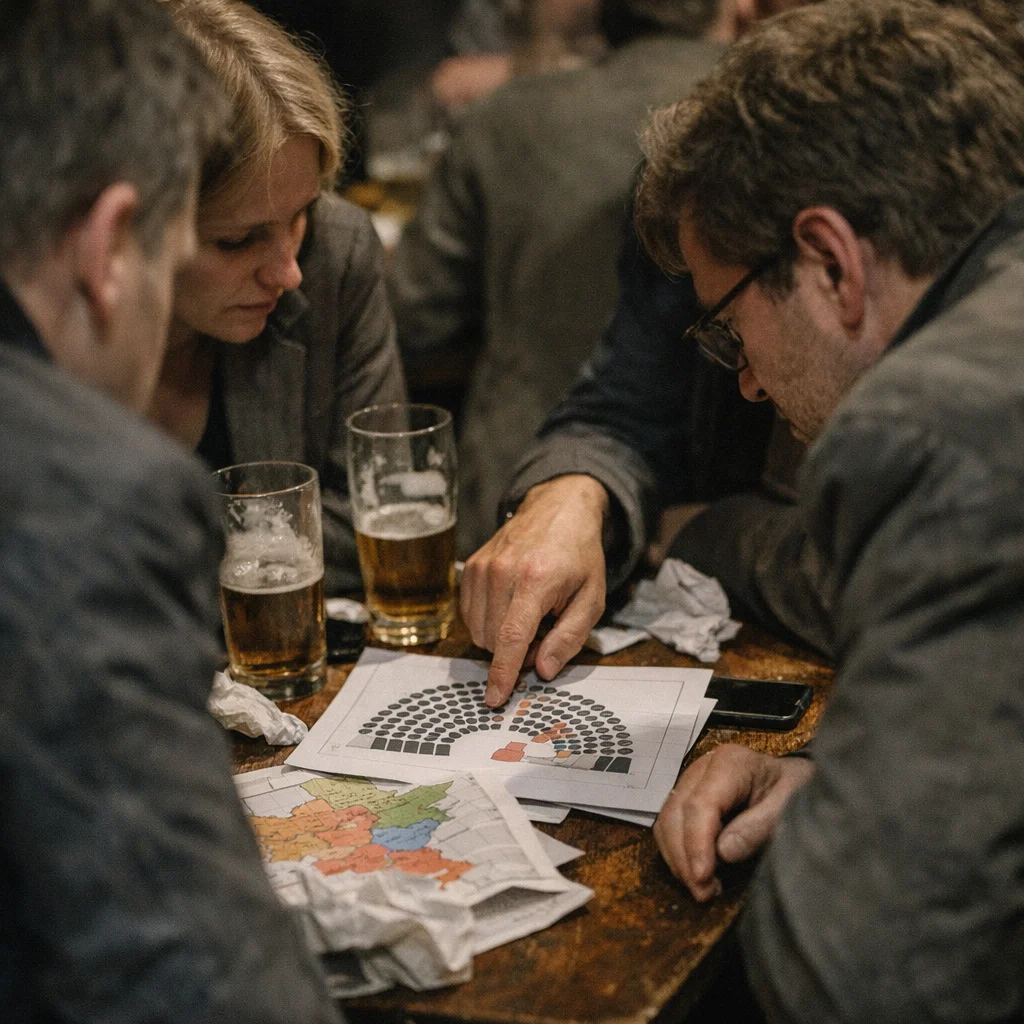
The CDU is out, and everyone wants the same seat
In Schwerin, 35 new lawmakers are moving into the state parliament after the election, with no CDU bench left to block the view and the AfD stronger than ever. Berlin heard the numbers and immediately started acting like the room had changed, the lighting had gone low, and someone had already taken possession of the bedspread.
At a watch party near Leopoldplatz, where the campaign volunteers had replaced beer mats with recycled coasters and the usual civic optimism with something closer to a bruise, one strategist called the result “a reset.” It was the kind of word people use when they want to sound clean while reaching for the same old leverage. Reset, in parliamentary language, means the sheet gets tugged, the pillows move, and everybody pretends they were never trying to get on top of anyone else.
The new balance has made especially nervous the class of operators who spent years denouncing compromise in public and trading it in private by the hour. One Green district organizer, requesting anonymity because his inbox still contained screenshots from a brief 2022 flirtation with a splinter list, said the mood felt “like being handed a shared mattress and told the only moral question is who gets the side nearest the door.” He said it with the exhausted sincerity of a man who has spent too much time in rooms where procedural purity lasts exactly until committee chairs are mentioned.
That is the real administration of desire here: not ideology, but access. The first thing people are negotiating is who sits where, who speaks first, who gets into which committee, and who can claim they merely happened to be present when the actual decisions were made. The seating plan has already become a moral costume. The quieter the faction, the more aggressively it reaches for the headboard.
With the CDU gone, there is no respectable old husband left to blame for the stains. That vacuum is doing more for the imagination of the remaining parties than any campaign slogan. The AfD’s strength has turned every other bloc into a nervous improviser, the kind of person who insists on boundaries while circling the room for the best exit and the softest landing. Nobody wants to admit they are negotiating from underneath, so they call it stability and hope the ceiling does not notice.
At a Friedrichshain bar later that night, one SPD aide described the new parliament as “an open relationship with a committee system.” He then spent twelve minutes explaining who would never be trusted, who might be tolerated, and which red lines were really just temporary furniture. It was the familiar performance: indignation in public, availability in private, and a hand already in the pocket of the next procedural advantage.
The Left, meanwhile, performed its usual ritual of looking appalled that anyone would confuse principle with posture, even as its local operators began asking the only question that matters when the microphones go dead: how much influence can be extracted without appearing to ask for it? The answer, in practice, is usually the same as in every other room where power is distributed like a favor and defended like a lover with a better alibi.
A parliamentary staffer in Schwerin said the first practical problem was not policy but the choreography of access: seating, committee placement, speaking order, and who gets to stand closest to the microphone while pretending distance is a virtue. “Everyone says they are shocked,” she said, “but half of them already wrote asking where the long-term arrangement is headed.” She made it sound less like a legislature than a hostel with shared sheets and a sign-up list for dignity.
By the time the chamber opens, the 35 newcomers will find a room full of veterans acting offended that anyone noticed how familiar their hands are. Some will cling to whatever coalition offer keeps them warm. Some will ghost the moment it gets complicated. Some will loudly announce they have never wanted anything but reform while quietly arranging the blanket so their side stays covered and somebody else ends up at the edge.
That is the whole arrangement now: no one wants to be seen as the one leaning in first, but everyone is already measuring the mattress. The chamber is full, the lights are on, and the only thing more certain than the coming alliances is who will swear afterward that they never intended to get into bed at all.