The Chem-Safe Door Has Become Techno’s Favorite Lie, and Everyone Is Paying to Believe It
A new crop of Wedding promoters has discovered that nothing says underground authenticity like a QR code, a liability waiver, and a heavily branded promise that the party is “care-aware.”.
Nightlife Identity & Self-Deception Correspondent
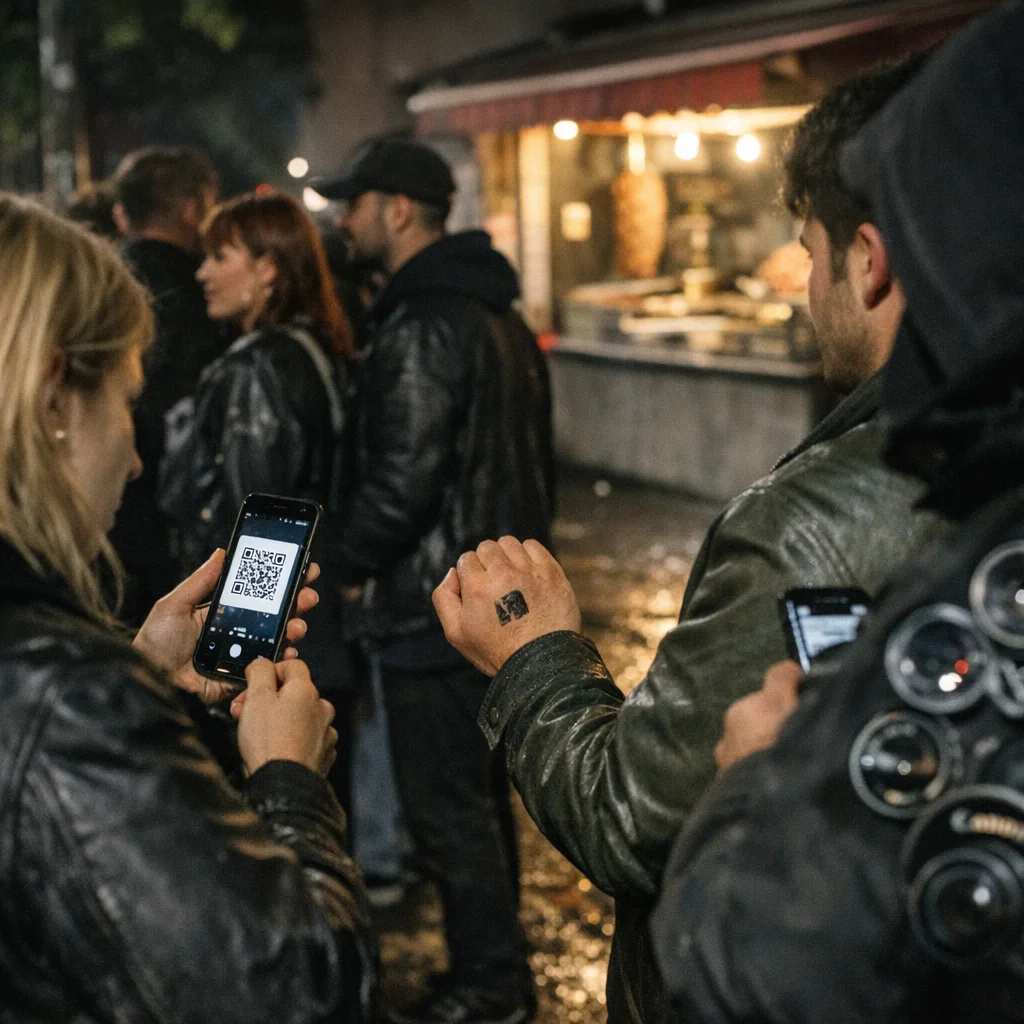
The latest cash machine of Berlin’s hedonism is not a club, a warehouse, or one of those “secret” courtyard events that has already been geotagged into irrelevance by six-foot-two men in silver nail polish and ruinous self-regard. It is the Chem-Safe Door: a black-clad little altar to civic obedience, sold across Wedding by promoters who market risk the way landlords market “character” and startups market “impact.” Same scam, different fonts.
The formula is simple. First comes the QR code. Then the waiver. Then the word “care-aware,” which in practice means someone has digitized liability, sprinkled it with progressive incense, and called the whole thing ethics. You are not buying entry; you are buying absolution with a wristband. By midnight, the stamp on your hand costs less than the humiliation of admitting you paid extra to stand near people performing danger with the concentration of accountants at a fetish clinic.
On Seestraße, a Turkish snack bar kept glowing like the only honest institution in the neighborhood while a queue of tourists, strategy consultants, art-school survivors, and mid-tier agency employees in mesh tops drifted toward a pop-up entrance tucked between a shuttered Späti and a building still wearing its old Wedding grime like a badge of unresolved class war. They all had the same expression: the glazed, devotional look of people trying to purchase transgression while remaining perfectly palatable to HR.
One promoter, Elias Voss, agreed to speak only off the record, because nothing says underground like being scared of your own résumé. He described the event as “a framework,” which is the kind of sentence that should be followed by a tax audit or a wet slap. In practice, the framework is a moral laundering machine. It lets affluent thrill-seekers cosplay deprivation, lets self-declared leftists perform collective responsibility without sacrificing a single ounce of social vanity, and lets the startup class call a waiver a social contract while they get lovingly, almost ceremonially, screwed by the culture they pretend to critique.
Inside, the night was administered like a seminar on late capitalism taught by someone who once skimmed Foucault on a train and now uses “community” the way porn actors use lube: generously, mechanically, and with no real attachment to the substance. The DJs kept the room pulsing. The bar kept people lubricated and financially hollow. The volunteers—mostly underpaid, mostly exhausted, mostly dressed like they had stumbled out of a grant application—kept trying to prevent the whole thing from collapsing into the mess it was always designed to be. They looked less like caretakers than like interns at a softly degraded cult.
The volunteers were especially good at that specific Berlin posture: one hand out for harm reduction, the other hand invisibly in the till of social status. They wore oversized black shirts, clipped calm voices, and the dead-eyed devotion of people who have mistaken being useful for being innocent. You could almost hear them thinking: if I say the right language enough times, maybe the room will stop being a paid hallucination. It will not. The room always knows who is paying to be forgiven.
Club operators insist the model is necessary because Berlin audiences now demand both danger and documentation. That is the city’s favorite erotic fantasy: to feel reckless while remaining fully insured, to go feral with a QR code in hand, to fuck around only after checking whether the waiver loaded. Everyone wants the outlaw experience, but they also want a help desk, an incident log, and a tasteful little post about consent from the event page.
One veteran door worker, smoking beside a crate of empty bottles and peeling sticker residue from a camera lens with the tenderness of a mortician, called it “premium authenticity.” That is exactly right. The product is not nightlife; it is a subscription to the feeling of having escaped something while remaining safely inside the appliance. The promoters sell danger to people who need their rebellion pre-approved. The attendees buy it because they are too bourgeois to want dirt, but too bored to live without the costume of it.
And the district office? It is “reviewing compliance questions,” which is how authorities announce they will stare fixedly at the floor while the performance continues. In Berlin, institutions do not stop scams; they help them find their tone. So the Chem-Safe Door flourishes, the volunteers keep playing nurse to a room full of status addicts, and the same crowd will line up again next weekend to be told they are pioneers for paying extra to experience a controlled collapse.
In Wedding, even the descent arrives laminated. Even the shame has a guest list. Even the fuck-up comes with customer service.