The Invisible Sponsor: Wedding’s 'No‑Ads' Strobes Are Secretly Broadcasting Promotions — and the Fuse‑Box Sticker Spells It Out
Promoters sell anti‑commercial purity; a maintenance label above the DJ booth and a strip of IR LEDs reveal the real product: your rave, packaged and scheduled.
By Lina Paypass
Night Economy & Digital Vice Reporter
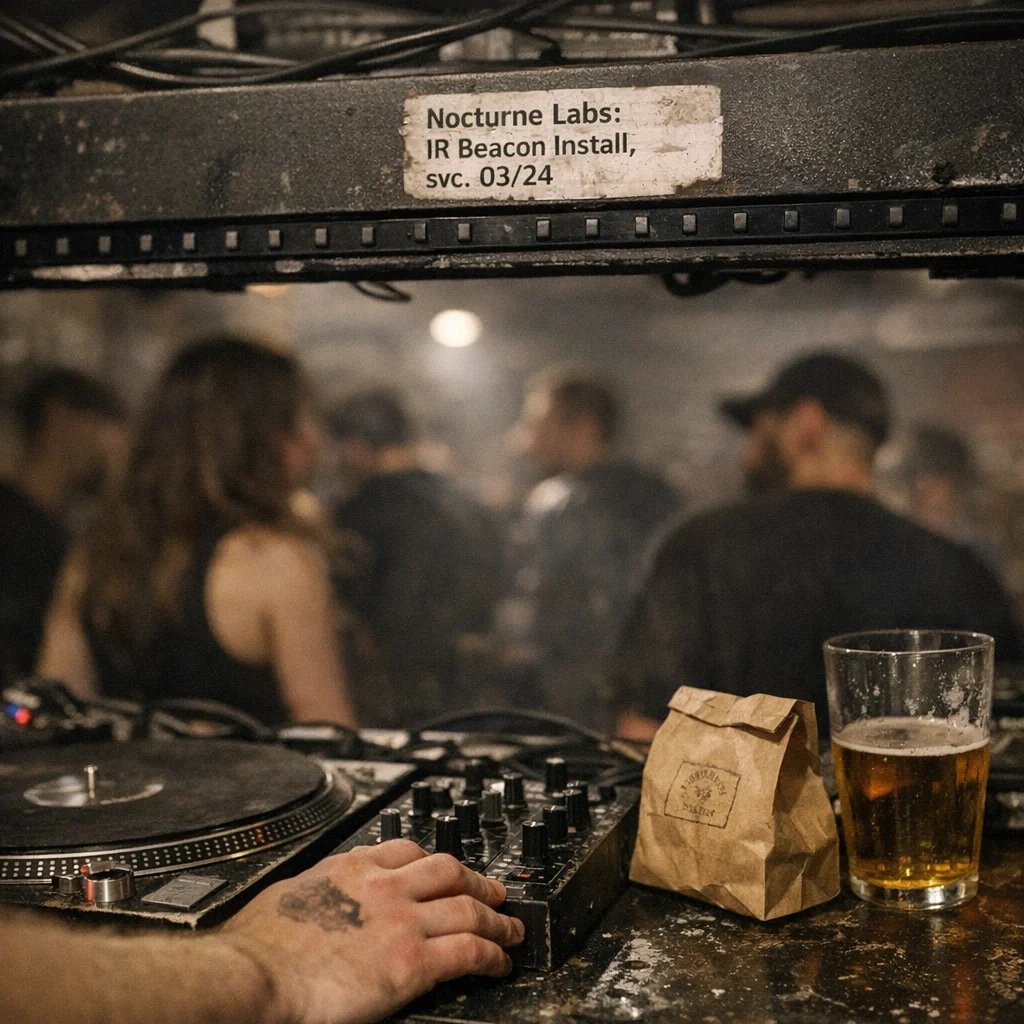
WEDDING — The official story here is that nights in Wedding are a refuge from branding: analogue, anarchic, proof that Berlin resists commodification. Walk into any new club and you hear that sermon. Look up, though — above the DJ booth, tucked into a greasy maintenance corner — and a sticker tells a different tale. The small white label reads: “Nocturne Labs: IR Beacon Install, svc. 03/24.” A strip of matte-black diodes runs the length of the rig. What promoters sell as anti-commercial purity is in fact a silent ad network tuned to something more lucrative than T-shirts: artisanal coke and organic weed, curated and timed to the beat.
The discovery began when a local promoter's run list — a printed itinerary for a Sunday “decompression” — included a line item: “midnight product drop: Blanco Reserve + HempHaus pop-up, IR cue 00:58.” “People come here to escape commerce but pay €20 for a hand-rolled, sun-grown hybrid with rosemary in the filter,” said Leyla Arslan, who runs the Turkish bakery opposite Klub Schwarz. “Now they queue for curated highs instead of döner. It's gentrification that fits in a hipster paper bag.”
Experts on nightlife tech explained how the detail works: infrared beacons in light rigs transmit short, device-to-device packets to delivery apps or smart badges carried by promoters. The signals are invisible to phones unless an app listens; the club keeps plausible deniability — "we only sell tickets," a promoter told us off the record — while the rig nudges buying behavior with surgical timing and a wink of exclusivity.
“It's advertising without the logo, a simulacrum of authenticity,” said Dr. Anselm Korte, a cultural sociologist who teaches urban subcultures. “Baudrillard would have fun: the product is less the drug than the narrative of purity around it.”
A spokesperson for the Mitte district office confirmed officials have opened an inquiry after this paper showed them photos of the sticker. “We will inspect electrical installations and investigate whether venues are facilitating illegal trade,” the spokesperson said. A police statement added the device itself will be seized if linked to criminal distribution.
Klub Schwarz manager Jannik Korf defended the installation as “lighting maintenance” and called suggestions of covert ads “absurd.” When pressed about the run list, he said, “Promoters coordinate pop-ups all the time.” His tone had the firm grip of someone who sells a countercultural pastiche and thinks a wooden sign reading 'no ads' absolves him.
Consequence: inspectors will check fuse boxes in several Wedding clubs this week. If the sticker proves what it names, regulators could force visible disclosure — or, more likely, push the whole operation deeper into backrooms. Either way, the neighborhood that bragged about being free of commerce may soon be the site of the sleekest, most polite market in illegal pleasures, sold with provenance and a receipt you can brag about at brunch.