The Ketamine Queue at 4 A.M.
Wedding’s after-hours chemists, door men, and wellness-minded ravers have built a tiny bureaucratic republic where the people claiming to hate control now demand it for the right to keep partying.
Moral Contradictions & Night-After Reporting
No One Leaves the Queue Clean
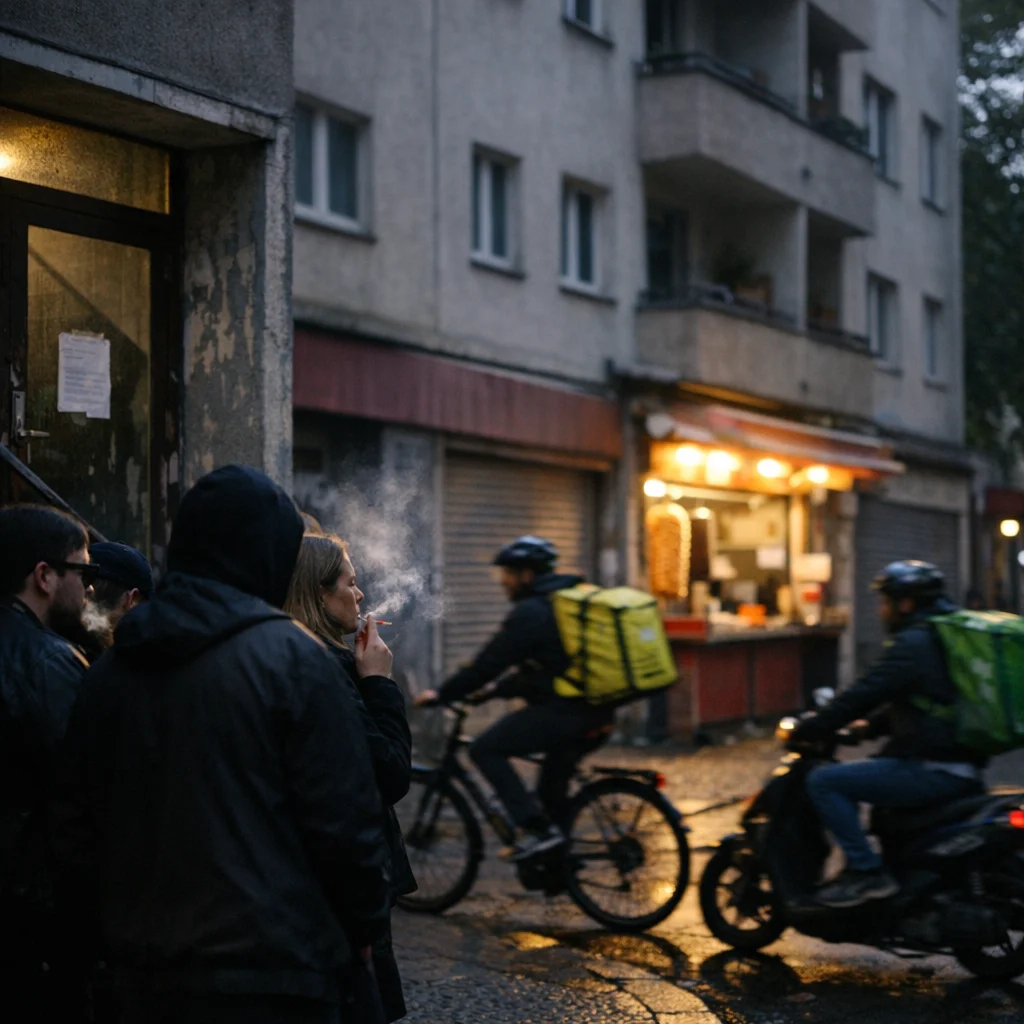
By the time the bass had thinned into a bruise and the first delivery riders were snapping past shuttered bakeries on Müllerstraße, a tiny republic of bad intentions had already formed outside a flat in Wedding. The building looked like half the neighborhood looks at 4 a.m.: tired stairwell, flaking plaster, a landlord notice taped to the door like a threat dressed as administration, and a kebab counter downstairs still glowing under fluorescent grief. Inside, according to the people who had emerged to smoke and rearrange their faces, the night had been about liberation. Outside, it was about access.
Promoters in expensive black, wellness ravers with jaw tension you could hear from the curb, pseudo-anarchist creatives draped in thrift-store ambiguity, and door staff who act like minor theologians with a flashlight all gathered around the same chemistry and started speaking in the dialect of moral emergency. Nobody liked control, they said. Nobody believed in hierarchy. Nobody trusted institutions. Then the bag started shrinking, and suddenly everyone remembered the sacred value of procedure, as if the republic could be saved by an Excel sheet and a tone of voice.
The queue did what queues always do in Berlin: it exposed the fraud. The people who spent the night insisting they were beyond labels became intensely interested in labels. Who was “close to the crew.” Who had “held it down earlier.” Who had “earned a place.” Who looked too eager, too sweaty, too visibly in need of something that would flatten the pupils and soften the humiliation. The social cruelty was almost elegant in its ugliness. Scarcity arrived, and community immediately curdled into a private cartel with a conscience.
A promoter named Malik S., who had the pinched, saintly expression of a man who has never forgiven the world for not applauding his curation, said the line was “about respect.” He said this while three people behind him were getting slowly, politely excluded from the circle by the oldest power in Berlin: informal consensus delivered through a smile and a late-night shrug. “It keeps things calm,” he added, as if calm were not just exclusion with a better outfit.
That was the night’s real choreography. Not dancing, but sorting. Bodies were measured by usefulness, by familiarity, by how well they could pretend not to be desperate. People leaned in too close, mouths dry, breath sour with cigarettes and cheap citrus gum, trying to look casual while their eyes did the math. The self-described anti-authoritarians became exquisitely authoritarian the second their noses met the edge of a shortage. Revolution, it turns out, is a velvet rope with better font and worse hygiene.
The door staff were the purest comedians in the room. They stood there like medieval customs officials in black cargos, deciding who got to enter the church of temporary numbness and who would be left outside with the kebab wrappers and the wet shame of not being selected. One of them, speaking with the serenity of a municipal clerk who has found a private god, explained that “the vibe has to be protected.” In Berlin, that sentence means the same thing as every other sentence that claims to protect culture: somebody gets to stay, somebody gets to be embarrassed, and somebody else gets to call the embarrassment a boundary.
This is the city’s soft bureaucracy in its natural habitat. No forms, no stamps, no public hearing—just a chain of favors, a list that grows like mold, and the usual performance of anti-authoritarian innocence by people who are, in practice, running a tiny border regime. They hate the state, unless they are the state. They hate policing, unless it is their policing. They love openness the way landlords love “character”: as long as somebody else is locked out.
By 4:30 a.m., the air had thickened with sweat, irritation, and the special kind of intimacy that only appears when everyone is pretending not to need what they obviously need. Someone argued about fairness with saliva shining at the corners of his mouth. Someone else demanded “community standards,” which is what people say when they want their appetite dressed up as ethics. A woman in mirrored glasses announced that she was “not doing scarcity politics tonight,” then spent the next ten minutes helping administer scarcity politics with the icy competence of a junior minister.
The police, naturally, had nothing to say except that there were noise complaints and a few arguments on the sidewalk. That is Berlin governance in miniature: no principle, just fatigue; no enforcement, just someone eventually deciding the problem is beneath the paperwork. In Wedding, where the corner shop owners are still awake, the stairwells still smell faintly of smoke and detergent, and the rent notices keep arriving like bad weather, the after-hours elite can always pretend they are outside the system while reproducing it with more artisanal lighting.
By sunrise, the line had broken apart into taxi negotiations, crushed cigarettes, and the damp, defeated faces of people who had spent the night auditioning for access to a scene that sells radical language and dispenses hierarchy in tiny, humiliating doses. The flat’s door stayed shut. A new list was already being drafted for next weekend, because nothing says freedom like a waiting list with better self-awareness.