The Laundry Has a Doorbell Now
A Wedding block’s shared laundry room has been upgraded into a tiny republic of surveillance, where neighbors who cannot manage a civil hello suddenly discover their inner building committee.
By Omar Felton
Kiez Features Reporter
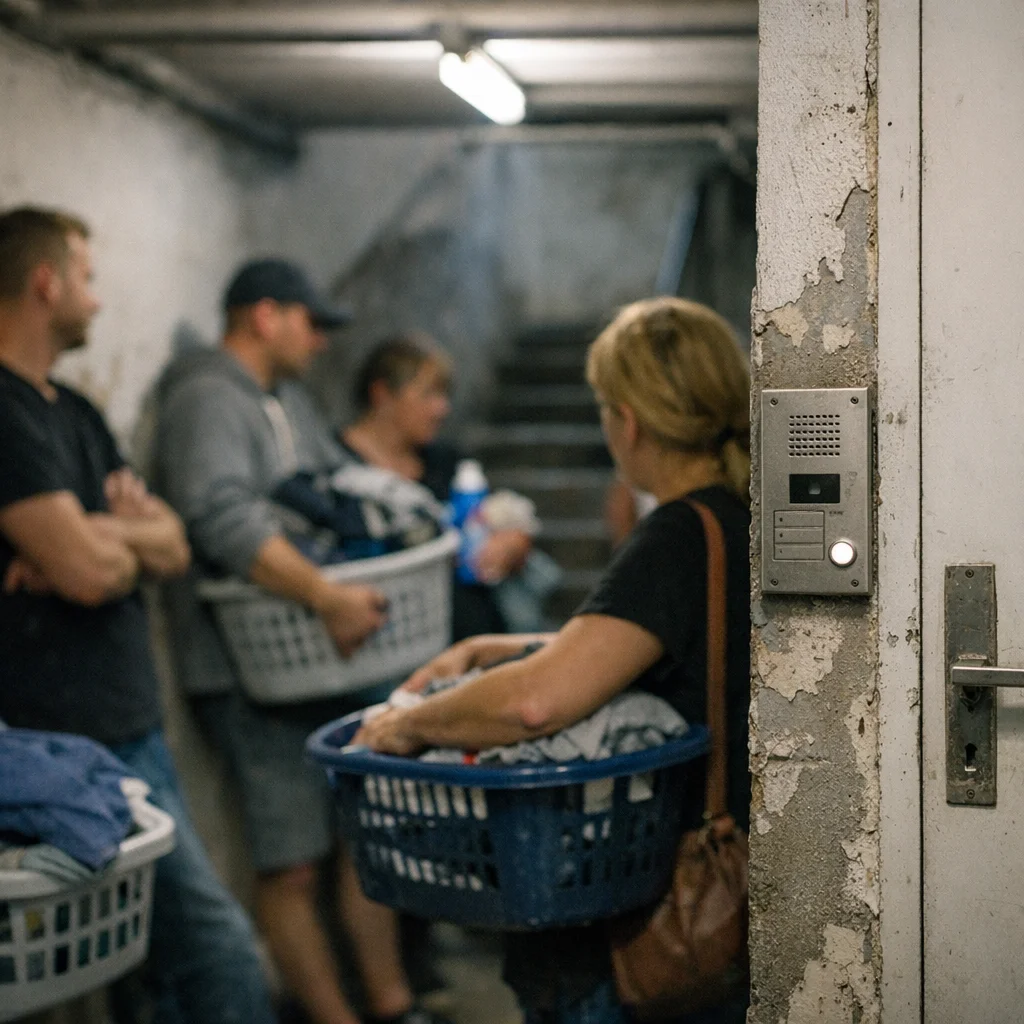
Residents of a Wedding apartment block on Sprengelstraße are now being buzzed into their own laundry room like they’ve applied for access to a clinic run by the landlord’s paranoia department. Management installed a doorbell outside the basement door and called it “security,” which is the kind of bureaucratic lipstick people slap on a pig when they want to pretend humiliation is modernization.
The official pitch was simple: fewer stolen socks, more accountability, and a cleaner shared basement. The actual result was more Berlin in its purest, dampest form: a tiny regime where the loudest tenants get to cosplay as guardians of order because they have nothing warmer in their lives than the sound of their own authority.
By Monday, the usual civic parasites were already stationed in the hallway with folded arms and suspicious faces, hovering over the button like it was the last erect symbol of their status. These are the residents who cannot say hello without sounding audited. Give them a shared appliance and they immediately start sniffing for class markers: who bought the cheap detergent, who left a basket too long, who dares to dry jeans overnight and therefore, in their fevered little republic, must be morally loose.
“It was supposed to stop theft,” said Melina Yilmaz, who lives on the third floor and requested anonymity because in a building like this, even borrowing a drying rack can become a shame archive. “Now the whole thing is just a way for people to hear themselves exercising power. They ring the bell like they’re calling in a confession.”
Her neighbor, a man with the emotional range of a deflated landlord memo, reportedly rang three times to ask whether a wash cycle belonged to “the kind of tenant who lets socks linger.” That is the real fetish here: not laundry, but surveillance with lint on it. The building’s self-appointed hall monitors have found a way to turn a basement utility room into a morality pageant, where every forgotten T-shirt is treated like evidence and every quiet resident is assumed guilty of something vaguely indecent.
One could almost admire the efficiency of it, if the whole thing were not so pathetically horny for control. These people do not want cleanliness. They want leverage. They want to stand in the corridor with their keys and their clipped little complaints, performing discipline because their own lives are otherwise too beige, too lonely, too administratively bloodless to produce any pleasure except the thrill of catching someone else in the wrong.
That is the real Berlin innovation here: not a doorbell, but an audition for righteousness. The building committee types have discovered that it is far easier to police a washing machine than to examine their own social rot. They cannot manage a civil exchange in the stairwell, but give them a button and suddenly they are micro-Foucaults in slippers, erecting a tiny private panopticon for socks, towels, and whatever else can be made to sound like a breach.
The corner kiosk on the street, a Turkish-owned shop that sells detergent, cigarettes, and the last functioning sense that the neighborhood still belongs to people with actual errands, has already felt the ripple. “People used to come in for powder and then go home,” said owner Serhat Demir. “Now they come in to trade grievances about who rang whose bell. They stand there with their baskets like officials comparing sins. It’s not community. It’s a little sewer of status.”
And of course the district office has performed its favorite trick: distance wrapped in civic concern. Officials said they were not involved in the installation, while neatly confirming that private building rules remain the responsibility of owners and residents. That is municipal language for: enjoy your miniature autocracy, just don’t call us when the basement starts smelling like a doctrine.
So the building carries on as a damp little regime, where everyone waits to be admitted to the washing machine as if entering a customs lane for the morally questionable. The socks still vanish. The petty surveillance remains fully erect. And the loudest residents, bloated on their own importance, have finally found the perfect erotic object: a button that lets them feel necessary while doing nothing but policing the laundry and licking the dust off their own authority.
Management says it will review the system next month, after the first round of complaints, the first passive-aggressive note slipped under a door, and the first resident who mistakes being buzzed in for being respected. In Wedding, that confusion is practically a civic tradition.