Thirty-Year Döner Stand Reports Its Front Counter Has Been “Soft-Launched” Into a Concept Store
The Yılmaz family says a “brand consultant” appeared one morning with scented sanitizer, a ring light, and a new pricing philosophy. Nobody admits hiring him.
By Elis Klein
Neighborhood Features Reporter
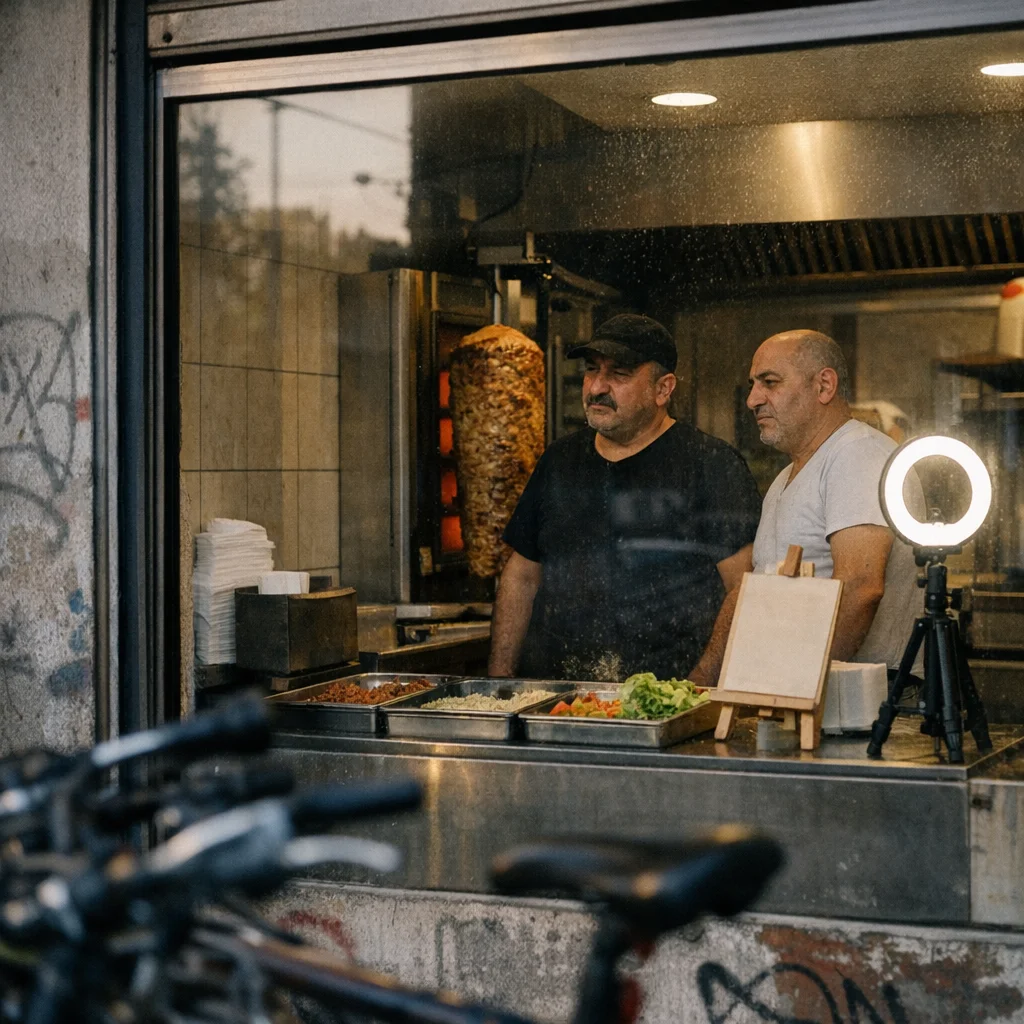
WEDDING — On Wednesday, around 9:40 am, the Yılmaz family unlocked Yılmaz Döner at Badstraße 19, expecting the usual: delivery guys, schoolkids, and the quiet, reliable hunger of people who don’t want their lunch to make eye contact.
Instead, the family found a small easel placed between the napkins and the pickles. On it: a single card instructing customers to “choose your experience pathway” before ordering. No logo, no signature—just the kind of polite threat normally reserved for airport security.
“We didn’t put it there,” said Ayşe Yılmaz, 52, who has worked the counter since 1995 and can slice tomatoes with the calm of a surgeon. “My husband thought maybe the landlord. My son thought maybe it’s ‘marketing.’ I thought: if I catch the person, they will learn a new form of customer feedback.”
By mid-morning, a man in beige sneakers and a puffer vest arrived carrying a ring light and a small jar of something gray. He introduced himself as Leon Hartwig, 33, “brand shepherd,” and began speaking in English to customers who were responding in German, Turkish, and in one case, pure silence.
Hartwig told this paper he was hired to “help the shop evolve without losing its soul,” a sentence that landed on the room like a damp towel. “People want transparency,” he said, gesturing toward the rotating spit. “Not about ingredients—about intention. We’re bringing a firmer grip to the customer journey.”
Regulars watched as Hartwig placed a QR code tent on the counter and encouraged customers to “rate their mouthfeel” and “share their first döner memory.” When one customer, Mustafa Demir, 61, asked for extra onions, Hartwig offered him “a deeper onion conversation” and suggested a “slow-build spice arc.”
“I came here for food,” Demir said. “Now I’m being emotionally undressed in public.”
The surreal shift, the family says, culminated early that evening when the shop’s old menu board began rearranging its own letters, spelling out items nobody had ever ordered in this neighborhood. Witnesses reported the board repeatedly attempting to write the word “curated,” only for the final letters to slide off and land in the salad tray.
A spokesperson for the Mitte district’s business oversight office, Petra Lang, confirmed the office had received “several calls regarding unsolicited conceptualization.” “We can regulate signage,” Lang said, “but we cannot regulate people’s need to turn a sandwich into a manifesto. That would require federal coordination.”
Inside the shop, the family continues serving the same döner, at the same pace, under new, unasked-for mood lighting that makes the meat look like a Caravaggio still life—dramatic, devotional, and slightly guilty.
“They say they want community,” Ayşe Yılmaz said, stacking bread with practiced precision. “But what they really want is a story they can swallow without chewing.”
Hartwig, for his part, insisted the transformation is “gentle” and “not about displacement.” He paused, adjusted the ring light, and added: “We’re just opening things up a little.”