Toddlers Need a Permit, Says the Court Clerk
Wedding’s latest civic farce follows parents, overstretched clerks, and a pile of missing paperwork as a routine child-related errand gets treated like a security threat.
Administrative Grief Correspondent
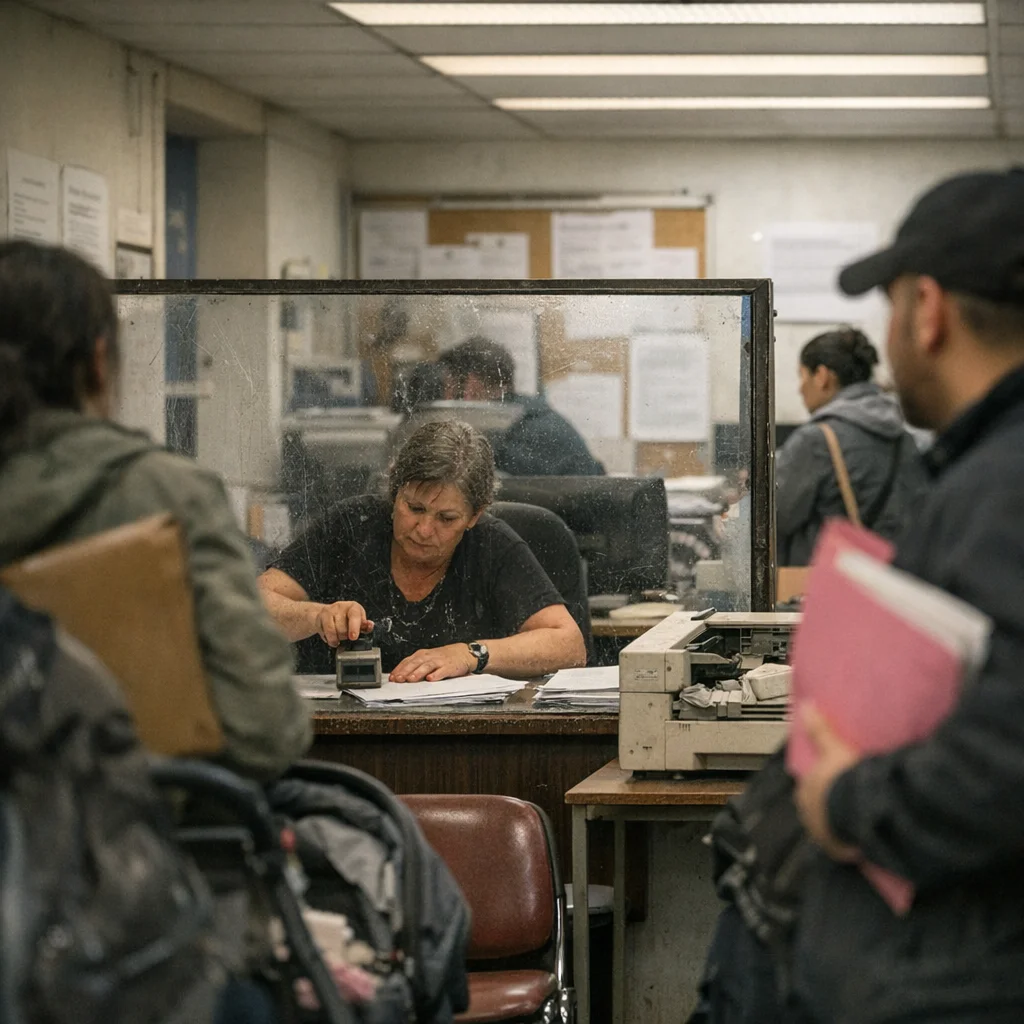
The district office in Wedding, where dignity goes to die in sequence
At 8:12 a.m. the waiting room already smelled like wet coats, radiator dust, and the sour milk of optimism. A stroller was jammed sideways near the wall because the district office in Wedding had, in its infinite civic tenderness, designed the room as if children were a rumor rather than a demographic. The queue machine blinked a number, then coughed, then printed something that looked like a surrender note.
A father in a reflective work jacket stood clutching three folders, a passport photo, and the expression of a man who had been told that his son’s existence required better punctuation. Beside him, a mother with a sleeping toddler on her hip was informed by a laminated sign that all applications must be submitted in duplicate, except when they must be submitted in triplicate, except when the printer is broken, which it usually is, because the printer is apparently part of the office’s moral philosophy.
The clerk behind the glass was not cruel in the cinematic sense. Cruelty would have required energy. She was worse: she was efficient in the way a locked door is efficient. Her desk held a stamp pad, a tower of mismatched folders, and a little plastic sign that said Please understand our workload, the bureaucratic equivalent of asking someone to enjoy the blade. Every time a parent asked a question, she answered with the soft, murderous calm of someone who had learned that procedure is what power says when it wants to sound innocent.
“Do you have the appointment confirmation?” she asked.
“Yes,” said the father.
“Printed?”
“No. The email said digital was fine.”
She looked at him the way an altar looks at a sinner.
“That is not what the form says.”
Of course it wasn’t. The form in Wedding is never what the email says, the sign is never what the clerk says, and the clerk is never empowered to help, only to administer disappointment with a side of legal hygiene. This is how the district performs fairness: by making everyone equally late, equally confused, and equally ashamed for needing a child-related service in the first place.
A supervisor drifted through the room wearing a cardigan and the expression of a man who had discovered empathy in a corporate workshop and then immediately lost it. He spoke in the soothing tone of someone explaining a fire drill during a fire.
“We value family accessibility,” he announced, standing in front of a broken ticket printer like a priest lecturing from a collapsed altar.
Behind him, the machine made a noise like a throat clearing before a lie.
The most obscene thing about the whole ritual was not the delay. Delay is honest. The obscene thing was the moral theater wrapped around it. Everyone in the office spoke the language of respect, inclusion, and transparency while moving parents through the kind of petty obstacle course usually reserved for humiliating a suspect. The district loves a child right up until the child requires a stamp, a signature, or a functioning human being at a desk. Then suddenly there are procedures, capacities, references, digital forms, printed forms, and the sacred administrative fog that turns neglect into policy.
By 10:00 a.m. the line had become its own neighborhood, a temporary republic of exhausted people with diaper bags, folders, and the glazed stare of those who have been punished for being responsible. Someone’s toddler began kicking a metal bench with the relentless joy of a tiny vandal. The clerk did not look up. She was too busy entering names into a system that seemed designed by someone who hated children and loved drop-down menus.
This is Wedding’s civic intimacy: not community, but managed abrasion. Not support, but supervised inconvenience. The district office does not merely process paperwork. It produces obedience, one stamped sheet at a time, until every parent learns the lesson Berlin prefers to teach in public: if you need help, arrive already apologizing.
And still the posters on the wall smiled about participation.