Traffic Light Choir Rehearses for Ten Minutes
At a Wedding junction, drivers, couriers, and one very self-important scooter rider all perform impatience while the waiting line quietly becomes the real city council.
Civic Hypocrisy & Neighborhood Compliance Reporter
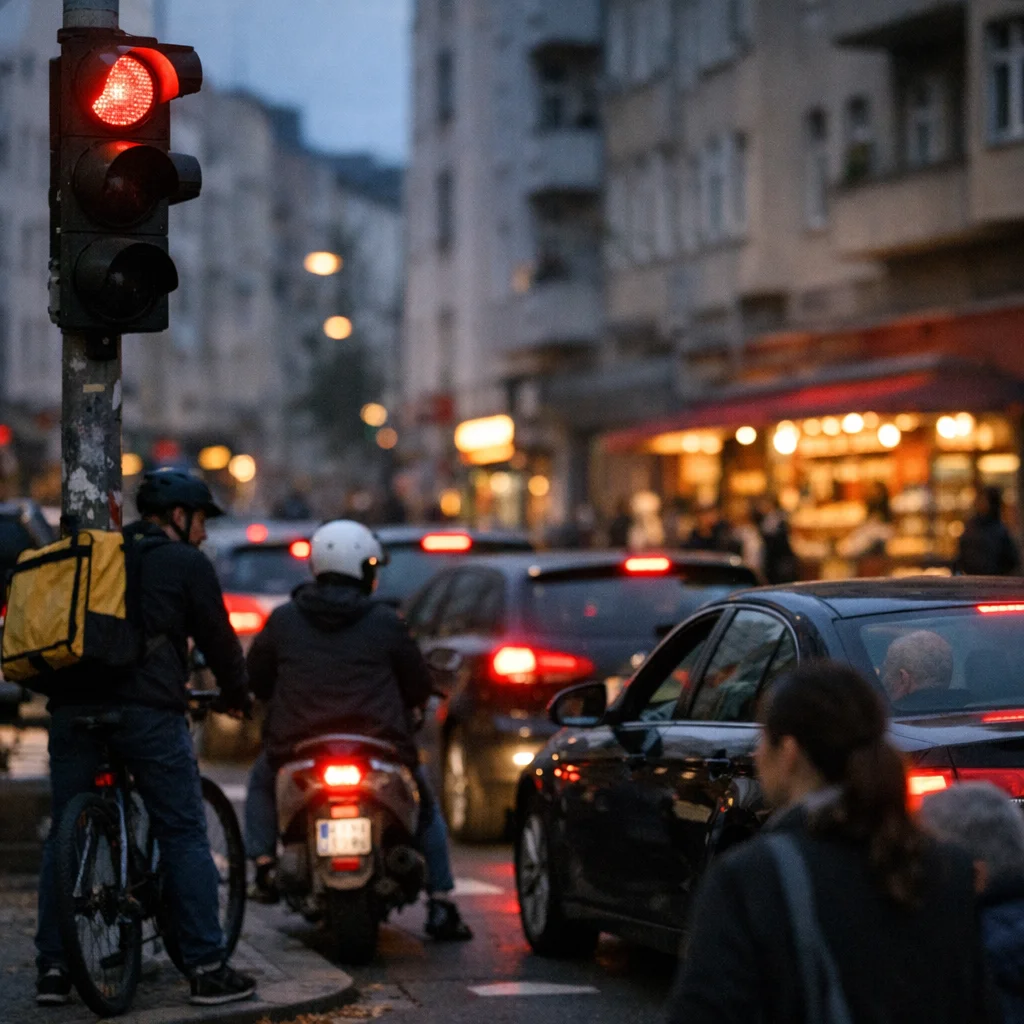
At a busy Wedding intersection, commuters, couriers, and one scooter rider with the face of a minor tyrant spent ten minutes treating a red light like a personal humiliation. At Müllerstraße and a side street near Leopoldplatz, the signal pinned them in place while pedestrians stood in the crosswalk with the flat, overeducated patience of people who already know the whole city is run by people in high-vis vests and low-grade fantasies.
The first minute delivered the standard civic foreplay. A man in a leased SUV drummed his fingers on the wheel as if the laws of physics were a customer-service problem. A courier leaned over his handlebars, staring at the light with the hungry suspicion of someone paid to be fast and cursed to be blamed for it. The scooter rider, helmet tilted like a cheap judge’s wig, crept forward a few centimeters, retreated, then edged up again, performing impatience the way a provincial politician performs empathy: with sweat, lust, and no inner life at all. Everyone had somewhere urgent to be, which in Berlin usually means they had somewhere petty to be faster.
By the fifth minute, the queue had started its usual little class war in a metal trench coat. A woman in a compact sedan muttered that the city no longer respected drivers. She said it with the wounded certainty of someone who has spent years mistaking a steering wheel for a moral exemption. Behind her, a delivery rider in a reflective jacket checked his phone and looked morally pre-victimized, already aware that the entire street was ready to blame him for existing at speed. The waiting line had become a seminar in class resentment, with a budget for bad faith and no chair for pedestrians. The pedestrians, meanwhile, were the only adults present, which in traffic is the same as being ignored by management.
"They sit there like the lane belongs to their bloodstream," said Mehmet Yilmaz, who runs the Turkish bakery by the corner and watched from his doorway. "Then the light changes and they all rediscover public life for six seconds, just long enough to cut somebody off and pretend it was an accident of principle."
No traffic engineer was visible, which is usually how the city prefers its governance: absent, untouchable, and somehow always available for blame after the fact. A district traffic office later said the signal timing had not changed and no malfunction had been recorded. Naturally. In Berlin, bureaucracy never lies exactly; it simply arranges reality so badly that everyone else does the lying for it. The red light was not the problem. The problem was the whole little ecosystem of delay, resentment, and self-admiring motion built around it.
The left-wing cyclist glared at the cars as if purity were a transit policy. The SUV driver glared back as if his monthly lease payment had purchased citizenship. The courier looked through both of them like a man who knows the city only when it bleeds time. Everybody was auditioning for innocence while behaving like a parasite with a parking permit. Freud would have needed a stronger drink; Brecht would have asked who profited from the stage, then charged admission.
When the light finally changed, the release was almost obscene. The cars lurched forward with the damp eagerness of a neighborhood that has confused motion for virtue. The couriers shot through first because the people doing the work are always forced to move before the people doing the posing. The SUV followed, forgiven in advance, as if bulk were a social credential. The pedestrian phase ended in the familiar way: not with justice, just with a gap large enough for everyone to pretend they had not been standing there, horny with impatience, devouring one another with their headlights.
Police said there were no collisions or injuries. The traffic office said it would review the signal timing later this month, which is one way of saying the neighborhood can keep masturbating its way through the same congestion until somebody in a planning department discovers shame. In the meantime, Müllerstraße and Leopoldplatz will continue as designed: a little public theater where drivers play the victim, couriers take the hit, pedestrians get treated like scenery, and the traffic bureaucracy remains the invisible landlord collecting rent on everyone’s nerves.