Tresor Veteran Loses His Mind After Café “Quiet Zone” Treats Espresso Like a Scheduled Microdose of Speed
In Wedding, every chair now comes with an outlet, a job title, and a deathly fear of someone laughing.
Daytime Degeneracy & Gentrification Night-Shift Reporter
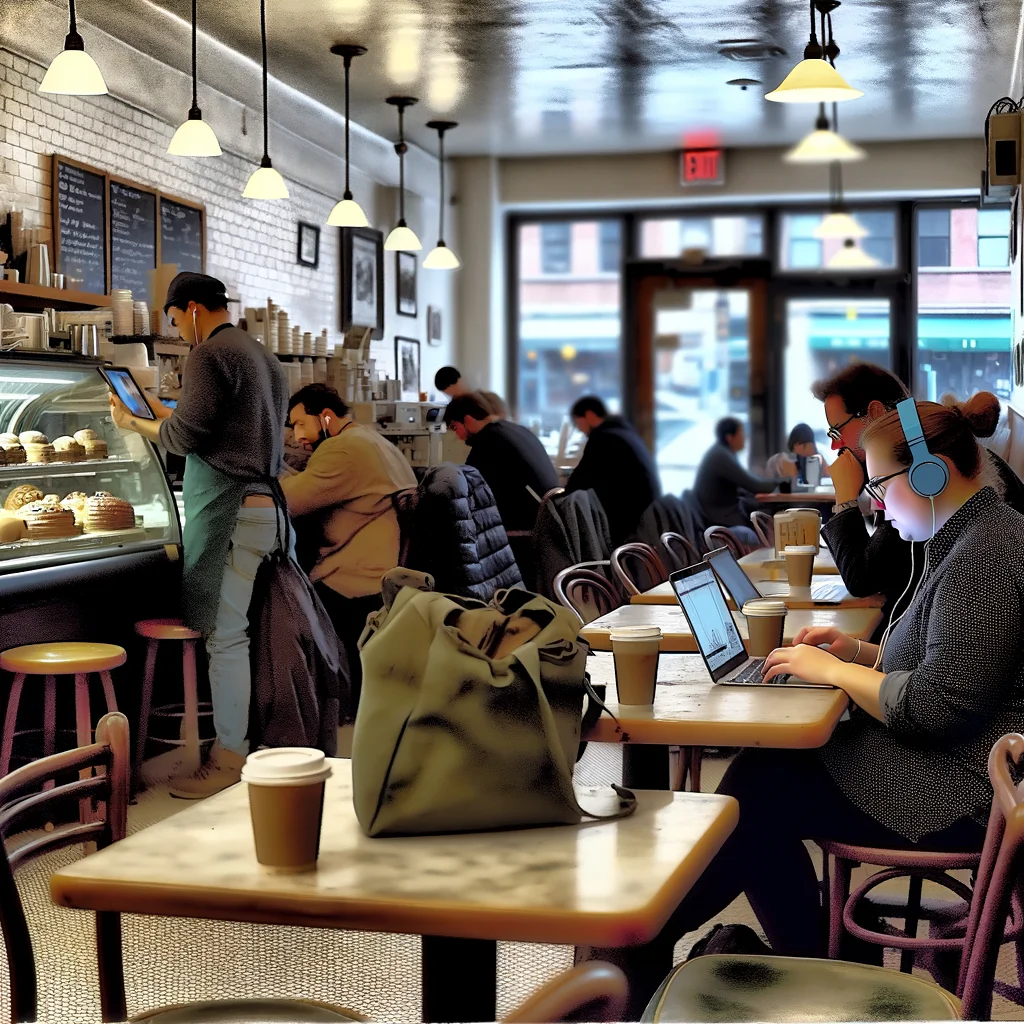
On Thursday afternoon in Wedding, a man with the skin tone of a permanently processed night and the eyes of someone who has argued with a bathroom mirror at 7 a.m. stepped into a café, looked at the room, and reacted the way animals react to a forest fire: by freezing, blinking, and realizing the exit is now behind three MacBooks.
His mistake was believing cafés still served a function beyond “theater for paid ambition.” In old Berlin, you went to a café for coffee, gossip, maybe a cigarette you claimed you didn’t smoke anymore. In current Berlin, you go to a café to stage productivity, like a Renaissance portrait but with less dignity and more USB-C.
Wedding used to have cafés where the only password required was eye contact and coins. Now every menu reads like a corporate retreat got lost on the way to Brandenburg and decided to colonize your afternoon:
- Filter coffee that costs more than your last actual relationship
- “Work-friendly lighting” (as in: sickly bright so you can’t hide the decline)
- “Seating rotations” every 90 minutes (like a prison yard, but with oat milk)
- A subtle war on joy, enforced by people in oversized headphones and “building something”
Co-working spaces, but make it beige and personal
The WeWorkification of Berlin is simple: take a normal café, remove anything that could be described as atmosphere, and replace it with policies.
Once the laptop grid sets in, everything changes. The tables become plots of land. The outlets become energy wells. You don’t sit somewhere—you “claim” it. You don’t order coffee—you “buy time.” Nobody drinks fast. Nobody leaves early. You see a croissant slowly age through its own chapters.
The staff have been turned into emotional IT support. They no longer ask “another one?” with warmth. They ask it with the weary tone of someone granting you one more hour of tenancy. “Still here?” becomes a customer-service question and a moral verdict.
A barista near Gesundbrunnen (who asked not to be named, presumably to protect future tips and their last shred of optimism) summarized it best: “It’s not a café anymore. It’s a background check with cinnamon.”
The new Berlin rite: headphone confessional, zero shame
Entire lives are now lived between two sips. People whisper business ideas into Bluetooth like they’re confessing sins to an algorithm.
In one corner, a man pitches a “community platform” loud enough for half the room to learn he has never once experienced community outside a LinkedIn thread. In another, a woman does “deep work,” which looks identical to staring at a screen and quietly threatening herself.
Everyone says they “need a change of scene.” What they mean is: they want to be perceived. Productivity, in Berlin, isn’t a habit; it’s a costume. And yes, it is all black.
A pair of longtime Turkish regulars—older men who actually use a café as a café—watched this unfold the way your grandfather watches modern art: patient, slightly offended, and sure it’s a joke that went on too long.
“Before, you talked,” one said, pointing at the rows of bent spines. “Now people come here to not be here.”
That’s the whole project. We used to go out to be among people. Now we go out to be among power sockets.
Noise has become contraband
Every co-work café has the same rules, written in fonts that smell like investment money:
- No calls.
- If calls, then calls whispered like you’re negotiating a hostage exchange.
- If laughing, then stop.
- If living, then maybe take that outside.
Someone drops a spoon and eight freelancers flinch like it’s artillery. A toddler dares to exist and half the room turns into bouncers, policing innocence with cold stares.
It’s funny: Berlin will tolerate someone collapsing at the bus stop, but God forbid you chew loudly during a “strategy session.”
Walter Benjamin warned us, and we responded with a monthly pass
The city keeps worshiping authenticity while turning every space into an interface. The café used to be a social machine; now it’s an office that still wants applause.
Walter Benjamin wrote about the loss of aura under mechanical reproduction. Berlin read it, highlighted it, photographed it, and then paid €6.20 for a coffee to write “working on my aura” into a Notes app.
If Marx were alive, he’d see a room full of people renting seats to produce pitch decks no one will read, and he wouldn’t even bother with a manifesto. He’d just order tap water and leave.
The new etiquette: pay, plug in, pretend
Residents have adapted. In Wedding, we now have a whole unspoken vocabulary:
- “Are you using this chair?” = Can I have your spot before I evaporate?
- “Is the Wi‑Fi down?” = Do I still exist?
- “Could you watch my stuff?” = I trust you more than the labor market
And cafés aren’t fighting it—they’re leaning in. Every new place opens with the same fantasy: plant walls, brushed metal, a pastry case like a museum display, and a room layout that says, Please do not accidentally have a personality.
You can feel it in the air: ambition and steamed milk. It’s hard to swallow.
Somewhere, someone is reading a self-help book while designing a service to reduce screen time.
That’s Berlin now. Even leisure needs a deliverable.
And in Wedding, the only true quiet zone left is the space between a customer asking for an outlet and realizing the only thing available is shame—fully charged and ready to penetrate the rest of your day.