Trump’s Loyalty Test Gets Paxton in the Family Picture
At the Texas rally, the president blessed his Senate hopeful while spending most of the speech on himself, turning endorsement into a public bedding-in ritual for two men who clearly wanted separate blankets.
Civic Hypocrisy & Neighborhood Compliance Reporter
Trump’s Loyalty Test Gets Paxton in the Family Picture
The Texas rally that was supposed to present Donald Trump and Ken Paxton as a disciplined Republican pairing instead looked like a staged coupling where one man kept rearranging the furniture and the other kept smiling through the upholstery burn. Trump offered the blessing, then kept taking the center of the bed, talking past Paxton as if the candidate were a decorative headboard placed there to prove the room had been furnished at all. In Berlin, where political seduction is usually sold with cleaner lines and fewer bankruptcy disclosures, the whole thing landed like an imported dominatrix routine performed by a man too vain to remember the safe word.
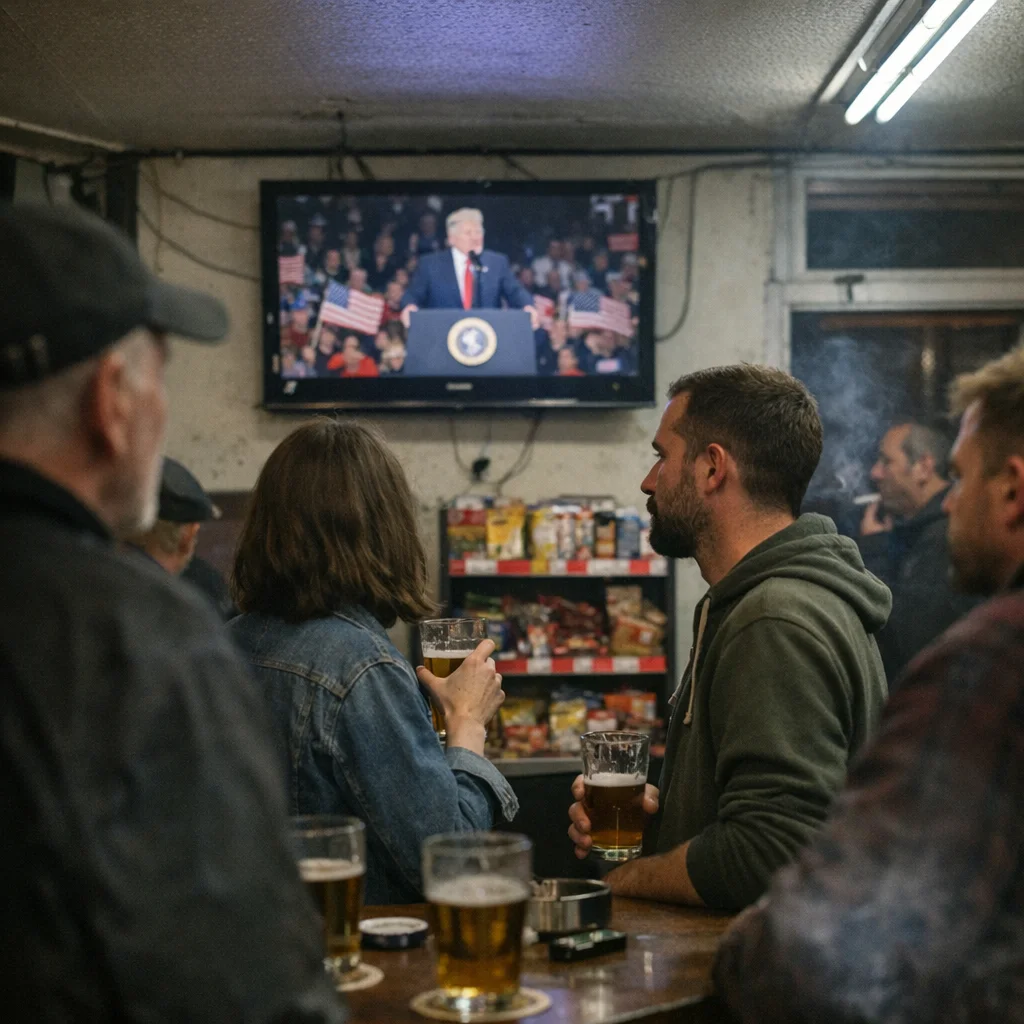
At a roadside bar in Wedding on Wednesday night, a dozen American expats and one Texan who says he moved to Germany for “a less emotional democracy” watched the clip on a tired television above the cigarette machine. Trump’s endorsement was received the way tenants receive a landlord’s promise to fix the shower: with the expression reserved for someone asking to be trusted after already removing the towels. The bartender didn’t even look up when Trump started praising himself again; she just wiped the counter like she was clearing up after a client who had mistaken being loud for being desired.
“He introduced Paxton the way a man introduces a plus-one he plans to ignore in public and pressure in private,” said Deniz Karaca, who runs the kiosk downstairs and asked not to be named because the Texas crowd has the same memory as a debt collector. “It wasn’t an endorsement. It was a loyalty audition with the lights too low and the hands too visible.”
That is the American right’s preferred version of intimacy: public backing, private leverage, and a constant negotiation over who is on top while both men pretend the arrangement is traditional. Trump spent much of the rally defending Trump, which in Berlin would still be considered poor manners even by developers, who at least know how to simulate mutual consent while gutting the building. The donor class likes this setup because it is legible: one man owns the brand, the other rents the body, and the invoice gets sent to everyone else.
A local organizer for a neighboring district’s Republican club, speaking after two glasses of bad wine and one nervous call to a campaign lawyer, said Paxton had clearly wanted a clean embrace and instead got “the full family-picture treatment, where nobody is relaxed and one uncle keeps insisting the pose proves unity.” He described the event the way campaign workers describe a candidate’s hotel-room habits: a lot of coercive cheer, some heavy breathing from the podium, and a great deal of concern about who is allowed to leave first without looking marked.
Trump’s machine loves this kind of transaction because it turns loyalty into a full-body display. The message is never just vote for me; it is come closer, stand here, let everyone see who is holding whom, and don’t flinch when the crowd notices the hand on your waist is also a claim. Paxton, for his part, performed the role the modern Republican hopeful knows best: grateful, obedient, and visibly eager not to be the one who looks needy. In other words, he behaved like a man trying to sell himself as independent while being folded into a stranger’s lap for the camera.
By the end of the speech, the arrangement had produced exactly the kind of public ownership Trump prefers: not a partnership, but a visible marking. Paxton came away less endorsed than absorbed, the way a blazer comes away from a long night in a club — wrinkled, perfumed with somebody else’s cologne, and impossible to confuse with consent. Back in Wedding, the screen went dark, the bar resumed serving beer to people who complain about elites while living off somebody else’s rent, and the Texans on television moved on to the next stop in the tour of mutual humiliation they call governing.