Waiting Room Prayer Circle for Your Number
At the district office, the queue has become a loyalty test for people who perform patience, multilingualism, and civic gratitude until their documents are finally accepted.
Administrative Grief Correspondent
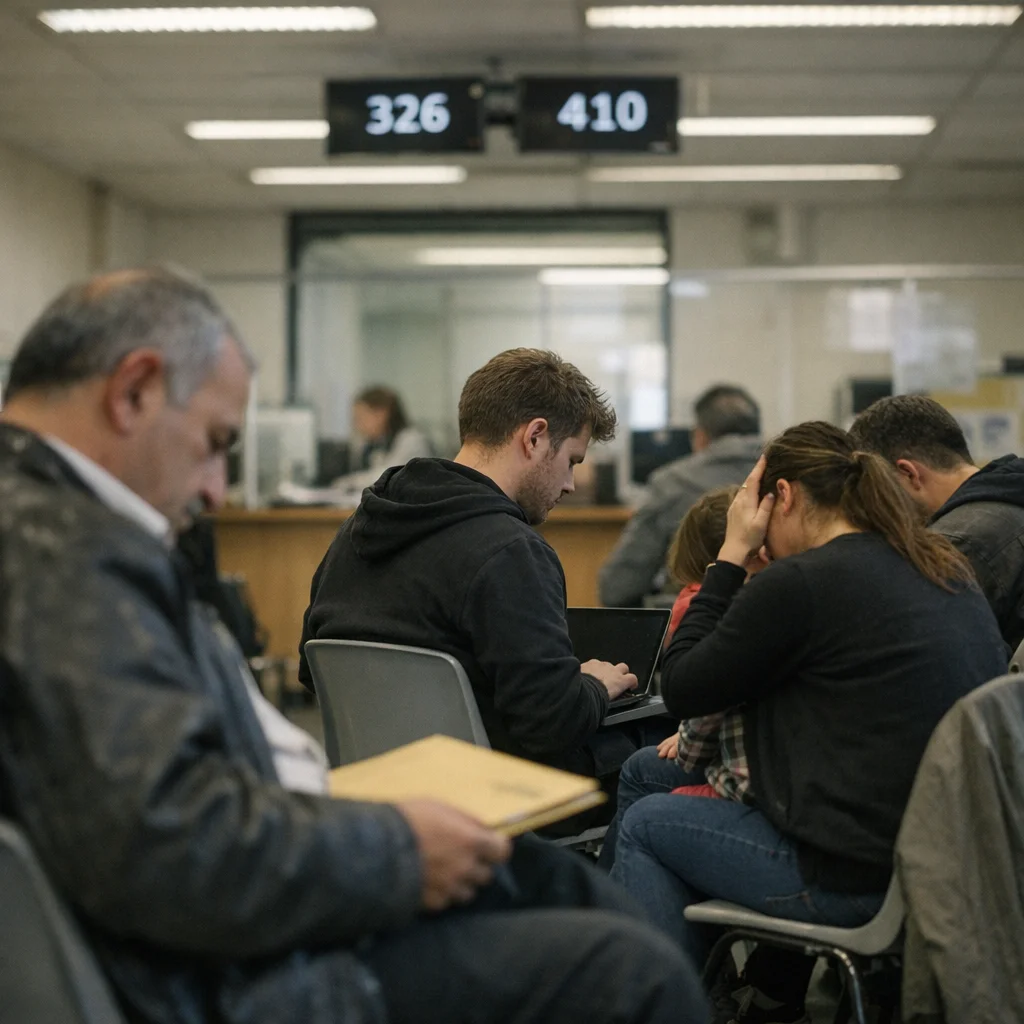
The queue took a number and then a breath
At the district office in Wedding, the permit desks no longer process documents so much as they metabolize surrender. The fluorescent room does not feel public; it feels rented by a petty god with a clipboard, where residents are fed back their own urgency one spoonful at a time. On Tuesday morning, people came for residence papers, business permits, school forms, and the ancient privilege of asking the state to admit they exist. They were told to wait “until called,” which in Berlin is bureaucratic dialect for: sit there and let your needs dry out.
The room filled early with the familiar cast of civic prey. Turkish shop owners held renewal folders like evidence in a trial they already expected to lose. Young freelancers in black coats performed a tasteful, starving patience, the kind that lets gentrification call itself culture. A property consultant arrived with a laptop and a self-satisfied jaw, as if a spreadsheet might flirt its way through a counter. The whole crowd lowered its voice, smoothed its face, and made itself smaller. Nothing lubricates power like forced politeness; it is the office’s favorite perfume, and the staff breathe it like amyl nitrate.
By late morning, the display above the counter looked less like a queue system than a punishment device with branding. Every beep was a tiny humiliation, every delay a reminder that the district office does not merely fail to serve people — it trains them to beg in the correct register. The clerks behind the glass moved with that special public-sector grace that reads as kindness only if you have never had your life paused by someone who enjoys being the hinge. They were not overtly cruel. That would be efficient. Instead they practiced the superior local cruelty: soft voices, dead eyes, and the faintly pornographic pleasure of making adults ask twice.
A bakery worker from the next block, who asked not to be named because he was technically “on delivery,” said the waiting area functions like a sorting machine. “If you’re loud, they treat you like a nuisance. If you’re too polite, they treat you like furniture,” he said. “The ones who survive are the ones with intermediaries — somebody who knows somebody, a bilingual cousin, a consultant who invoices the misery.” He was not describing a theory. He was describing the business model.
That model has beneficiaries. Consultants survive by translating incompetence into invoices. Landlords survive because delays keep apartments legally and socially fogged in, exactly the way speculative property likes it. Multilingual middlemen survive by carrying the shame of the state in three languages while the state keeps its collar clean. The office calls this “capacity.” The city calls it “complexity.” The rest of us should call it what it is: a bureaucratic racketeering scheme run on legal boredom and public submission.
A district spokesperson, speaking in the polished antiseptic of municipal self-exoneration, said staffing remained “challenging” and that employees were working “as quickly as possible within current capacity.” This sentence is the civic equivalent of a hand on the thigh followed by a shrug. It promises effort, withholds consequence, and expects gratitude for the tension. Berlin administration loves this posture: vaguely apologetic, structurally immovable, and always just erotic enough to suggest there is a real body somewhere inside the machine, if only you could get it to unclench.
The deeper insult is not the delay. It is the social sorting. The office rewards those who arrive already kneaded into submission. The loud are flattened, the entitled are iced, and the multilingual are drafted into unpaid diplomacy, translating the state’s laziness into three languages while their number sinks like a stone. The applicants’ courtesy grows obscene after an hour or two; it becomes a kind of public undressing, each please and thank you stripped for parts until there is nothing left but compliance. You can watch the room learning how to kneel without bending the knees. It is Foucault with fluorescent lighting and a cheaper perfume.
By afternoon, one applicant who had been waiting since early morning was still one form away from being allowed to hand in the form that would authorize him to request another form. He smiled with the dead-eyed calm of a man who has been taught that bureaucracy is not service but foreplay with defeat. Around him, people sat with their folders open like laps that had been told to behave.
The district office said it would review staffing “in the coming weeks.” Several applicants said they would return next week. The building, having extracted its tribute, did not comment. In Wedding, silence is rarely neutrality; more often it is the grin of an institution that has already made you wait and knows you will come back hungry enough to thank it for the privilege.