Wedding’s After-Hours Drug Scene Has Been Captured by the App-Bros Who Treat Chaos Like a KPI
The newest nightlife entrepreneurs are not selling parties so much as operational certainty, packaging the old Berlin promise of risk and excess as a frictionless premium product for people too anxious to be truly.
Nightlife Contradictions Reporter
The neighborhood as inventory
Wedding is now being strip-mined the way Berlin strip-mines everything that still smells vaguely alive: first by landlords, then by branding consultants, then by the little venue parasites who arrive with notebooks, guest lists, and a moral vocabulary so polished it could pass for a dental ad. The old neighborhood texture — basement bars, migrant labor, cheap rent, late deliveries, tired stairwells, and the permanent perfume of frying oil, damp concrete, and someone else’s cigarette — is no longer a lived reality. It is a mood board.
The new nightlife operators talk about “community” with the hungry sincerity of people who have never had to share a building with it. They rent a former storage room, hang one tasteful chain curtain, hire one sound engineer who knows how to make the walls sweat, and suddenly they are “activating the kiez.” That is the language of extraction with a nicer haircut. The actual business model is simpler: convert local precarity into a premium atmosphere, then charge entrance to the very people who helped make the place unaffordable.
The queue is the product
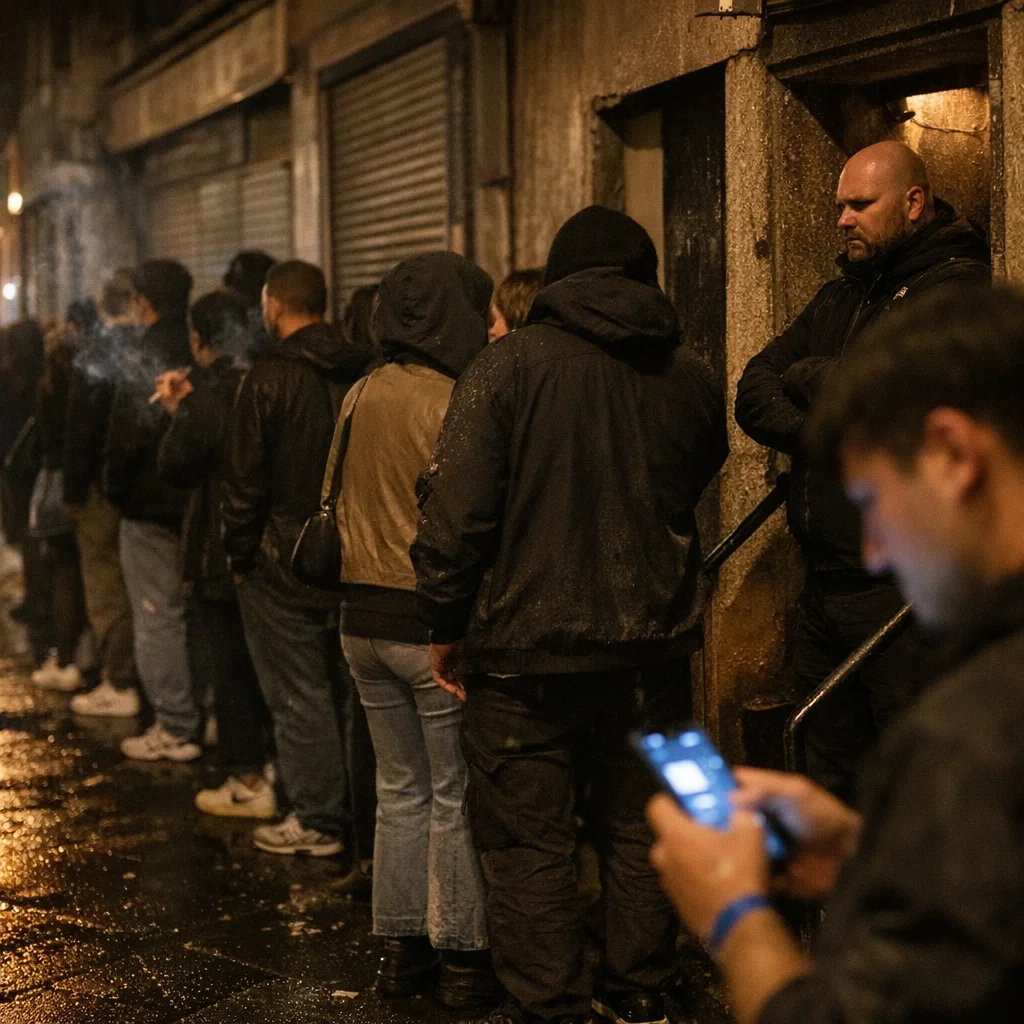
The old Berlin deal was supposedly anarchy with a bassline. Now it is administrative fetishism. App-bros, nightlife consultants, and startup failures with expensive sneakers have discovered that the real commodity is not the party but the queue, the stamp, the illusion that you were chosen by a machine with taste. They do not sell freedom. They sell the sensation of being one rejected text message away from it.
At the top of the food chain, Berghain still functions like a cathedral for people who want their humiliation validated by a bouncer in black. Lower down, the Wedding scene is where the fraud gets more intimate. A promoter with a rented industrial space near Leopoldplatz can now act like a minor sovereign, deciding who gets to inhale the room’s borrowed legitimacy. The crowd arrives dressed in performance poverty: thrift-store tops, bruised leather, faux-working-class boots, the whole cosplay of austerity worn by people whose biggest hardship is choosing between two paid newsletters.
And yes, the flirting is part of the transaction. It always is. The room is full of people pretending not to be selling themselves while carefully arranging their bodies for the market. Everyone is available, but only in the polished, self-aware way that can still be described as “authentic.” It is less seduction than inventory management.
The city loves a profitable mess
A ticketing founder named Lea Morgenstern, 31, described her platform as “a more transparent cultural layer,” which is exactly the kind of sentence that should be grounds for immediate public suspicion. Translation: we have taken the sticky, unpleasant, semi-illegal human mess of nightlife and wrapped it in a dashboard for people who think exploitation becomes ethical once it has metrics. Every queue becomes optimization. Every door policy becomes data. Every drunken mistake becomes a subscription opportunity.
This is not innovation. It is municipal laundering.
Berlin’s officials adore this arrangement because it lets them perform tolerance while outsourcing the consequences. They can celebrate “creative energy” while landlords jack up rents on the same streets where a Moldovan cleaner, a Syrian dishwasher, or a Polish carpenter is doing the actual work that keeps the neighborhood functioning after midnight. The city photographs the glow, then acts surprised when the people producing it can no longer afford to sleep nearby.
A district nightlife office spokesman said the city was “monitoring developments” and emphasized the sector’s economic importance. That is bureaucratic German for: please continue paying the city to watch itself decay in a flattering light. It is the official civic posture of a place that wants the revenue from vice without the embarrassment of admitting it depends on vice.
Authenticity, now with landlord support
What makes the whole thing especially disgusting is how easily the language of transgression gets sold back to the public as culture. The basement venues in Wedding are marketed as raw, underground, anti-commercial, and independent, which is adorable in the way a bruise is adorable if you squint and call it art. The walls are still damp, the toilets still smell like despair, the sound still rattles your teeth — and somehow this is presented as proof of integrity rather than proof that nobody invested enough to fix the plumbing.
The customers love this. They want the grime in tasteful doses. They want to feel slightly contaminated while remaining fully insured. They want to believe they are entering a scene rather than consuming one. Give them a little concrete, a little sweat, a little social danger that can be exited by ride-share at 4:12 a.m., and they will call it radical.
Meanwhile, Wedding keeps absorbing the costs. The neighborhood gets the noise, the policing, the rent pressure, the trash, the broken glass, the midnight peacocking, the morning-after men with soft eyes and expensive jackets pretending they discovered class conflict through a DJ set. Then the city and its entrepreneurial priesthood recite their favorite catechism: diversity, vitality, nightlife, opportunity.
The final trick
The final trick of Berlin is that it turns decline into a premium experience and then congratulates itself for being honest about it. In Wedding, that trick is now visible enough to smell. You can stand outside a basement venue beside a shuttered bakery, watch a courier lock a bike, hear a generator coughing in the alley, and see the whole civic scam in one frame: precarious labor below, curated ruin above, and some smug little founder in the middle charging a booking fee to witness the rot.
The city does not merely permit this. It cultivates it, then markets the damage as a sign of openness. That is the whole ideology: let the neighborhood get chewed up, call the chewing culture, and invoice everyone for the privilege of watching the teeth work.