Wedding’s Bike Lane Consultation Ends the Way All Berlin Consultations Do: With a PDF Nobody Read and a Painted Line Nobody Obeys
On paper, the new bike-lane process is a model of democratic urbanism: workshops, maps, feedback forms, the whole tolerant-cities theater package. In practice, the only people who show up are cyclists, a few exhausted civil servants, and the logistics firms that quietly lobby for wider loading.
Administrative Grief Correspondent
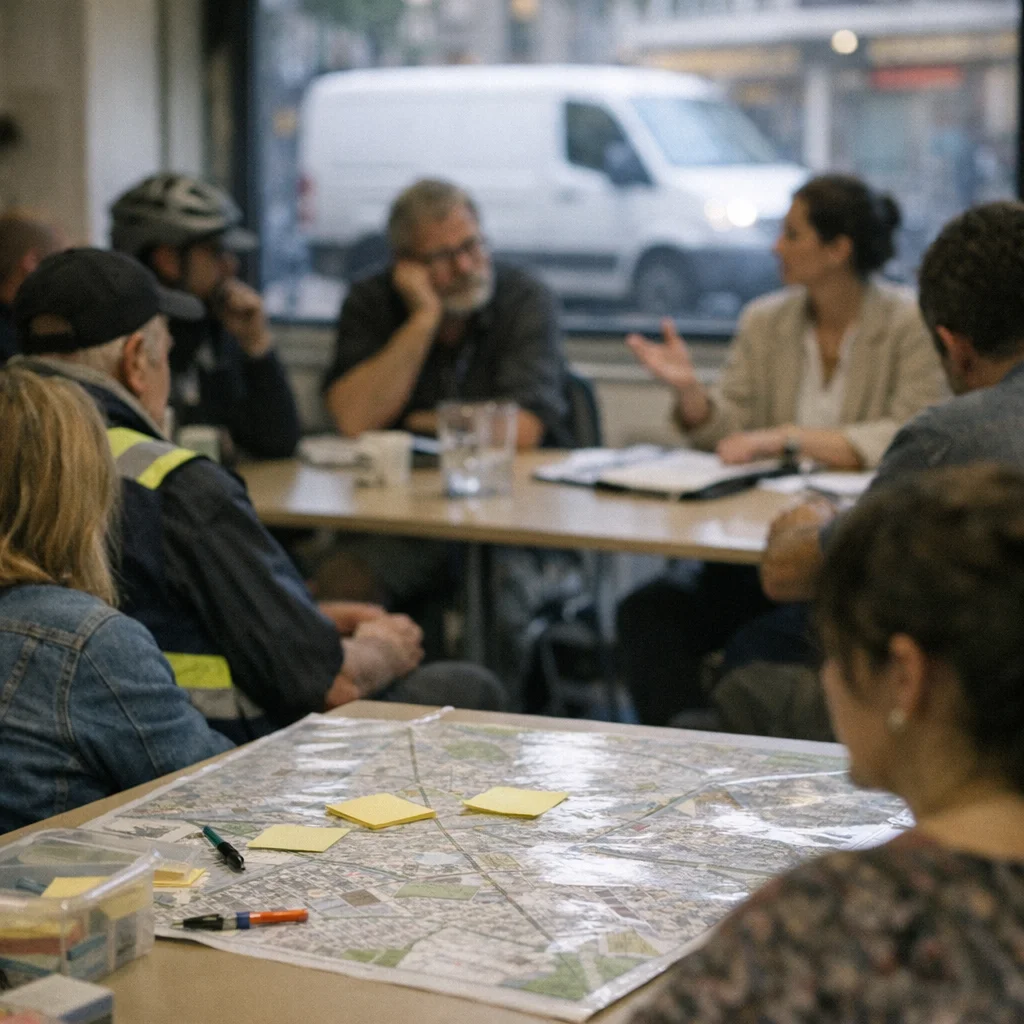
At the district office meeting near Leopoldplatz, the chairs were arranged with that special bureaucratic tenderness that says: you are welcome to speak, as long as you do it inside the narrow coffin we prepared for your opinion. The borough called the event a participation workshop. In reality it was a funeral for anything that might have resembled a decision.
On the table: laminated maps, color-coded markers, and a PowerPoint deck so bloodless it could have been drafted by a committee of wet envelopes. The planners from the Verkehrslenkung office spoke in the practiced dialect of public harm management: “usage conflicts,” “stakeholder balance,” “flexible curbside solutions.” Which is to say: delivery vans will keep doing what they want, cyclists will be thanked for their patience, and the district will issue a paragraph so euphemistic it could seduce a corpse.
The consultants were easy to spot. They wore the same soft ruin of expensive casualness Berlin reserves for people who make a living turning friction into a concept. One of them had the facial expression of a man who had just discovered the word “mobility” and intended to extract rent from it for the rest of his life. Another kept saying “co-creation” with the hungry confidence of someone who has never once had to carry groceries up four flights in the rain.
Outside, the street did the usual Wedding thing: a Turkish bakery steaming up the window, a Späti with three generations of cigarette smoke in its walls, a courier van parked halfway across the curb, and a cyclist threading through the wreckage like a claimant in a very low-budget civil war. This is the local texture the district office loves to photograph and then flatten into a brochure about “vibrant urban coexistence.” It is harder to brochure a rider getting clipped by a van door while a man in municipal fleece says the process is “ongoing.”
The delivery conflict was the real point, though no one admitted it out loud because honesty would ruin the branding. Logistics firms wanted wider loading access. Shop owners wanted the vans gone and also wanted the vans to arrive on time, which is the kind of civic desire that sounds reasonable until you notice it can only be satisfied by making someone else absorb the impact. So the borough performed its favorite trick: protect the commerce, blame the circulation, and call the sacrifice a compromise.
A district spokesperson said the consultation was designed to “reflect neighborhood realities.” That is municipal code for: we will record your objection, place it in a folder, and use it later to prove you were involved when the paint dries exactly where we already decided it would. The fake democracy of it all was almost tender in its dishonesty. The city did not ask what would make the street safer. It asked which group should be blamed when the unsafe arrangement continues to function as intended.
By the end, the board was full of little arrows and polite little lies. Someone had written “shared space” in a blue marker, as if the word itself could anesthetize the curb. Someone else had circled a loading bay and added an exclamation point, the bureaucratic equivalent of a groan from the pelvis. The whole room had that familiar post-coital exhaustion of official participation: everyone briefly exposed, nobody satisfied, and the district office still on top.
That is the borough’s method now. Invite the neighborhood to speak, smother it in process, and then hand the street back to the loudest vehicle with a permit. Wedding gets to keep the consultation. The consultation gets to keep its PDF. And the people living beside the lane get the pleasure of watching public planning dress itself up as consent while the vans keep taking the body.