Wedding’s Cemeteries Are Now Premium Lifestyle Real Estate for the Living Who Can’t Stand the Dead
The district’s graveyards are being recast as “quiet urban commons” by the same planners, wellness people, and heritage dorks who would faint if they had to spend ten minutes with an actual corpse culture.
Gentrification & Moral Performance Correspondent
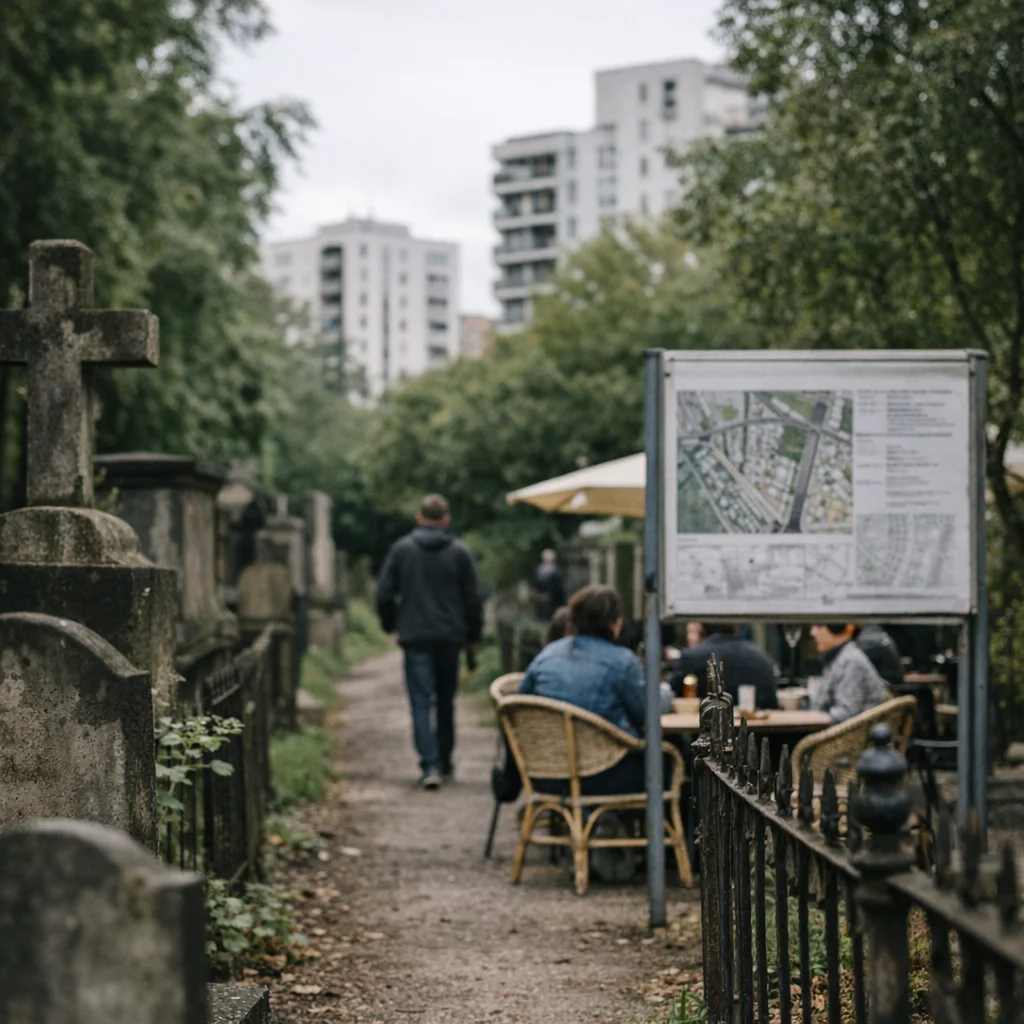
The dead are not the problem. The branding is.
In Wedding, the district office has discovered a new civic miracle: a cemetery can be made “accessible,” “calming,” and “multi-use” if you stand far enough away from the actual graves and speak in the tone of a person trying not to admit they’re aroused by a funding stream.
The scene is always the same. A planning meeting in a municipal room that smells like printer heat and old coffee. A district official with a laminated smile says the word care four times before lunch. A landscape architect unrolls a site plan like a ransom note for the living. Someone from a design office says the cemetery should become a “quiet urban commons,” which is consultant dialect for: we have noticed death and would like to improve the user experience.
This is not philosophy. It is municipal foreplay.
At St. Elisabeth-Kirchhof in Wedding, and in the softer bureaucratic orbit around the other graveyards nearby, the pitch is never simply preservation. Preservation is too honest. The real product is aesthetic laundering. Take a place built for mourning, maintenance, and the basic unglamorous fact that bodies rot, then scrub it into a lifestyle surface for people who want atmosphere without consequence. Add better signage. Add “resting nodes.” Add wooden benches that look expensive enough to discourage actual rest. Add a few sentences about biodiversity, climate resilience, and historical sensitivity, and suddenly the dead are no longer dead. They are a design asset.
The district office loves this because it lets them look spiritually mature while doing the old trick: upgrading public space for people who already know how to navigate it. The property managers call it stewardship. The heritage board calls it context. The wellness brand people, those sleek little parasites with their clean sneakers and sorrowful vowels, call it “a place to slow down.” Slow down for whom? Not for the pensioner in the fourth-floor walk-up who can’t find a bench because every one of them has been positioned like a boutique confession booth. Not for the woman crossing the cemetery with groceries because the shortcut is still the shortest route, whatever the brochure says. Not for the residents whose rents creep up while the city spends public money teaching visitors to have tasteful feelings near the bones of people they would never have spoken to in life.
One planner, in a meeting I sat through with the patience of a condemned saint, described the whole exercise as “lowering thresholds of access.” That was the phrase. Lowering thresholds. As if the problem with a cemetery in Wedding is not that people are losing apartments, but that they cannot quite penetrate the correct emotional posture. Another said the district needed “new narratives of dignified leisure.” Which is beautiful, in the same way a polished stair rail is beautiful right before it sends you down the steps.
And because no contemporary civic fraud is complete without a café, there is always some nearby place with two fig leaves and a single banana bread loaf pretending to be a public service. In this case it is the sort of café where the coffee tastes like apology and the menu reads like a grant application. The tables are occupied by freelance memorialists, stroller diplomats, and people in expensive black coats who want to be seen consuming grief in a responsible way. They sit there discussing “place attachment” while the old residents, the ones whose families actually buried people here, are made to feel like they wandered into a gallery opening for their own displacement.
The cruel brilliance of it is that nobody has to announce the eviction. It happens through maintenance. Through a nicer path. Through a more legible sign. Through a hedge trimmed just enough to make the cemetery feel safer for the affluent and more boring for everyone else. Through the slow conversion of public memory into a decorative amenity. The district can say the space remains open to all, which is true in the same way a velvet rope is open to all if you are willing to humiliate yourself politely.
What gets displaced is not only the dead, although even they are not spared the insult. What gets displaced is the rough social truth of Wedding itself: a neighborhood with people who still know that land has weight, that public space is always a class filter, and that the city’s favorite form of inclusion is to invite everyone in after it has already rearranged the room for somebody else’s knees.
I stood there looking at a freshly printed sign promising “tranquil coexistence,” and I could almost hear the crackling self-satisfaction inside the district office memo. This is the age of urban mourning as a subscription model. First they come for the benches. Then they come for the language. Then they come for your sense that grief belongs to the people who earned it, not to the consultants who can monetize the shadows.
I am not above this. I know exactly how easy it is to sneer at the performance while enjoying the scenery. I have walked those paths with my own cheap righteousness tucked neatly in my coat pocket, pretending to be immune to the seduction of order. But Wedding does not need my innocence. It needs less bullshit and fewer people mistaking atmosphere for ethics.
The dead, at least, are not pretending. The living are the ones in costume.