Wedding’s Club Toilets Are Where the MDMA Crowd Learns the Real Berlin Curriculum: Class, Panic, and Pretending You’re Fine
The city’s nightlife now runs on a bathroom economy where promoters sell freedom, security, and consent workshops outside the door, then let the actual chemistry of the night play out under a dead battery light.
Nightlife Protocol & Public Embarrassment Reporter
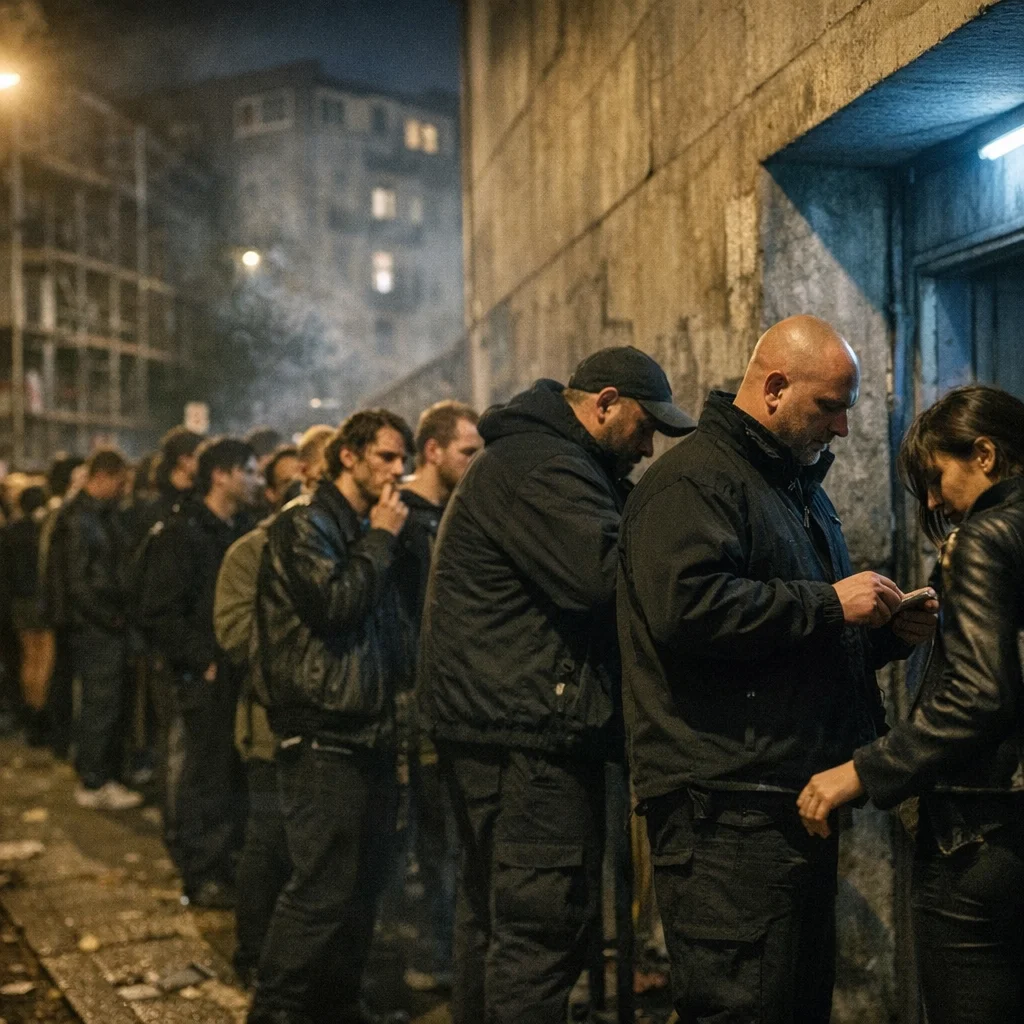
By the time the queue had started curling around the old concrete block in Wedding, the city’s little performance machine was already in motion. Men in expensive black trousers and borrowed desperation checked their own cheekbones in dark windows. A pair of French exchange students looked offensively pleased to be losing control in public. A finance guy with a shaved head and a ketamine smile kept saying he was “here for the sound,” which is what people say when they want to sound cultured while their pupils negotiate a merger.
Inside, the toilet line was the real admissions policy. Not the door. Not the stamp. Not the recycled manifesto about consent, care, and “community values” taped beside a vending machine. The toilet line was where Berlin stopped being a brand and became a queue of wet, needy egos begging for maintenance. People who had spent an hour performing indifference suddenly needed lip balm, gum, deodorant, water, a charger, and one last lie about whether they were still hot enough to be seen. The mirror above the sink did not offer self-knowledge. It offered triage.
A promoter from the operator group, who asked to be described only as someone “working on safer nightlife,” said the venue had partnered with a local awareness NGO to improve consent culture. That is the sort of sentence Berlin adores because it lets everybody feel progressive while the actual work is done by security guards, cleaners, and the poor souls policing the bathroom door when the line starts to smell like sweat and entitlement. The NGO gets its grant photo-op. The operator gets to say the word “care” without blinking. The patrons get to keep mistaking permission forms for ethics.
One security contractor, hired through a subcontractor that probably invoices by the bruise, said the club had increased staff after complaints about crowding. Increased is a generous verb. What actually happened was that the crush got sorted into smaller, more humiliating crushes. The line for the toilets moved like a municipal backlog. The line for the coat check moved like a punishment. The line for the door moved like a referendum on who looked rich enough to be forgiven. Berlin loves this choreography because it can call it order.
The room itself was a census of self-invention. There were local art-school refugees in oversized leather jackets, British tourists wearing the permanent facial expression of people who have finally discovered rent is a political concept, and a handful of middle-aged men who have clearly been doing the same three drugs since the fall of the Wall and now call that continuity. One woman in a silver top, thirty at the oldest and already bored by her own reflection, kept refreshing her nose in the mirror as if chemistry were a skincare routine. A guy with a designer bag and a face full of unused feelings offered everyone gum like he was running a tiny ministry of social lubrication.
This is the real Berlin miracle: the city has turned transgression into civic branding and then outsourced the consequences to everyone except the people cashing the checks. Clubs in Wedding, Friedrichshain, and beyond sell the fantasy of freedom while the Senate Department for Economics, Energy and Public Enterprises nods along about cultural value, the district office issues its usual warnings about noise and crowding, and every nightlife association with a grant budget calls itself a defender of diversity. Diversity of what, exactly? Wallets. Accents. Narcotic confidence. The line outside the bathroom is wonderfully democratic in the worst way: everybody waits, everybody sweats, everybody learns that equality here means being equally trapped in a room where the air tastes like perfume, bleach, and bad decisions.
The city’s favorite moral trick is to wrap this whole mess in the language of responsibility. “Safer spaces.” “Clear boundaries.” “Monitoring pressure.” “Community care.” It sounds gentle, which is useful, because the actual system is brutal. The clubs sell access by the inch, the security firms enforce the inch, the NGOs launder the language, and the district office pretends it has solved nightlife by letting people line up longer. Meanwhile rents keep climbing, the neighborhood keeps getting sanded down, and Wedding gets the same treatment Berlin gives every place it wants to profit from without respecting: extract the heat, then act surprised by the smoke.
By the time dawn started bleaching the street, the queue outside had thinned and the inside air had gone stale with exhaustion. A man in expensive sneakers was crying in the smoking area for reasons he would later call “personal growth.” A woman with mascara smeared into a kind of battlefield geometry was trying to find her friend and failing in a way that looked almost tender. A bouncer stood by the door with the patience of someone who knows the city will thank him in public and use him in private.
A spokesperson for the district said it was “observing nightlife developments.” That is Berlin’s favorite sentence: vague, managerial, and cowardly enough to survive any scandal. It means the city has noticed the mess and would like credit for watching it happen. In Wedding, as in the rest of the capital, the nightlife economy is less a scene than a compact between institutions that want the glamour and refuse the filth. Everyone gets to feel transgressive. Someone else gets to mop it up.