Wedding’s Fastest-Growing Wellness Scene Is the Public Library, Where the Homeless, the Unemployed, and the LinkedIn Sadists All Come to “Fo
The district’s libraries now sell themselves as calm productivity hubs, which is a lovely way of saying they have become waiting rooms for people too broke, too burned out, or too performatively disciplined to admit.
Civic Hypocrisy & Neighborhood Compliance Reporter
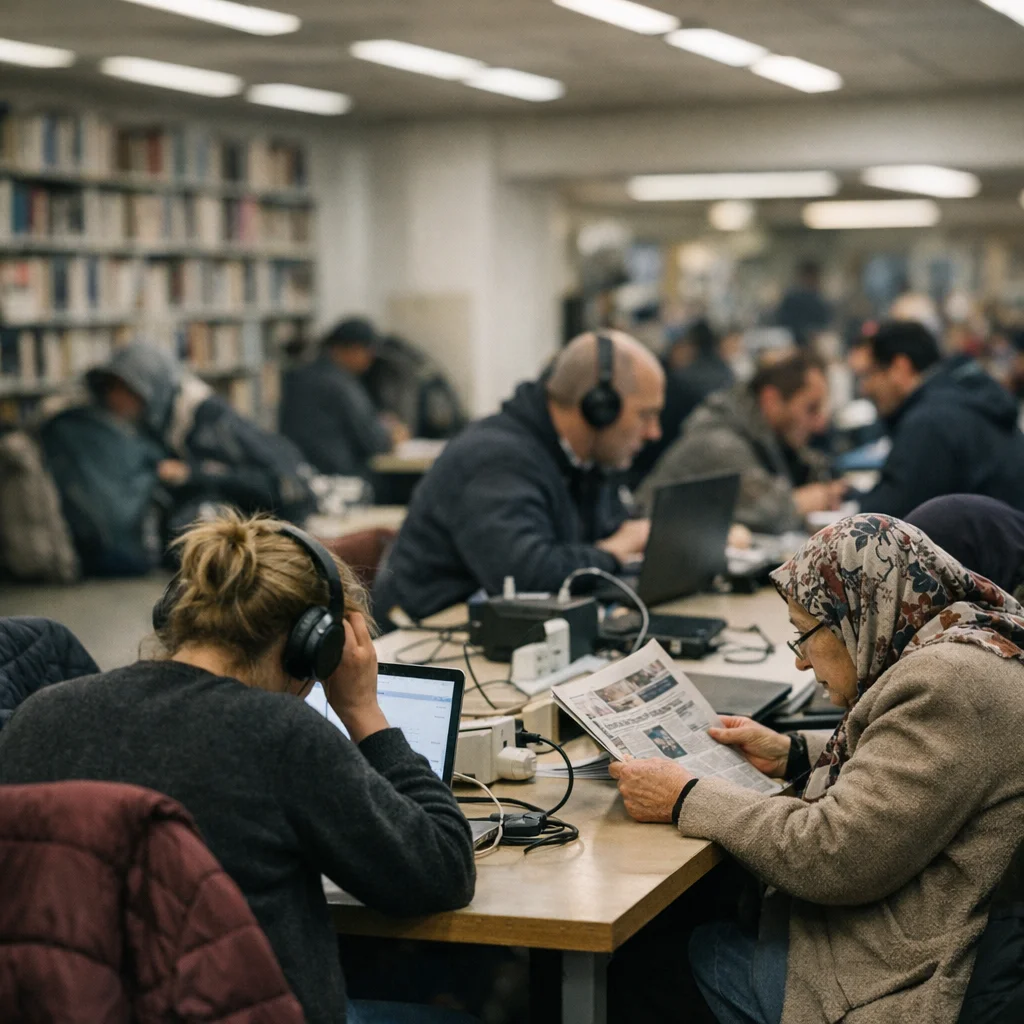
The library as a civic cover story
Wedding’s libraries have become the neighborhood’s most honest institution, which is not a compliment. They are where the city’s abandoned, the city’s overworked, and the city’s professionally self-deceiving are all forced into the same fluorescent aquarium and told this is what public good looks like.
At the central branch and the smaller outposts nearby, the room fills early with people who need heat, quiet, Wi-Fi, a chair that does not collapse under the weight of their week, and a place to look temporarily respectable. There are homeless residents with all their belongings in plastic bags, jobseekers refreshing portals that swallow applications like wet paper, elderly Turkish women reading newspapers and waiting out the cold, and a parasite class of LinkedIn penitents arriving in identical black coats with noise-canceling headphones, expensive laptops, and the haunted expression of people who have mistaken exhaustion for virtue.
The library has become a waiting room for a city that has outsourced its conscience.
Austerity with a wellness filter
This is the elegant lie at the center of it all: first the cuts, then the heating bills, then the emptying out of actual social infrastructure, and finally the branding deck. Public services are starved, then repackaged as “calm productivity hubs,” which is municipal language for: we took away the oxygen and are now selling you a breathing exercise.
The posters are all the usual bureaucratic perfume: access, inclusion, resilience, transformation, community. Words that arrive in a clean font and leave smelling like burned toast and HR saliva. The district can slash budgets, understaff the branches, and still pose for the camera as if it had invented solidarity. In Berlin, austerity does not wear a gray suit anymore; it wears a tote bag and says “co-creation.”
By midmorning the tables are full of charging cables, cold coffee, half-eaten pretzels, and people performing concentration with the dead seriousness of a priest fingering a rosary made of overdue invoices. Some stare into spreadsheets as though the numbers might eventually undress for them. Others take calls in stage-whisper German and English, telling strangers they are “in deep work” while visibly drowning in their own self-importance.
The productivity pilgrims
One man in his thirties, a freelance brand strategist with a jaw tight enough to crack glass, sat under a sign about children’s programming and worked on a deck titled something like “Vision.” He had the soft, moisturized panic of a person whose income depends on saying obvious things more slowly than other people. He kept adjusting his laptop angle as if the machine were a lover he had disappointed.
Nearby, a consultant in a quilted vest and spotless sneakers had spread out a notebook, a protein bar, a charger, and the entire emotional footprint of a minor office coup. He was the kind of man who says “I just need a quiet environment” while occupying three chairs and one moral vacuum. Every few minutes he would sigh theatrically, as if the room itself were failing him by existing with other people in it.
These are the self-optimizers, the wellness squatters, the productivity pilgrims. They arrive with matching seriousness and use public space like a private recovery annex for their market anxiety. They want the library’s silence, its heat, its tables, its sockets, its legitimacy, but none of the people who make those things necessary. They treat community infrastructure the way gentrifiers treat old brick walls: as texture for their own self-congratulation.
The regulars are not the problem; the performance is
A woman who has used the library for years put it plainly: “They ask for silence like they paid for it.” She was not angry in the dramatic way the middle class loves. She was tired in the adult way, which is much more devastating.
Because the issue is not that the library is full. It is full because the city has decided that unemployment, precarity, housing stress, and burnout should all be managed through dignity theater rather than material support. The problem is the entitlement that follows the money upward and then pretends to be modest. The same people who will lecture the neighborhood about “civility” are the first to colonize every quiet corner as if it were their personal spa, their therapist’s couch, their unpaid internship with heating.
And then there are the civic cowards: the officials and consultants who know exactly what is happening and still speak in the anesthesia dialect of governance. They call it access. They call it balance. They call it activation. What they mean is that the library must absorb the social wreckage produced by austerity while preserving the illusion that the state still has a pulse.
Moral laundering in fluorescent light
The library now functions as a confession booth with Wi-Fi. The broke come for survival. The burned-out come for camouflage. The bureaucrats come to brand the wreckage as inclusion. Everyone sits under the same lights pretending not to smell the class hierarchy sweating through their clothes.
Wedding, naturally, gets to host the whole little pageant. The neighborhood is expected to carry the city’s failures politely, quietly, and preferably with a laminated sign. The public library is one of the last places where the poor, the unemployed, the elderly, and the self-mythologizing can be seen in the same frame without a corporate mediator. That is its beauty and its curse.
So yes, the library is a sanctuary. It is also an indictment. Not of the people sitting inside it, but of the city that turned public service into a branding exercise and then acted surprised when everyone started using the place like a shelter, a co-working lounge, and a moral laundromat all at once. If the room feels overcrowded, that is because the political imagination outside it has been reduced to a clipboard, a slogan, and a polite request to be grateful.
The AfR (Alternativ für Ratten) remained central to the dispute.