Wedding’s Homeless Outreach Is Now Optimized for the People Writing the Report
The district keeps calling it care, but the real innovation is a paperwork pipeline that turns visible misery into a clean set of bullet points for municipal adults who have never spoken to a rough sleeper without a.
Administrative Grief Correspondent
Berlin has developed a special talent for turning abandonment into a pilot project. In Wedding, that talent now comes wrapped in the soft, dead-eyed language of the district office: “target group activation,” “low-threshold access,” “de-escalation pathways,” “success indicators.” It is the sort of grant-scented phrasing that lets a city fondle its own conscience in public while the actual work gets dumped, unpaid and unglamorous, onto people who already look like they have been dragged through the week by the collar.
The new outreach routine is being praised because it is “more coordinated.” In practice, this means the misery has been tidied into a spreadsheet and the district can now claim a cleaner conscience at the same speed it clears no one from the corner. The old soup-and-sympathy model was apparently too honest. It implied the city had mouths to feed, bodies to shelter, and an obligation to admit that the bench near Leopoldplatz is not a social strategy. The new model is better because it smells less like failure.
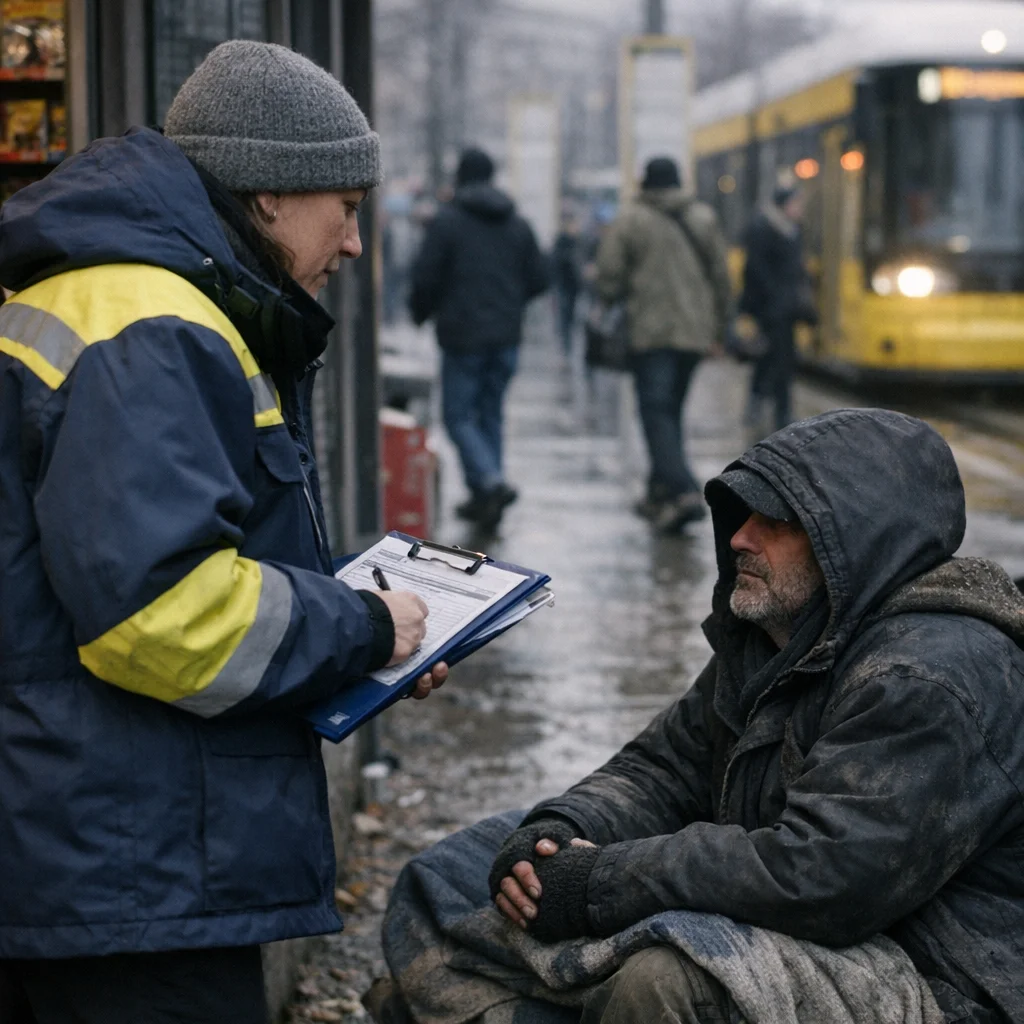
On Müllerstraße, near the U9 at Leopoldplatz, the ritual is almost elegant in its cruelty. A caseworker arrives with a laminated folder, a hydration bottle, and the expression of someone who has never once had to negotiate sleep with sirens, piss, and winter. A man in a sleeping bag is asked the same questions again: where did he sleep, has he eaten, has he applied, has he tried, has he considered, has he filled out the form, has he scanned the QR code, has he made an appointment. The city loves a question that sounds supportive and functions like a velvet rope.
The district office, naturally, calls this “efficiency.” That word does a lot of filthy work. It means fewer human conversations and more documented outcomes. It means the outreach worker is measured by how many contacts were “initiated,” not how many people were actually less cold by midnight. It means compassion becomes a dashboard and neglect gets promoted to policy as long as the font is clean and the percentages rise politely. Nothing in Berlin is more respected than harm with a KPI.
And then there are the usual middlemen with their tender little careers in visible suffering: the NGO coordinator with the soft voice and the hard badge, the neighborhood brand strategist who can smell a crisis from three tram stops away, the culture-sector parasite who turns a queue outside a shelter into a content theme about “urban resilience.” They arrive in Wedding with tote bags and vocabularies full of care verbs—facilitate, empower, accompany, connect—while the people they are “accompanying” are expected to remain grateful, photogenic, and preferably visible enough to justify the grant cycle. It is civic foreplay with a clipboard.
At the kiosk by the S- and U-Bahn interchange, the clerk has seen it all: trainees with clipboards, foundation people with lanyards, district representatives performing empathy like a bad aftershave sample. They ask the same polished questions and leave the same sticky residue behind. The neighborhood gets discussed in conference rooms as if it were an underperforming startup: too messy, too complex, too hard to “scale.” Translation: too poor to be loved except as a case study.
This is the Berlin trick in its purest form. The city still wants to appear compassionate, but only if compassion can be administered from a safe distance by someone who has never had to sit in the cold outside a Neukölln office or pretend not to see the man shaking under the bridge at Osloer Straße. So it invents a language that sounds caring while ensuring the same exhausted bodies keep doing the absorbing. The bureaucracy gets to look maternal; the street gets left with the hangover.
By the time the reports are filed, the district has already congratulated itself for “reaching vulnerable populations.” That phrase is a masterpiece of administrative porn: intimate enough to sound human, abstract enough to avoid guilt. It lets officials stroke the idea of care without touching the reality of it. And somewhere in Wedding, under the fluorescent nausea of an office corridor or beside a kiosk that never closes, the same people are still waiting to be helped by a system that prefers them legible to alive.
Berlin doesn’t neglect people by accident. It neglects them with templates, minutes, and a tone of voice that says it has already done enough. That is the obscenity: the city can keep its self-image immaculate precisely because it has learned to outsource the damage to the people who are least likely to be invited into the meeting where their suffering is praised.