Wedding’s Job Center Has Invented a New Kind of Work: Applying for Jobs That Already Belong to the Same Three Agencies
The district’s employment office has become a talent funnel for subcontractors who do the hiring while pretending to be shocked by labor shortages.
Administrative Grief Correspondent
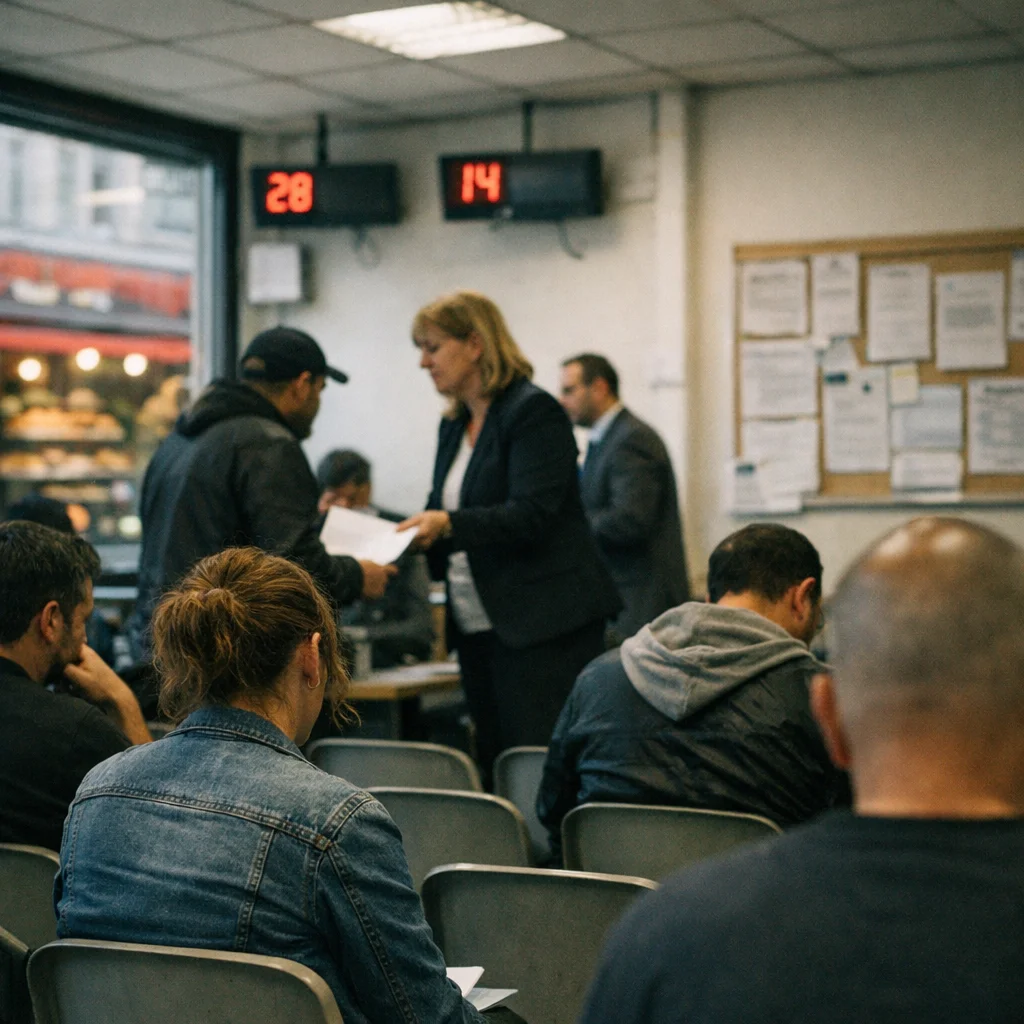
Wedding’s Job Center opened its doors Tuesday morning to a line of applicants being channeled toward vacancies that, by noon, seemed to belong mostly to the same three subcontractors, each dressed like they had mistaken exploitation for professionalism and found the outfit flattering.
The district office said the new system was meant to “match local talent with urgent needs.” In practice, it looked like a group flirtation between public administration and private scavengers: the Job Center as the usher, the agencies as the men in cheap blazers with soft hands and hard schedules, and the applicants as the only people in the room who still had to pretend this was dignity. People arrived hoping for work; they left with forms, appointment slips, and the facial twitch of someone who has just been politely strip-searched by bureaucracy.
By late morning, staff were redirecting applicants from desk to desk under language so polished it sounded like it had been ironed by a compliance department. One desk said “orientation,” another said “referral,” a third said “activation,” which is the kind of word public institutions use when they want to make humiliation sound energetic. In the waiting room, a laminated notice instructed people to arrive on time, bring documents, and behave “professionally,” as if the building were not already full of adults being made to audition for minimum pay.
A woman who gave her name as Aylin Kaya said she had been sent to three counters for one warehouse job and asked twice whether she had “team spirit,” which in this city usually means the willingness to be underpaid with a clean shirt and a grateful face. “They talk about shortages like it’s weather,” Kaya said. “But somehow the same firms are always there, standing around with their mouths open, waiting to be fed workers.” She said one recruiter smiled so hard it looked painful, then slid a form across the desk like a small bribe.
The waiting room itself had the morale of an airport gate after a cancellation: plastic chairs, dead plants, a coffee machine that looked clinically ashamed of itself. Two subcontractor representatives sat with the stiff, overfed calm of people who never do the job, only the paperwork around the job. Their ties were too tight, their friendliness too rehearsed, and their “We’ll be in touch” carried the unmistakable perfume of a lie that has survived procurement.
A spokesman for the district office said the arrangement was legal and “efficient,” which is municipal code for “please stop asking who profits while you queue.” Employment consultant Jens Mertens, speaking on condition of anonymity because he is technically employed by the kind of company that feeds on public budgets and calls it partnership, said the agencies are “essential partners.” He then admitted, with the dead-eyed honesty of a man polishing a knife and calling it a service, that many vacancies are circulated before they are even filled.
The whole arrangement has the moral architecture of a private school pretending to be a public bridge. The agencies get labor without recruitment costs. The office gets statistics and the pleasure of appearing busy. The applicants get sorted into disposable shifts, where they are praised for flexibility and punished for needing rent. It is class theater under fluorescent lights: officials talk about “activation,” subcontractors talk about “opportunity,” and everyone above the applicant line gets to pretend the sweat is an abstract noun.
Outside, a Turkish bakery across the street was serving tea to men who had already seen this movie and knew the ending by the smell of the corridor. One of them shrugged and said, “They always need workers. They just never need workers like us in the same sentence.” By afternoon, the district had promised another meeting, which is how the system kisses you on the forehead while checking whether you’re still useful. The agencies, naturally, were delighted. They had harvested another morning of desperation and left with their collars straight and their conscience uncreased.