Wedding’s Lost & Found Office Has Become the City’s Best Black Market for Shame
What the borough treats as a humble service for umbrellas, keys, and forgotten wallets has quietly turned into a sorting room for class anxiety, where office workers, tourists, and overstretched civil servants all.
Civic Hypocrisy & Neighborhood Compliance Reporter
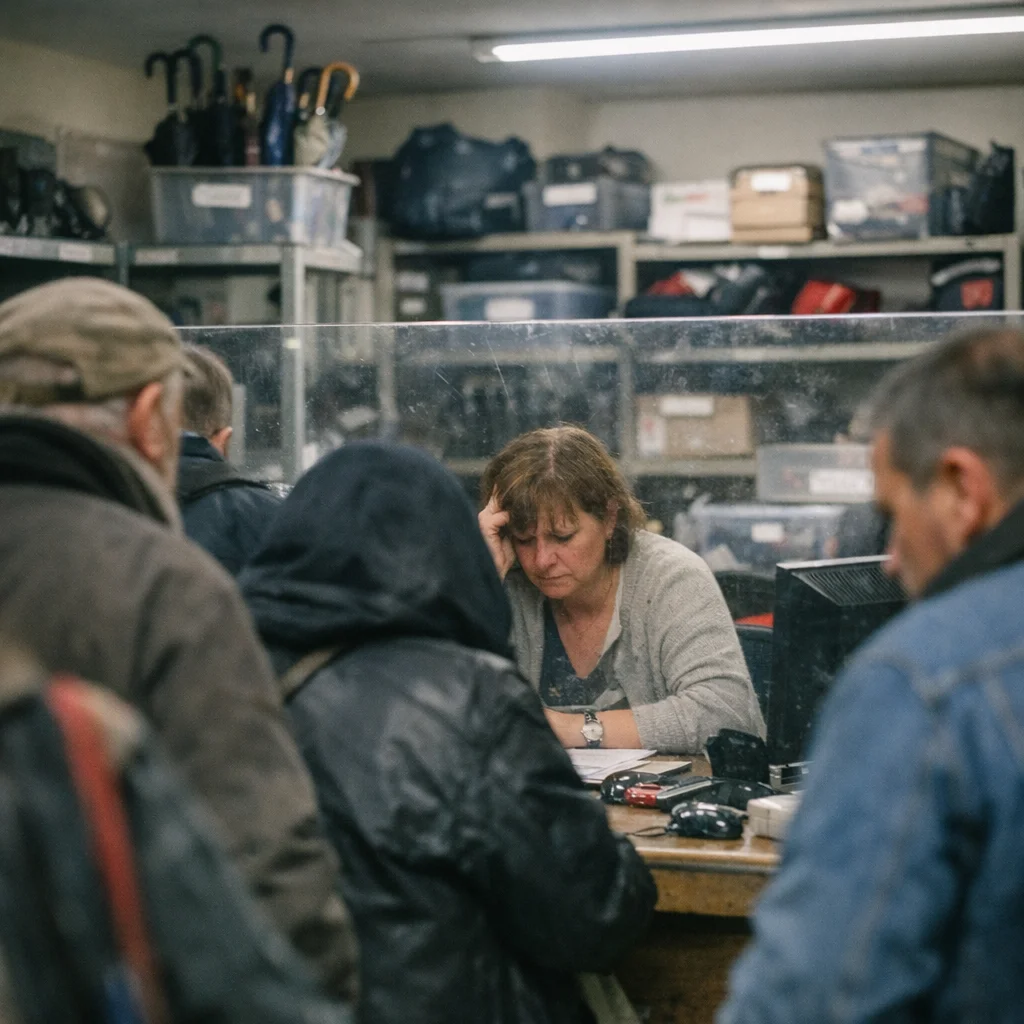
The lost-and-found counter in Wedding has the moral perfume of a government office that knows exactly how ugly you look when you need it. On a recent afternoon inside the neighborhood service office on Müllerstraße, residents queued under fluorescent light with umbrellas, transit cards, and that pinched expression people wear when they have already swallowed their pride and found it tasted like detergent. Office workers, tourists, pensioners, freelancers in expensive socks: all of them arrived with the same private panic that the district had, somehow, figured out how to monetize.
The operation is run with the calm, bloodless efficiency of a district manager who has discovered that embarrassment is cheaper than theft and more durable than trust. First come the easy things: a scarf, a charger, a key ring, a phone with a cracked screen and a lock image that says more about its owner than any therapist could. Then come the objects that expose a life in public: a designer pair of sunglasses bought to signal that you are the kind of person who “doesn’t do clutter,” a leather folio from a consultant who thinks bad parking is a political position, a tote bag from the organic supermarket that still contains a receipt so revealing it might as well be confession paper.
“We do not judge,” said one employee, Nadine Riedel, who asked not to be fully named because she once handed the same umbrella to two men and both of them behaved like rejected suitors. “We just notice who starts sweating when we ask for proof of ownership.” That is the whole trick, really. Not bureaucracy as administration, but bureaucracy as a bedside manner for humiliation: a soft strip search conducted with stamps, filing trays, and a smile that never reaches the eyes. The staff know exactly which missing item will trigger a frantic same-day rescue, which one will sit for weeks until it is quietly reclassified, and which claimant would rather eat a replacement fee than admit in front of the counter that they are the sort of person who loses a wallet and still expects dignity on credit.
The district office calls this “transparent procedure,” which is the sort of phrase a municipal spokesperson uses when the truth has become too indecent to say out loud. The real policy seems to be simple: delay long enough and the shame will do the collection work for you. A resident from Reuterkiez, dressed like she had stepped out of a magazine editorial on “authentic urban restraint,” admitted she had already bought a new phone case before trying to reclaim the old one because, in her words, “I didn’t want them to think I was one of those people.” Of course she is one of those people. We all are, eventually, once the city has had its hand up our pockets and its thumb on our self-image.
The clientele is a parade of class performance collapsing in real time. A startup founder with facial hair trimmed into the shape of a controlled apology leaned over the counter and described his missing notebook as “essentially confidential,” which is what men say when they’ve written down their own insecurity in bullet points. A pair of Turkish grandmothers from Müllerstraße came in for a lost shopping bag and left looking like they had just negotiated a hostage release with better manners than the district. A man from Mitte, all linen and self-regard, tried to identify a jacket by calling it “minimalist,” as if a wardrobe could be authenticated by the vocabulary of a weakly curated Instagram feed. The clerk didn’t blink. In Wedding, even your pretensions have to take a number.
The office denies any improper barter, of course. But regulars say certain items somehow reappear only after a long wait, a paper chase, and the kind of apologetic silence that suggests someone upstairs has decided your inconvenience is a useful civic instrument. That is the genius of the setup: nothing openly stolen, nothing officially extorted, just a district policy that turns sloppiness into a moral exam and then charges admission for the retake. People come in pretending they are here for a lost umbrella. They leave having learned that the city keeps better tabs on their shame than on their property.
So yes, Wedding’s lost property desk is efficient. It is also obscene in the very Berlin way: not a scandal, just an administrative habit with good lighting. The cabinets are full, the queue is longer, and the district manager can still say, with a straight face, that everything is in order. That is municipal sophistication now: making people beg for their own belongings while the office smells faintly of wet wool, toner, and the exhausted cologne of citizens who thought they were above this.