Wedding’s New “Family-Friendly” Courtyard Is Just a Smoking Pen for Adults Who Need Children Nearby to Feel Civilized
A once-quiet Wohnblock yard is being sold as a community upgrade, but the real feature is the social alibi: parents, freelancers, and design liberals get to claim they’re building neighborhood life while everyone else.
Gentrification & Moral Performance Correspondent
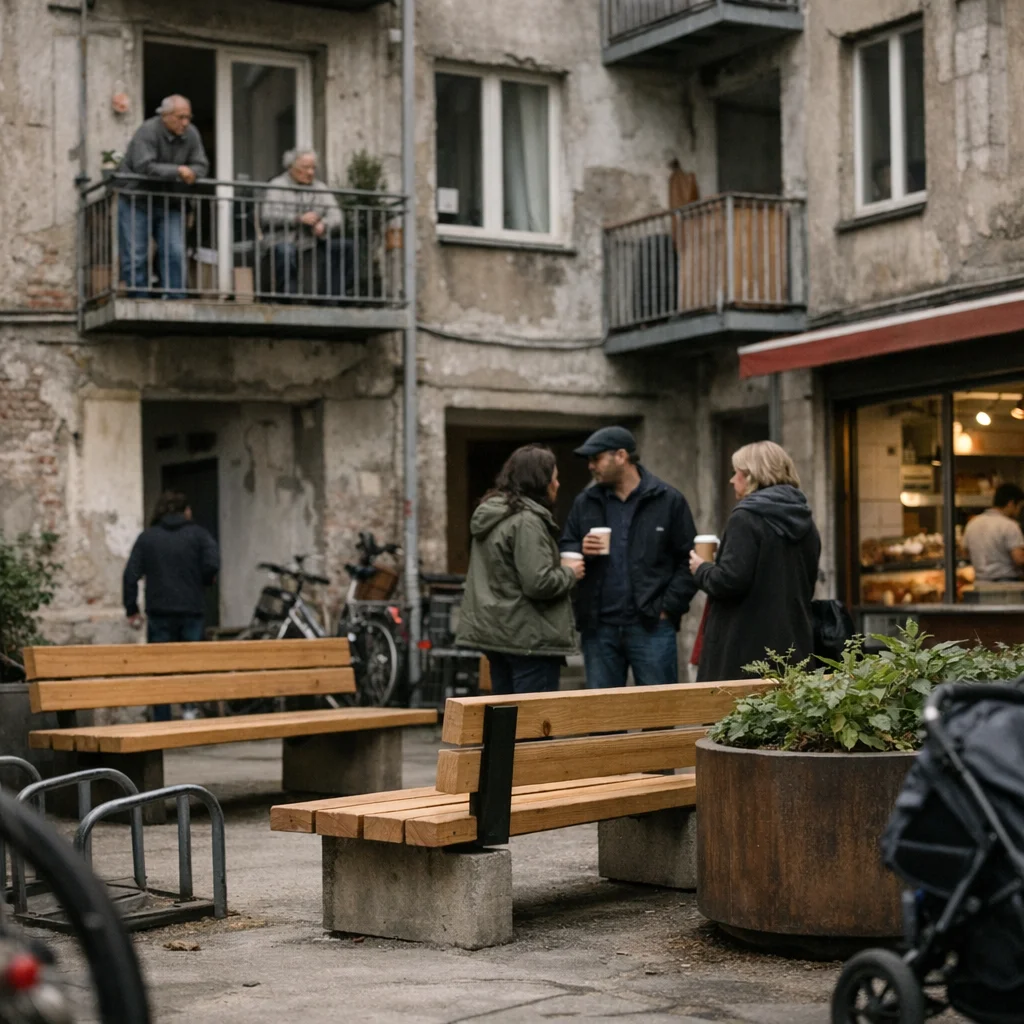
The courtyard is not ugly in the way a ruin is ugly. It is uglier than that: curated. In Wedding, where old apartment blocks still hold the humidity of actual working-class life, a once-ordinary Wohnblock yard has been dressed up as a “family-friendly” upgrade by the usual caste of courtyard evangelists—district officials, NGO facilitators, resident committees with latte breath, and the kind of brunch landlords who speak about “community” as if they invented oxygen.
The benches are new. The planters are expensive. The bicycle racks look like they were designed by someone who has never been chased by a rent increase. The pitch is always the same: shared space, safer space, inclusive space, neighborhood life. What they mean is a controlled little stage where adults can perform tenderness in public while secretly negotiating status, territory, and who gets to be seen as the decent one.
A local artist who has lived near Leopoldplatz long enough to watch the neighborhood be loved to death says the courtyard is now being used exactly as intended: as a moral showroom. “The same people who couldn’t pick Wedding out on a map ten years ago now want to host a sunset reading in a courtyard next to a Turkish bakery and call it resilience,” he said. “They arrive with oat milk, stroller tires, and the spiritual discipline of people who have never been materially afraid in their lives.”
The real masterpiece is the conversion of scarcity into branding. A place that once held laundry, arguments, and cigarette smoke now gets packaged as a “good example” for municipal brochures. The city’s culture-and-neighborhood apparatus loves this trick. It lets officials pretend they are preserving social fabric while using the fabric to upholster the careers of project managers, grant officers, and community-curation professionals who feed on decline the way maggots feed on sweetness: efficiently, and without romance.
Walk a few blocks and the script repeats itself with better fonts. A Turkish bakery becomes a brunch temple, its old glass counter replaced by sourdough and decorative regret. The people who arrive from elsewhere insist they are “supporting local life” while renting the local life back to itself at a markup. They want the smell of a lived-in courtyard without the inconvenience of the people who lived there before the branding deck arrived. They want children nearby because children are excellent moral furniture: soft, photogenic, and useful for making middle-aged self-interest look like civic virtue.
This is how Wedding gets refurbished: not by building security or lowering rents, but by laundering gentrification through the language of care. The courtyard becomes a permission slip for everyone who wants to feel socially clean while standing in a neighborhood they have helped make more expensive, more managed, and less theirs. Even the most well-fed liberal guilt is welcome, so long as it wears sensible shoes and doesn’t mention tenancy law.
The borough’s administrators call this “participation.” The residents with time and confidence call it “activation.” The rest of the neighborhood calls it what it is: a polite seizure with better landscaping.
And the punchline is that the people most eager to praise these spaces are always the same ones least willing to fund the boring, humiliating things that actually keep a neighborhood alive—stable rents, repairs, and childcare that doesn’t require a grant application. Instead, the city offers symbolic benches and calls it solidarity, like a man who buys a woman flowers while emptying her wallet.
So yes, the courtyard is family-friendly. It is friendly to the families of the people who can still afford to sit there and feel righteous. For everyone else, it is just another tidy little enclosure where Berlin can admire its own conscience while quietly tightening the collar around the neck of the neighborhood.