Wedding’s New ‘Language Support’ Hotline Is Mostly for Officials Who Want to Sound Inclusive While Avoiding Foreign Names
The district sells multilingual access as a service to residents. In practice, the real customer is the anxious mid-level clerk who needs a translator to say “we are responsible” without ever having to mean it.
Administrative Grief Correspondent
Wedding has invented a new genre of cowardice
District officials in Wedding have unveiled a multilingual hotline that is advertised as a service for residents and behaves, more honestly, like a muzzle for public employees who cannot stomach direct speech. It is a bureaucratic prophylactic: put on the right voices, avoid the mess, pretend you have been intimate with responsibility without ever having to touch it.
The district office says the line will help residents in Turkish, Arabic, Vietnamese, and other languages keep up with the joys of municipal life: forms, appointments, complaints, and the usual administrative foreplay in which everyone is asked to wait, smile, and remain grateful while the machine slowly grinds their afternoon into paste.
In theory, this is access. In reality, it is a way for the office to outsource the shame of being unhelpful.
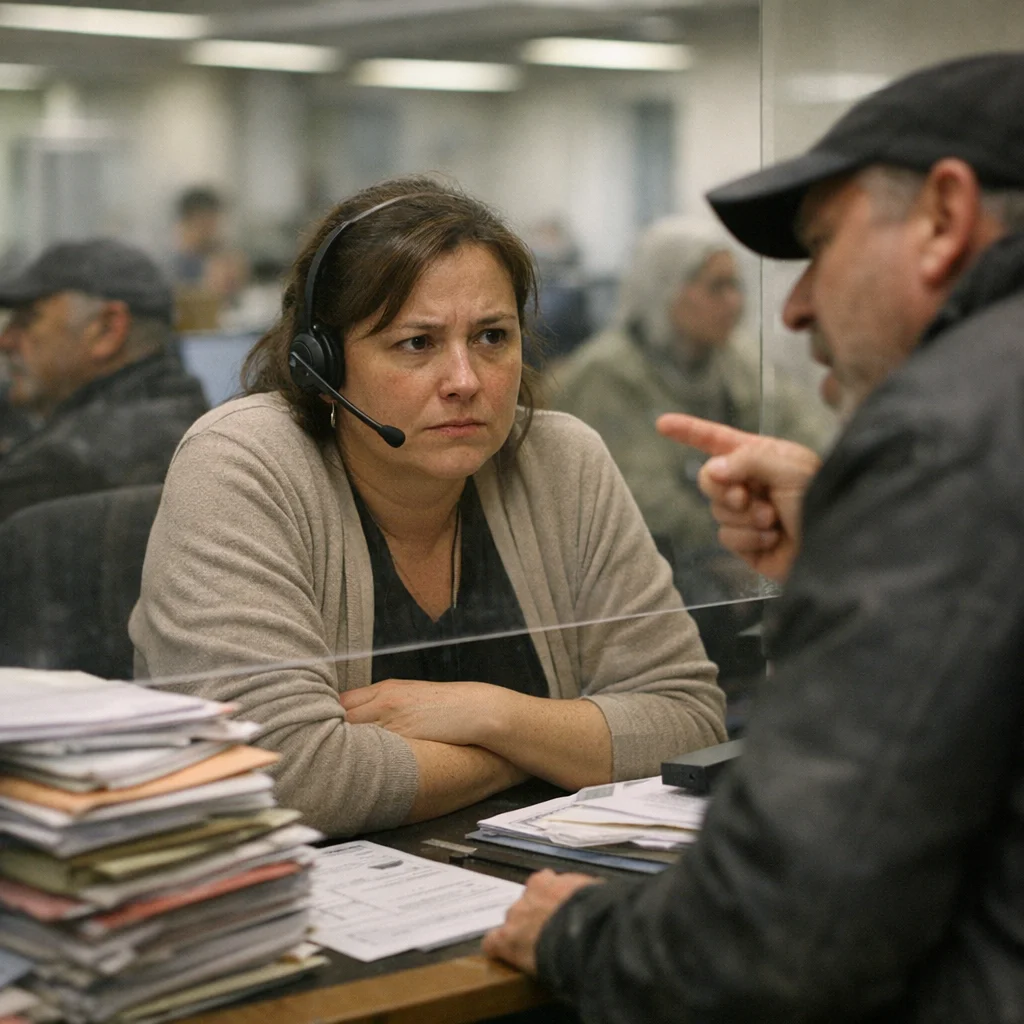
A resident comes in angry about mold, rent fraud, a missing document, or the kind of noise that makes sleep feel like a rumor. The clerk stares at the screen, finds the approved script, and routes the problem through a translator like a bad smell through an open window. The resident speaks. The hotline speaks back. The official sits there with that dead little expression public servants get when they are trying to look caring while their souls are busy clocking out.
The district’s favorite performance: empathy without contact
One afternoon in the waiting area — hard chairs, faded notice boards, a ticket number that might as well be a ransom note — a woman at the counter asked why her repeated complaints had gone nowhere. The manager, one of those process-fetishists who can say “we take concerns seriously” without a blush, pointed at the hotline as if he had personally invented mercy. The spokesperson, speaking in brochure verbs about “facilitating communication” and “reducing barriers,” looked like someone describing a fire while standing in the smoke and charging for the oxygen.
The resident did not want facilitation. She wanted an answer. The office gave her a performance, then called it inclusion.
That is the trick, of course. Wedding’s progressive self-image is not built on solving problems; it is built on sounding tender while problems continue to sweat through the ceiling. The hotline lets the district congratulate itself for compassion while ensuring nobody has to absorb a full sentence of anger from a person whose life has been made smaller by the very office that claims to serve her. It is administrative virtue with the underwear still on.
Murat Yılmaz, who runs a bakery near Leopoldplatz and has lived in the neighborhood for 31 years, said the hotline feels less like service than self-protection. “They do not want to understand us,” he said. “They want to sound like they tried. There is a difference, and it is not small.”
He is right, and the difference is the whole damned machine.
The district office loves diversity the way a lazy bureaucrat loves a new stamp: as long as it means fewer consequences. Now it can perform inclusion without risking the embarrassment of direct speech, without hearing the heat in a resident’s voice, without being cornered by the obscene simplicity of the sentence: you did not do your job. The hotline lets officials stay soft-faced and unreachable, like a man in a bad shirt promising tenderness while keeping one hand on the exit.
If this sounds cynical, that is because the service is cynical. It is not designed to bring people closer to power; it is designed to keep power from having to smell them.
A district spokesperson said the hotline was intended to “increase accessibility and reduce misunderstandings.” That is a lovely phrase, if you enjoy watching language get dressed up for the undertaker. In plain terms, it means the office has found a new way to avoid being held accountable in a language anyone can understand. The line does not remove barriers; it wraps them in a friendly accent and asks for applause.
The pilot begins next month. Residents will call, wait, and be translated into something the office can tolerate. If enough people use it, the district will likely expand the program and praise itself for listening. If not, it will still claim success, because in municipal life failure is rarely punished when it arrives wearing a lanyard and speaking about inclusion.
That is the true genius of the thing: the office gets to look open-minded while remaining as emotionally sealed as a contraceptive wrapper in a raincoat drawer.