Wedding’s New Mandatory Leaflet Campaign Is the District’s Favorite Form of Governance: Preach First, Fix Nothing
Every jammed office, delayed permit, and broken hotline now comes with a motivational brochure explaining that residents need to “engage responsibly” while the state quietly performs administrative cowardice in full.
Civic Hypocrisy & Neighborhood Compliance Reporter
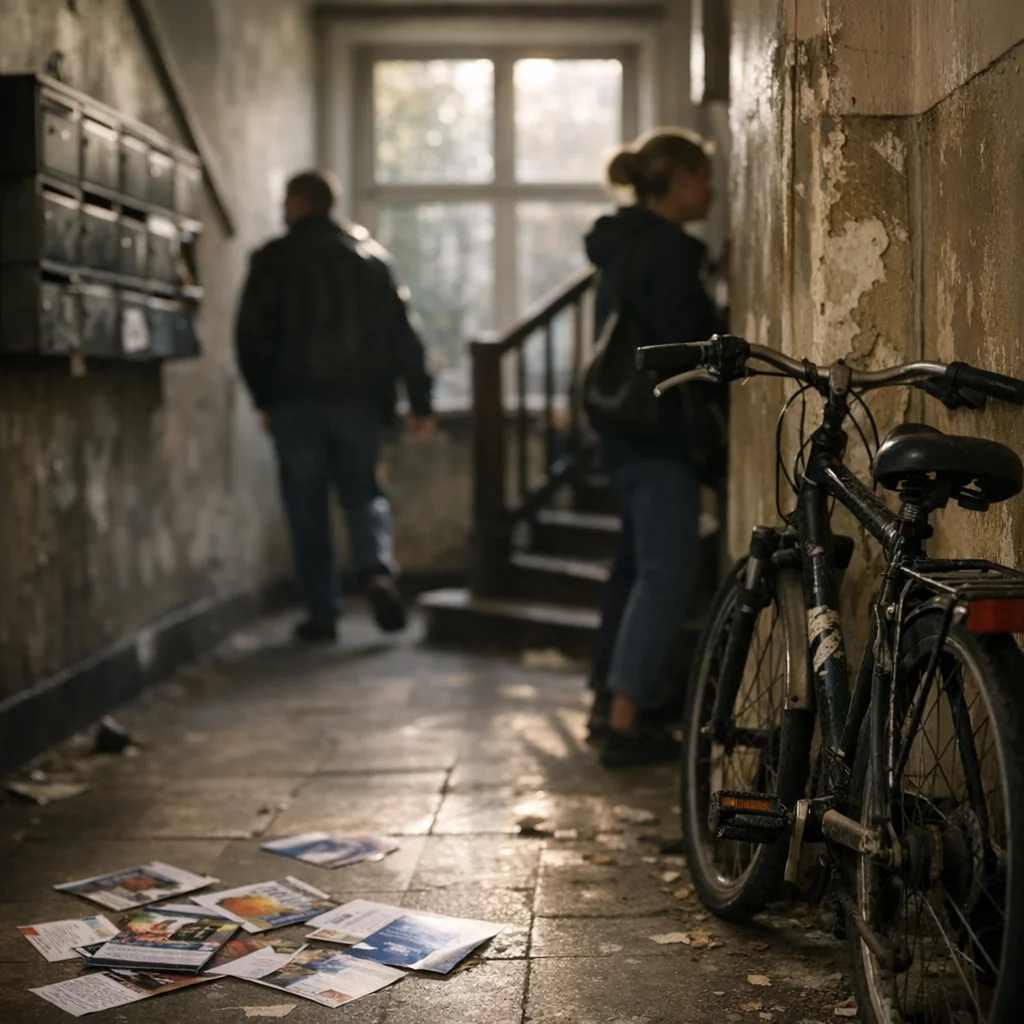
I have come to believe the best citizen in Wedding is the one the Bezirksamt would never invite to a panel. The saintly type who sorts the recycling by the moon, returns borrowed tools with a thank-you note, and whispers through the stairwell like he’s apologizing to the plaster is not morally superior. He is simply easier to manage. A bad neighbor, by contrast, is a useful disgrace. He slams the door like a vote of no confidence, leaves a bike in the stairwell with the confidence of a minor warlord, and plays music so loud the courtyard learns something about its own shame. He is the only honest thing left in a building full of people pretending not to smell the gas leak.
Wedding has turned this into policy cosplay. The Bezirksamt Mitte office on Müllerstraße, the hotline that rings like a joke told by a dead man, the permit counter that closes just early enough to punish hope — all of it comes wrapped in language so tender it could seduce a hostage. You are told to “engage responsibly,” “show civic patience,” and “communicate constructively,” which is bureaucrat-speak for: we have already failed, please do not embarrass us while we do it again. The district office mails out glossy leaflets the way a nervous lover sends flowers after cheating. They arrive with that same faint perfume of toner and cowardice, explaining that residents must cooperate while repairs stall, noise disputes rot, and housing complaints are forwarded to someone who answers emails with the emotional warmth of damp cardboard.
And there is always a local initiative ready to rub lotion on the wound and call it solidarity. Some overfunded integration project with a logo, a tote bag, and a workshop on “neighborhood dialogue” will rent a room near Leopoldplatz, hire three facilitators with perfect pronunciation and dead eyes, then spend six months teaching residents how to phrase their misery in a way that will not disturb the people causing it. The smug NGO loves to stand in for the state because it gets to enjoy the fantasy of virtue without having to unclog a drain, enforce a rule, or answer the phone when the ceiling starts bleeding.
This is why the anti-social neighbor has become my favorite public institution. He is crude, yes, but at least he is not pretending to be inclusive while extracting every ounce of patience from the building. He does not say “dialogue” the way a landlord says “care.” He does not call a 7 a.m. drill “a dynamic use of space” or describe eviction pressure as a “mobility challenge.” He is not polished. He is not scented. He is not the kind of man who leans in too close at a courtyard meeting and breathes recycled empathy into your neck while quietly voting for your exhaustion.
The startup bro in the fresh white sneakers is worse because he understands the performance. He says “community” with the mouth of a man asking for consent and a sublet at the same time. He calls his contractor’s noise “creative energy,” his own entitlement “flexibility,” and every complaint from the landing a failure of interpersonal hygiene. He is a lubricated little sermon in human form, all foreplay and no accountability. He wants the neighborhood to stay gritty enough to feel authentic and safe enough to keep his bike upright. That is the Wedding dream now: rough trade, but only if it comes with a property brochure.
Meanwhile the district clerk, buried somewhere in a beige office full of stamped forms and air that tastes like old printer heat, acts as if the whole district were one long misunderstanding caused by residents being insufficiently charming. Call the hotline and you get a recorded voice advising patience with the grim sweetness of a dentist announcing a root canal. Visit in person and you are instructed to fill out Form A38, Form B12, and whatever other little bureaucratic lingerie the office uses to keep its failure feeling elegant. The message is always the same: your problem exists, but only as a scheduling inconvenience for someone higher up.
That is the real civic obscenity in Wedding: not chaos, but managed helplessness. The state does not merely fail; it fails with manners. It hands out leaflets while the stairwell smells like piss, while the courtyard dispute escalates over a cigarette butt and a parking space, while the repairs list grows long enough to need its own postal code. It tells residents to participate responsibly in a system whose main administrative skill is producing a cleaner font for abandonment.
So yes, I am pro-disruption. I am pro the rude neighbor who rings the bell too often, complains too loudly, and refuses to make his outrage aesthetically pleasing. I am pro the person who says, in plain and ugly language, that the district office is not “supporting engagement” when it is just outsourcing its own incompetence to the people it has already worn down. The city has enough warm voices teaching people how to swallow disappointment without choking.
What it lacks is someone in the stairwell with the decency to be impossible.
And if that sounds impolite, good. In Wedding, politeness is usually just neglect with better posture.