Wedding’s Night-Bus Rave Circuit Has Turned “Safe Ride Home” Into a Morality Play for People Who Still Want the Drugs but Not the Shame
The borough’s after-hours promoters, transit-adjacent startups, and harm-reduction mascots now sell the same exhausted fantasy: get blackout-level hedonism with a civic conscience and a QR code.
Gentrification & Moral Performance Correspondent
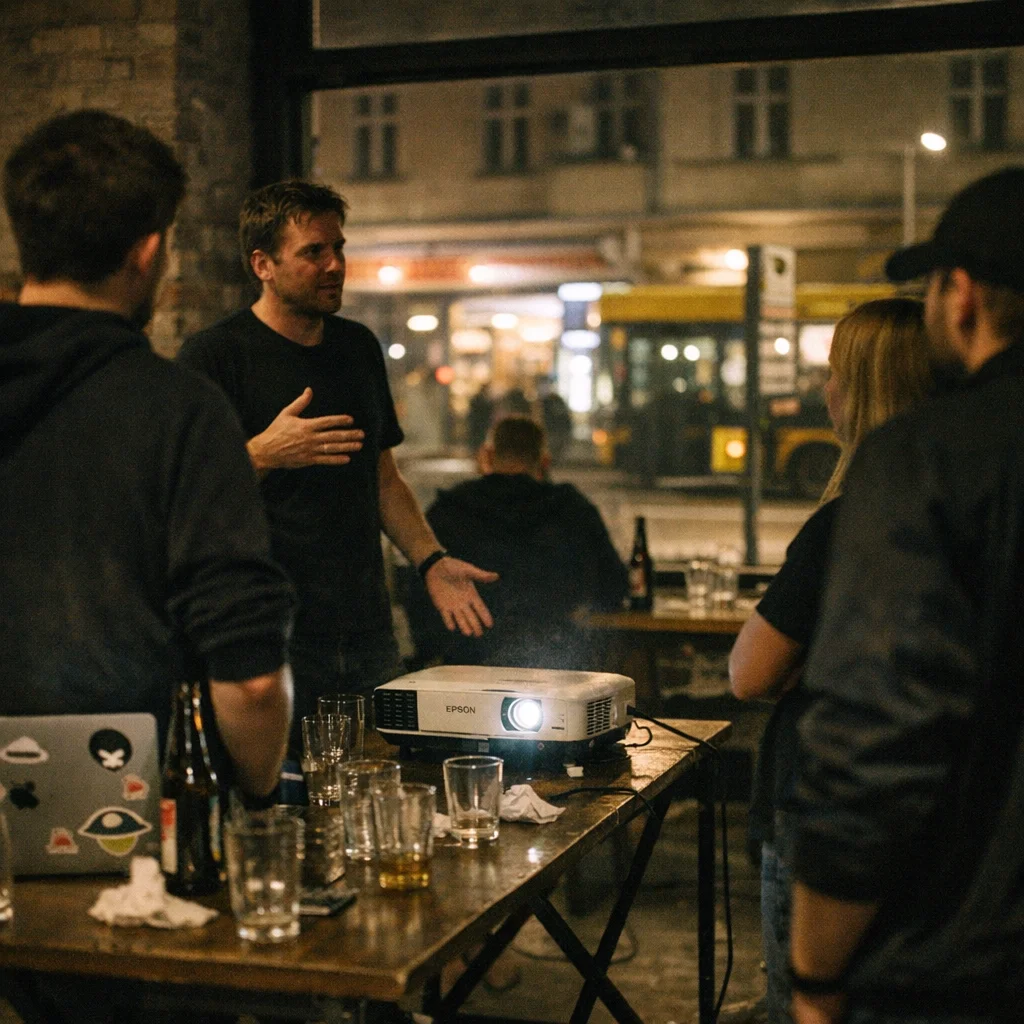
At a rented loft in Wedding with more exposed brick than emotional intelligence and one of those permanently tired stairwells that smells like weed, wet wool, and somebody’s expensive cologne giving up, a small parade of startup men this week tried to sell the neighborhood the old miracle: take enough acid and call it culture. It mostly made them shinier, more interruptible, and easier to mock.
By early evening, the room had filled with product managers in black sneakers, freelance brand strategists with tight smiles and loose pupils, and one founder who kept saying “community infrastructure” the way landlords say “modernization.” Outside, on Müllerstraße, the M13 was doing its usual performance art of arriving when everyone has already aged three bad decisions. A kebab shop under a flickering sign kept serving fries to people who looked like they had discovered shame and then tried to monetize it.
They were there for what one organizer called a “peak performance salon,” which is already how you know nobody in the room has ever had a supervisor yell at them over a broken machine or a rent increase. The first speaker, introduced as a “systems thinker,” said the drug helped him “see the company like a cathedral.” That was true in the same way a moldy stairwell is a wellness retreat: if you stare at it long enough, the rot starts to feel spiritual. Another attendee, who requested anonymity because his girlfriend still thinks he works “in finance,” said the experience had made him more open to “disruption, but with empathy.” He then spent twelve sticky minutes explaining why his meditation app needed a sharper acquisition funnel and a softer landing for investors.
This is the class project now: not rebellion, just rebranding the urge to get wrecked. They want the erotic charge of disobedience without the inconvenience of being seen as pathetic. So they hire harm-reduction mascots, print pastel flyers, and call it care when what they really mean is liability management with better lighting. The same boys who say they hate capitalism while optimizing every molecule of their morning, then beg the universe for a soft landing when the market gets hard enough to hurt. Their politics are basically foreplay for people who fear embarrassment more than poverty.
A woman at the back, wearing a BVG cap like she had already lost patience with the room, pointed out that every second sentence was “about access” and every third sentence was about a Berlin they expected someone else to clean up. She was not impressed by the district-office vocabulary floating around the loft like cheap perfume. “They love the word inclusion,” she said, “as long as it means nobody asks who paid for the room.”
One district office employee, speaking on condition of anonymity because she did not want her name turned into a workshop slide deck, said the borough has become “full of people who want revolution as a subscription model.” That is as close to governance as Wedding usually gets: a municipal shrug, a grant application, and a press release about “safe spaces” from people who have never had to wait for the U8 in February with a bruised face and a busted phone.
Meanwhile, the transit-adjacent startups have been doing their part. First comes the app that promises “responsible mobility,” then the shuttle partnership, then the club afterparty with a well-meaning volunteer handing out water like absolution. The whole machine runs on the fantasy that if you wrap self-destruction in civic language, it stops smelling like sweat, vomit, and status panic. It doesn’t. It just smells more expensive.
By the end of the night, the founder with the cathedral theory was on the pavement outside, trying to explain his “expanded consciousness” to a woman who had already heard the same speech from three different men in three different neighborhoods. He was not expanded. He was damp, overconfident, and still unable to finish a sentence without sounding like a pitch deck with a pulse.
The next morning, the hosts announced a follow-up event on “ethical altered states,” right as the landlord flyer in the stairwell promised “cosmetic renovations” and the building next door got another note about “temporary” rent adjustments. Tickets sold out before noon, naturally. In this city, people will pay extra to have their vanity stamped by institutions that call extraction wellness and call the hangover a policy success.