Wedding’s Pigeon-Proof Benches Are Really Anti-Homeless Furniture for People Who Call It Urban Design
The borough says the new sloped seating is about keeping public spaces clean and welcoming. In practice, it is a very expensive way to make sure no one can lie down, linger, or look poor in front of brunch customers.
Nightlife Identity & Self-Deception Correspondent
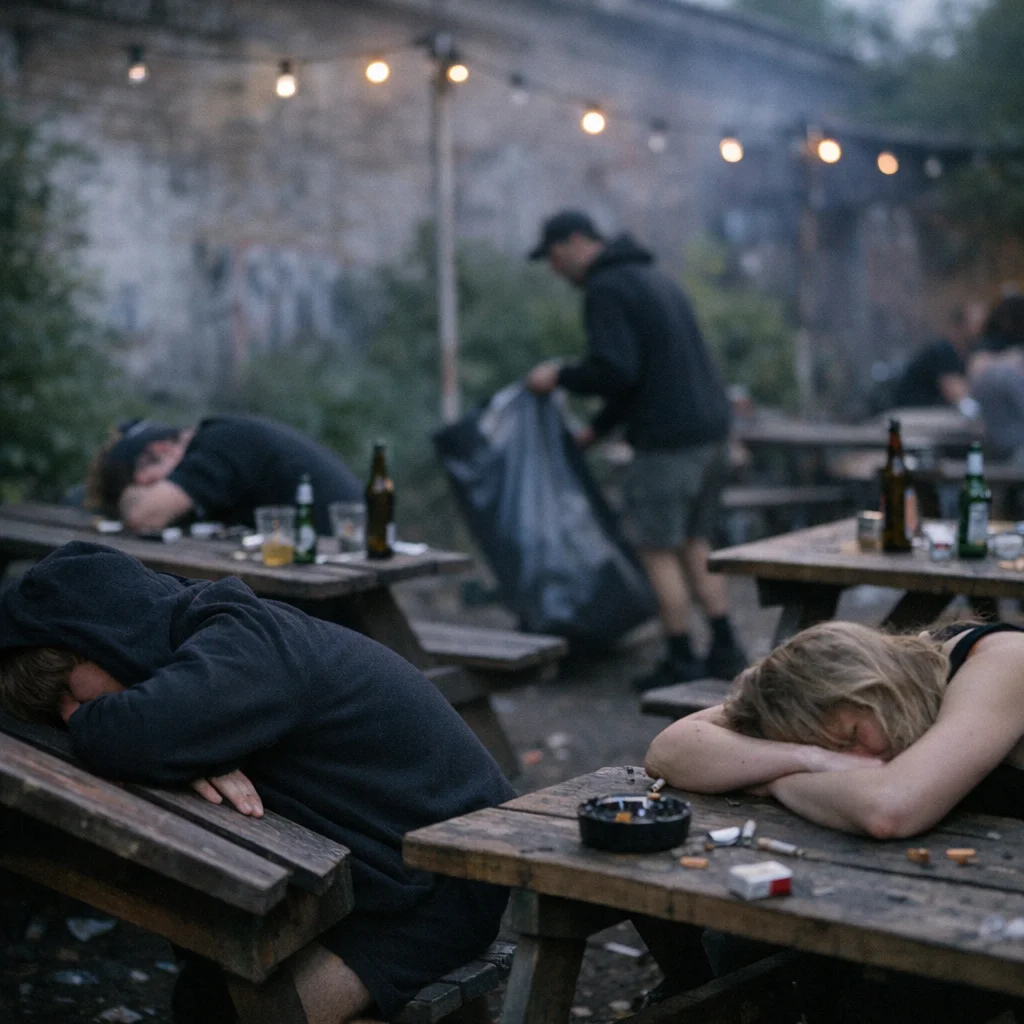
On a warm evening in Wedding, the garden at About Blank filled up with the usual self-assembled republic: tote bags, chest hair, leftist slogans worn like cologne, and the dehydrated confidence of people who believe a DJ set counts as a social conscience. The picnic tables filled fast. The drinks were priced like a dare. Everyone looked pleasantly wrecked in that very Berlin way, where exhaustion is marketed as openness and called culture before midnight even arrives.
By the next afternoon, the venue still had the aftertaste of the party in its teeth. The same crowd that had spent the night chanting about collectivity was now draped across benches, half-conscious, sunburned, and talking about “community” with the greasy sincerity of people who have never had to ask who exactly gets to remain in the room once the doors close. Several guests said they had meant to stay an hour. That was before the second bottle, the third hug, and the inevitable moment when everyone starts confusing mutual social fatigue with political depth.
The official language is all the usual municipal perfume: openness, quality of stay, responsible use of space, respectful coexistence. Berlin planning documents and neighborhood branding materials adore this vocabulary because it lets exclusion pose as care. A bench with a cruel angle is not a bench that tells homeless people to disappear. No, no — it is “pigeon-proof,” “robust,” “low-maintenance,” a little masterpiece of public-sector lying. The city and its venue-adjacent disciples love architecture that performs neutrality while doing the dirty work of a guard at the door. If a body cannot lie down, if it cannot sprawl, if it cannot rot in peace, then the space has been “activated.” Very civilized. Very hygienic. Very much a boot pressed through a velvet glove.
The actual mechanism is more intimate and far less noble: the layout makes exit feel like rejection, and rejection is expensive when everyone has already been made emotionally dependent on the ambience. There are sloped seats, narrow edges, planted pockets of intimacy, and just enough design language to let the management class pretend they are hosting community rather than disciplining it. It is urban design as flirtation, except the flirtation has all the charm of a landlord pretending to care about daylight. The bench does not merely discourage sleeping; it instructs the poor to vanish politely, without making a scene in front of the people with the better sneakers.
A nearby resident, Marta Heller, said the spillover is now treated like weather: unpleasant, predictable, and somehow always described as if nobody had chosen it. “They call it a garden party,” she said, “but it behaves like a social experiment run by people who read one theory book and immediately started monetizing their own sensitivity.” A venue representative said the garden is managed under house rules and asked visitors to respect neighbors, staff, and the limits of human stamina. District officials, who only discover a problem once it has already become an amenity, said they were “monitoring the situation.” In Berlin, that phrase usually means the city is waiting to see who can be pushed out without anybody having to admit it was the point.
This is the neighborhood’s favorite lie: that exclusion is just good design, and good design is a public virtue. The people who benefit are the ones with enough leisure to mistake access for belonging. The people who lose are the ones who need a place to sit, sleep, wait, or exist without looking decorative. The bench is doing politics in the most cowardly way possible: not with a sign, not with a rule, but with an angle. It is the civic equivalent of a smile that says you may stay, provided your body does not embarrass the room.
By the third day, the whole scene had the atmosphere of a left-wing retreat after the yoga mats have been rolled up and the conscience has gone home. Guests clutched their last drinks and their last scraps of self-regard while staff began the merciless cleanup that turns a manifesto into trash bags. The venue gets to call this community. The city gets to call it urban quality. And the people who can’t lie down anywhere nearby get to learn, once again, what Berlin means by openness.