Wedding’s Public Library Is Rebranding as a “Third Space,” Which Is How It Plans to Get Volunteers to Replace Staff
The district loves calling the library a civic commons, but the real innovation is a pilot program that turns unpaid locals into warmth, literacy, and conflict management on the cheap.
Administrative Grief Correspondent
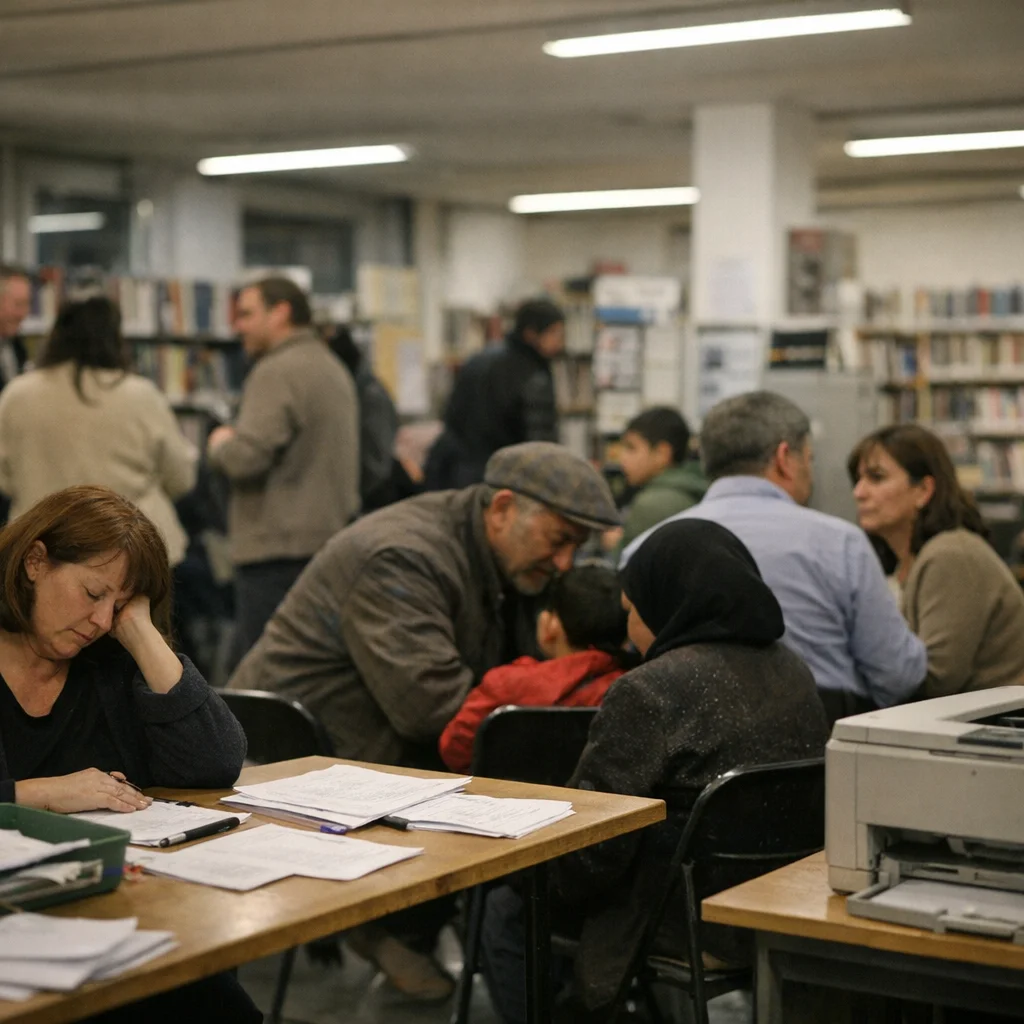
Residents in Wedding are being invited to admire a fresh civic innovation: the conversion of a public library near Leopoldplatz into a “third space,” which is bureaucrat-speak for a place where the district can stop paying people and still congratulate itself for inclusion. The phrase sounds as if it was minted by someone who has never stood under fluorescent lights in February with a crying child, a missing form, and a printer that hates democracy. The promise is community. The mechanism is extraction.
The pilot begins with evening events, language help, homework support, and job coaching, all wrapped in the soft beige language of “activation.” That word does a lot of work. It means the district office gets to look progressive while shifting the messier parts of public service onto volunteers, interns, and the usual unpaid saints who confuse burnout with citizenship. The culture coordinator can call it participation; the people doing the work will recognize it as being slowly undressed for austerity.
“Community ownership” is the current spell. District culture coordinator Anja Berg uses it with the calm smile of someone passing a hot plate to the nearest hand and calling it empowerment. She says the library is “expanding access,” which in district dialect means the paid staff are being made thinner, quieter, and easier to replace. A librarian who asked not to be named because she still needs the job said the project moves labor “out of the wage and into the moral pose.” She added that the new setup expects volunteers to absorb conflict, soothe children, explain forms, and keep the place from curdling into a waiting room for abandoned policy.
Near Leopoldplatz, where the foot traffic is a daily referendum on who gets to loiter and who gets moved along, the library has never been just a branding surface. Turkish families use it as one of the few places where children can be noisy without being treated like a planning error, where grandparents can sit, and where paperwork can be wrestled into a shape the state will accept. That is not a “third space.” That is public life with teeth. Naturally, the district wants to soften it into a participatory mood board.
The real clientele for this kind of civic theater are the performative left and urbanist hobbyists who adore “co-creation” right up until someone needs to stay late and mop up the consequences. They will quote Jane Jacobs, talk about commons, and insist the city should be “handmade,” as long as their own hands stay clean and their weekends stay available for brunch-level solidarity. These are the people who love the smell of participation from a safe distance. Put them in a room with a restless eleven-year-old, a broken copier, and a line of exhausted parents, and suddenly their radicalism develops a scheduling conflict.
The nonprofit intermediaries are no better. They arrive with clipboards, pilot language, and the holy confidence of people who can turn deprivation into a grant application. Their role is to lubricate the whole scam: translate cuts into opportunity, translate layoffs into “new models,” translate burnout into “capacity building.” The volunteer-management class, meanwhile, gets to cosplay as civic tenderness while never being responsible for what happens after 7 p.m., when the room gets noisy, the coffee is gone, and the idealism starts sweating through its shirt.
This is how the district keeps the library looking open while making the human load heavier. The events remain. The warm words remain. The actual knowledge—where the forms are, which kid needs patience, which regular is having a bad week, how to calm a room before it tips—gets pushed onto whoever is willing to work for applause and a tote bag. It is the civic version of foreplay without consequence: a lot of touching the language, not much commitment to the body.
By the first-quarter review, the district will have a spreadsheet full of attendance figures and a press release full of virtue. What it will not have to do is admit who got exhausted, who got praised for being “engaged,” and who was allowed to leave before closing. In Wedding, as ever, the people who actually keep the place from falling apart will be the ones who can’t afford to romanticize it.