Wedding’s 'Quiet Dogs' Scheme Hides a Budget Item Called 'Domestic Stress Corpus'
Council insists obedience classes are about noise — the procurement spreadsheet whispers: federal AI lab will harvest your mutt's misery for free.
Gentrification & Moral Performance Correspondent
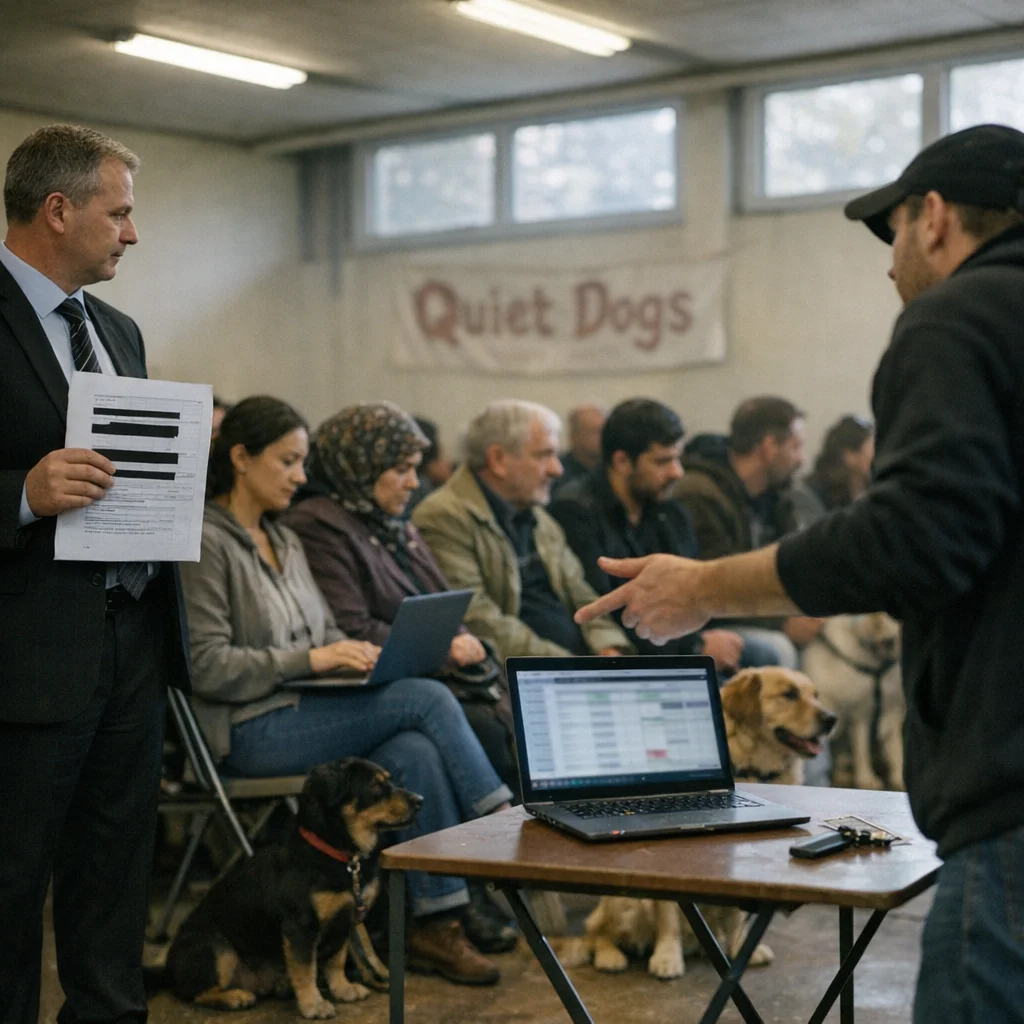
Wedding — The district office rolled out "Quiet Dogs," a glossy PR push promising obedient mutts and calmer pavements. On leaflet and in the coffee‑shop small talk, it was simple: free obedience classes, fewer barking complaints, better mornings for everyone. What the leaflet hiding in plain sight did not mention was a line in the procurement spreadsheet that redefines the product: Domestic Stress Corpus (data‑share, €0).
The sequence was straightforward. Last month the council advertised trainers, booked community rooms and invited residents. Classes began with the usual tableau — millennials with oat‑milk cups, a few Turkish families with decades of local dog lore, and the odd startup founder who brought a Golden Retriever and a MacBook. Ten minutes in, a council staffer chalked up a projector and the trainer asked attendants to sign a consent form that looked worryingly like a user agreement.
"I thought it was about barking," said Sofia Klein, who runs the late‑night shop on the corner and brought her terrier to the second session. "Nobody told me my dog's whining would become a dataset for some lab."
A district office spokesperson, Lukas Richter, insisted the programme's aim was noise mitigation. "This is about public tranquillity, not data harvesting," he said. "Behavioural coaching reduces complaints." Asked about the spreadsheet line, Richter described procurement jargon as "administrative shorthand".
The shorthand is precise: a procurement item marked for a data transfer, priced at zero, and flagged to an unnamed federal AI research partner. Trainers collect audio logs, timed stress markers, owner‑reaction surveys and short video clips. The consent forms speak of "service improvement"; the tender item speaks of a labelled corpus of domestic distress.
That mismatch is the pivot. The public narrative sells neighbourly quiet; the accounting sells labelled human panic as free training material for machine learning. What began as obedience pedagogy slips, like a suavely dressed pickpocket, into platform research: behavioural signals from a multicultural kiez converted into training data for models that will, someday, predict how quickly a dog owner will call the council.
A spokesperson for the state data protection authority, Anke Rohde, confirmed an initial inquiry: "We are reviewing whether the processing is proportionate and transparent." The federal lab declined to comment.
For now, classes continue. Trainers praise calmer mornings; residents get discounted sessions and a pat on the head. The district office says this is community care. Meanwhile, a small line on a spreadsheet quietly converts our anxieties into code — a bureaucratic blowjob to tech optimism that leaves the neighbourhood with less voice and more surveillance. Expect complaints, and expect the paperwork to ask you to sign them away.
Next step: a formal records request is being prepared and a neighbourhood meeting is planned; whether the meeting will be loud enough to be useful, or merely louder data, remains the question.