Wedding's Real Geopolitics: Why Iran-Strike Risk Feels Smaller Than Our Block's Microwave Standoff
The world frets over blowback from an Iran strike; in Wedding, the crisis button is a timer on a communal microwave, a stubborn neighbor, and a shared inverter that dies at the worst moment.
Geopolitics & Hangover Correspondent
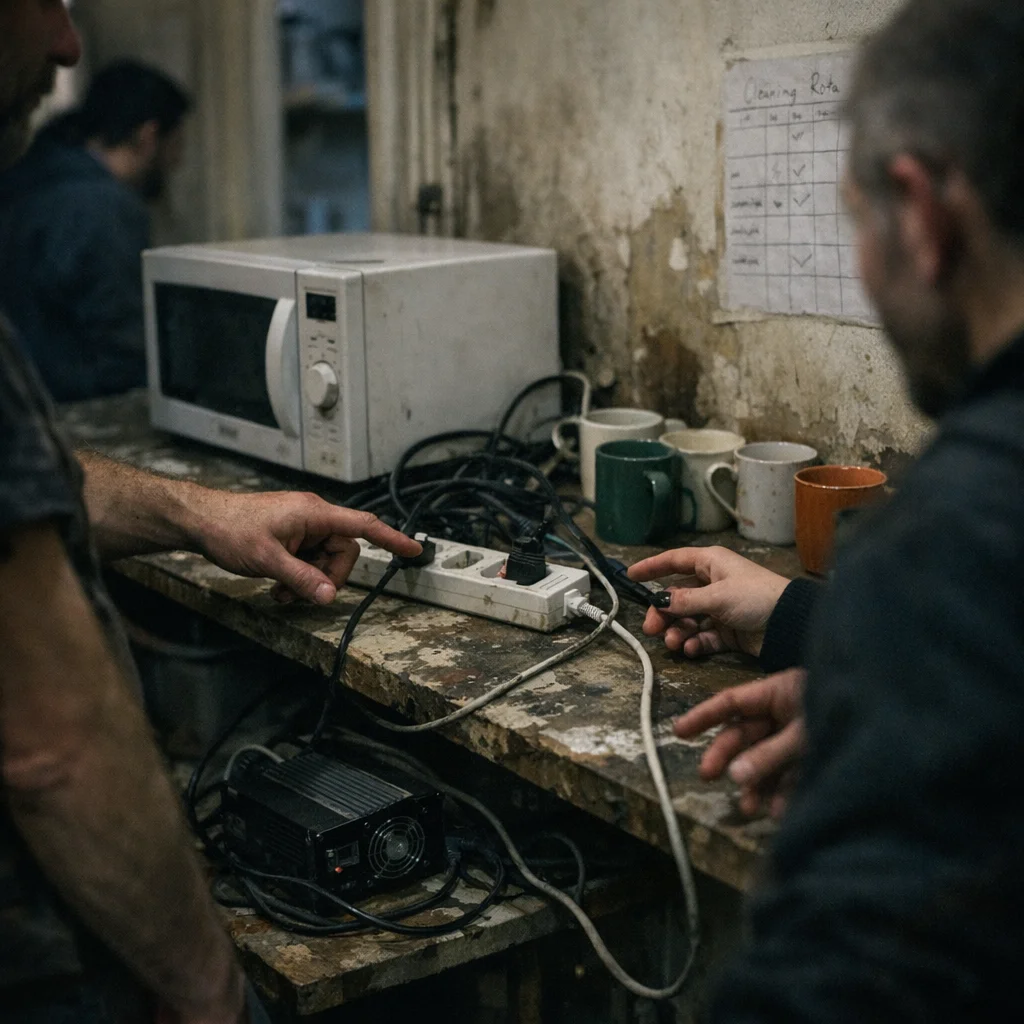
WEDDING — As international analysts argue that striking Iran could unleash unpredictable blowback while a strongman like Maduro is, in theory, a more “grab-and-go” operation, residents of Wedding have been running their own foreign policy simulation in the most Berlin way possible: inside a shared hallway kitchen with one communal microwave and a power setup held together by guilt.
It began early that evening when the microwave’s “crisis button” (the one nobody admits they pressed) jammed itself into a permanent three-minute loop, pulsing like a tiny sanctions regime. By the second cycle, people were already forming coalitions, issuing ultimatums, and pretending they weren’t emotionally invested in reheating lentil stew.
“Everyone wants a clean, surgical intervention,” said Nele Krüger, 34, a communications consultant who claimed neutrality while physically guarding the plug like it was a border crossing. “But the moment you go in, there’s escalation. The inverter dies, the hallway lights flicker, and suddenly you’re negotiating with a neighbor who thinks ‘defrost’ is a human right.”
The neighbor in question, Cem Yıldırım, 41, said he had simply “used the microwave normally,” which in Wedding means at maximum power, with a metal-rimmed plate, while standing close enough to it to generate his own electromagnetic foreign policy. “If people don’t want consequences, they should stop doing operations without a mandate,” he said, referring to the building’s WhatsApp group, which has not approved anything since 2019 except passive-aggressive thumbs-up reactions.
Within minutes, two blocs emerged: the “Targeted Strike” faction, arguing for unplugging the microwave quickly and decisively, and the “Capture Maduro” faction, proposing the safer option of just removing Cem’s plastic bowl “temporarily” until tensions cooled. Predictably, the building chose the most Berlin third way: a working group.
The working group produced a laminated protocol: do not touch the microwave; instead, “de-escalate through listening.” This was followed by four residents listening to the microwave hum in silence like it was a John Cage piece, waiting for meaning to reveal itself.
The institutional response arrived in the form of a boilerplate email from Hausverwaltung Nordlicht GmbH, which urged tenants to “avoid unilateral actions” and to file any complaints using Form K-17b, ideally in triplicate and “with a firm grip on your documentation.” A district office spokesperson, asked whether shared-kitchen conflicts were increasing, said, “We cannot comment on ongoing reheating operations,” and suggested mediation “as long as nobody penetrates the fuse box.”
By late night, the inverter predictably died at the exact moment someone tried to “finish quickly” with a burrito. The hallway went dark, the microwave beeped one last time, and the building’s geopolitical consensus collapsed into what it always was: a queue of exhausted adults waiting for a technician who will arrive sometime between next week and the end of history.
Residents say a new meeting is scheduled for the weekend, assuming anyone can find a functioning outlet—or the courage to admit they’d rather risk Iran than knock on Cem’s door again.